


Boeing prepares for another bruising labour strike, this time at fighter production campus
Less than a year after Boeing endured a costly and protracted work stoppage in its commercial aircraft business, the company is facing down a strike at its fighter manufacturing hub in St Louis, Missouri.
Just hours before their existing contract expired on 27 July, more than 3,000 staff represented by the International Association of Machinists and Aerospace Workers (IAM) union voted to reject an offer from Boeing, despite the proposal being hailed as a “landmark” agreement by IAM leadership just days earlier.
Failure to ratify the contract triggers a seven-day “cooling off” period, after which a strike could begin on 4 August if no deal is reached.
Such a work stoppage would impact several important Boeing sites around the greater St Louis area, including production lines for the F-15EX and F/A-18E/F fighters, the T-7A trainer jet, and the new MQ-25 unmanned refueller.
Production lines assembling precision munitions and components for the 777X airliner would also be affected, in addition to Boeing’s Phantom Works unit.
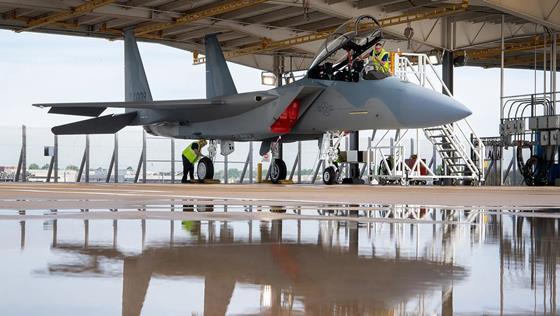
A strike would not directly affect Boeing’s commercial-derivative military aircraft, such as the 767-based KC-46 tanker or 737NG-based P-8 maritime patrol jet, which are assembled and modified at facilities in Washington state.
The IAM declined to share what specific aspects of the Boeing proposal drove members to decline the contract offer, saying only that it “fell short of addressing the priorities and sacrifices”.
Per the union, Boeing had offered a four-year deal covering average wage increases of 40%, plus unspecified improvements to medical benefits, overtime, and pensions.
While the IAM says it will seek to resume negotiations, Boeing is taking a harder line.
“We’ve activated our contingency plan and are focused on preparing for a strike,” says Dan Gillian, general manager of Boeing’s air dominance portfolio and senior site executive in St Louis.
“No talks are scheduled with the union,” he adds.
While that is expected to change eventually, Boeing is likely trying to project strength after enduring a bruising 53-day strike inside its commercial aircraft business last year.
During that ordeal, a different group of IAM workers similarly rejected multiple contract offers from Boeing, including one that had been approved by union leadership.
Although the six-week strike cost the workers an estimated $800 million in lost wages, the union achieved a significantly more generous contract than what had initially been offered. Boeing had first offered a 25% pay rise over four years, ultimately going as high as 38%.
In the process, the company lost some $5.5 billion as a result of the work stoppage that forced it to shutter its 767 and 777 production site in Everett and its 737 assembly facility in Renton.
In the case of the IAM unit representing its much smaller fighter manufacturing workforce, Boeing notably offered a 40% average wage hike straight out of the gate, likely assuming union members would demand similar benefits to those secured by their colleagues in Washington state in 2024.
Gillian describes the proposal as the “richest contract offer we’ve ever presented” to the St Louis workforce.
While the union has not commented further, the workers likely saw the tangible benefits achieved as a result of last year’s strike and voted accordingly.
The spectre of a strike marks an abrupt end to a string of good news for Boeing’s long-suffering defence business.
A turnaround effort begun under former chief Ted Colbert, and continued by its new leader, Steve Parker, has started to yield results.
In recent months, the company secured the must-win F-47 sixth-generation fighter contract with the US Air Force (USAF), securing a future for its fighter business.
In June, the USAF revealed that it plans to significantly expand its F-15EX buy from 104 examples to a total fleet of 129 aircraft.
Last week, the service committed to a massive expansion of its KC-46A tanker fleet, eschewing any competition for a new tanker and buying up to 84 more of the 767-based refuellers.
Representing as much as a 47% increase in the total USAF programme of record, that plus up gives Boeing a chance to turn a profit on the troubled KC-46 line, which has generated more than $7 billion in losses related to design issues.
Those bright spots, and the company’s view on the likelihood of a strike in St Louis, are sure to be on the agenda when Boeing releases its second quarter earnings results later today.
In Asia-Pacific news, Indonesia has firmed up its committment for 48 Turkish Aerospace Kaan fighters, building on an agreement originally signed in June.
And in case you missed our recent coverage from the Royal International Air Tattoo in the UK, highlights included a Red Arrows flying display powered by SAF and a rare public appearance by a Lockheed Martin U-2S spyplane from the USAF.


Ingen kommentarer:
Legg inn en kommentar
Merk: Bare medlemmer av denne bloggen kan legge inn en kommentar.