


The WW2 flying wing decades ahead of its time
In the last months of World War Two, Nazi Germany tested an experimental fighter more spaceship than aircraft. Only now are we realising how inspired it was. BBC Future looks at the Horten Ho 229, one of aviation’s most futuristic designs
By Stephen Dowling
2 February 2016
In December, US aircraft maker Northrop Grumman unveiled a revolutionary design for a future fighter aircraft that could, theoretically, fly over the war zones of the coming century.
Their concept looks more like a flying saucer than a fighter plane – it is what aviation experts call a ‘flying wing’, a design which ditches the traditional tail fin at the back. This design helps reduce the aircraft’s size, and creates a smoother shape – one less likely to bounce back radar signals being sent out to detect it.

It looks about as futuristic as fighter aircraft can get, but its genesis goes far further back than you think – to a truly groundbreaking jet fighter design built and flown in Nazi Germany in the dying days of World War Two.
That aircraft – the Horten Ho 229 – might be a footnote in aviation history, but it was so far ahead of its time that its aerodynamic secrets are still not completely understood. In fact, there’s a chief scientist at Nasa still working to discover just how its creators managed to overcome the considerable aerodynamic challenges that should have made it unflyable.

The ‘flying wing’ design isn’t an everyday sight in our skies because it’s incredibly hard to make work. By getting rid of the tail – which helps keep the aircraft stable and stops it ‘yawing’ from side to side – the aircraft is a lot harder to control. So why would you try to build something that was inherently difficult to fly?
If you can make a flying wing work, it has several benefits. The resulting plane becomes difficult to spot on radar, partly because it has no tail fins that will bounce back radar waves. The smooth shape also means the aircraft has as little drag as possible, which means it can be lighter and more fuel-efficient, and possibly fly faster than a more conventionally shaped aircraft using the same engine.
The Hortens – Walter and Reimar – began designing aircraft in the early 1930s, while Germany was officially banned from having an air force under the constraints of the Treaty of Versailles following World War One. The brothers had joined sporting air clubs, set up as a way to get around such restrictions, and which were a foundation for what could become Nazi Germany’s air force, the Luftwaffe.
Many of the amateur aviators who would later become Luftwaffe pilots cut their teeth flying various gliders and ‘sailplanes’, unpowered aircraft which taught them the rudiments of flying. The Horten brothers combined flying with designing aircraft as well – turning the family’s lounge-room into a workshop to work on new designs, according to the aviation website Aerostories.
New fighter
The pair followed some of the esoteric ideas of unconventional aircraft designer Frederich Lippisch, who was a pioneer of delta-wing aircraft designs; another radical form that came into its own once jet engines had been developed. The Hortens developed their flying wing approach with increasingly effective results, ending in their Horten Ho IV glider, in which the pilot lay prone in the aircraft, which meant the cockpit canopy didn’t jut so far out from the fuselage and create aerodynamic drag.
By the time the Ho IV glider was being tested, Walter Horten had already served as a Luftwaffe fighter pilot during the Battle of Britain. Russ Lee, a curator at the Smithsonian Air and Space Museum in Washington DC, says this was a turning point. “The Germans, of course, lost the Battle of Britain, and Walter realised that Germany needed a new kind of fighter aircraft. And an all-wing aircraft might make that good new fighter.”
At the same time, the head of the Luftwaffe, Hermann Goring, had requested designs in a project called ‘3x1000’ – aircraft that would be able to carry a 1,000kg (2,200lb) bombload 1,000 miles (1,600 kilometres) at 1,000km/h (625mph). That led the Hortens to develop what would eventually become the Ho 229 prototypes. The first of the three prototypes was an unpowered glider, built to test the aerodynamic design. The second added jet engines, and flew successfully on 2 February 1945, though it crashed after engine failure on another test flight a few weeks later, killing its test pilot. But the tests proved, says Lee, that the aircraft could take off, cruise and land, and the aircraft’s basic design was sound.

Lee has a good reason to know the Ho 229 backstory so well; he’s responsible for preserving and restoring the only other Ho 229 to have been built, the third, partially completed prototype, known as the Ho 229 V3. It was taken – like many other examples of cutting-edge German aircraft design – to the US after World War Two. Along the way, it spent a brief time at the British testing facility at Farnborough, near London.
“The word revolutionary is not inappropriate when you’re talking about the Ho 229,” says Lee. “The Hortens were more advanced in this area than anyone else in the world.”
The Northrop B-2, the aircraft that is at the forefront of the US nuclear deterrent, looks at first glance like an obvious descendent of the Hortens’ design genius. So much so, that some commentators described the Ho 229 as the “world’s first stealth bomber” – though its role would have been to shoot down the fleets of Allied bombers that were attacking German industrial targets and cities.
Besides the tendency to “yaw” side to side at the best of times, a tailless plane can become virtually uncontrollable when the engine cuts out. “One of the big things with this aircraft was its stability in flight. One of the hardest things is getting an aircraft without a tail to be able to be flyable during a stall, and that’s something every aircraft has to be able to complete,” says Lee.
The Hortens were able to keep their aircraft stable by making the wing long and thin (known as a high aspect ratio wing). This spread the weight of the aircraft over a greater surface area, and also decreases the proportion of air that creates a vortex around the wing – a mini whirlwind that creates drag – slowing the aircraft down.
Radical shape
Reimar Horten may not have been fully aware that he was solving these two crucial aerodynamic problems in one fell swoop. That’s what Al Bowers, a Nasa chief scientist at the Neil A Armstrong Flight Research Center in California believes. Bowers has been testing the Hortens’ design principles for many years. Bowers says Reimar Horten’s genius was in using a ‘bell-shaped’ wing to cancel out the yawing issues an aircraft without a tail usually suffers, but which also reduced drag.
The Ho 229’s wings are radically different to the kind of elliptical shape which was thought to generate the most lift and reduce drag (look at the wing of a World War Two Spitfire fighter below, an example of a conventional elliptical wing).

Horten’s wing design echoed the principles of another pioneering German designer, Ludwig Prandtl, who was the first aerodynamic scientist to stress that the shape of a wingtip could massively affect an aircraft’s flying ability. He’d also come up with the bell-shaped wing in the early 1930s but had done so to reduce drag, not realising that it would also solve the yawing problems in a tailless aircraft. The wing, in many ways, is doing what a bird’s wing does in flight; evolution hasn’t yet felt the need to put an upright tail on a bird, after all.
“The Ho 229 was decades ahead of its time,” says Bowers. “I believe it will be shown as the progenitor of the future of aviation.”
Flying wing designs gained some credence in the 1950s, mostly due to the efforts of Jack Northrop, who had been inspired by seeing some of the Horten’s sports gliders in the 1930s. The captured Ho 229 may also have encouraged him. Northrop’s unsuccessful YB-35 flying wing bomber design of the late 1940s, was hamstrung by massive vibration problems caused by the propeller-driven engines, showing that the Hortens were right to have used jets in the Ho 229. Northrop’s later jet-propelled YB-49 design used jet engines, and while it never went into service, it paved the way for the company’s B-2 Spirit stealth bomber decades later, a design which certainly shares some physical similarities with the Ho 229.
The Prandtl-D would be used on Martian research missions, possibly launched from a high-altitude glider, flying under its own power for some 10 minutes before gliding down to land on the planet’s surface. The Prandtl-D won’t be anywhere as big as the Ho 229 however – it’s expected to have a wingspan of only 2ft and weigh little more than 1.3kg (3lb).

“We believe that Prandtl’s solution (and Horten’s) is the answer we’ve been looking for all along,” says Bowers. “It explains so many things about the flight of birds, and minimising drag, and superior efficiency possible in future aircraft. It is my belief that we can improve aircraft efficiency by at least 70%. And my own work is just a scratch of the surface. Reimar Horten was on the right track. He never saw the full potential of his ideas. Yet I suspect if he could see where we are today, he would be pleased. Perhaps not so pleased by the pace of our progress, but that we are finally listening.”
As for the Smithsonian’s example of this inspired design? Lee says the work to preserve this pioneering design is gradual and painstaking, and unlikely to be finished until the early 2020s. Then, this inspiring, overlooked design will be on public display – and the Hortens’ aerodynamic genius can be appreciated by a wider audience.
Their concept looks more like a flying saucer than a fighter plane – it is what aviation experts call a ‘flying wing’, a design which ditches the traditional tail fin at the back. This design helps reduce the aircraft’s size, and creates a smoother shape – one less likely to bounce back radar signals being sent out to detect it.

Northrop Grumman's concept for a flying wing fighter has similarities to the Hortens' innovative design (Credit: Northrop Grumman)
It looks about as futuristic as fighter aircraft can get, but its genesis goes far further back than you think – to a truly groundbreaking jet fighter design built and flown in Nazi Germany in the dying days of World War Two.
That aircraft – the Horten Ho 229 – might be a footnote in aviation history, but it was so far ahead of its time that its aerodynamic secrets are still not completely understood. In fact, there’s a chief scientist at Nasa still working to discover just how its creators managed to overcome the considerable aerodynamic challenges that should have made it unflyable.

The Ho 229's design was incredibly advanced for its time (Credit: Malyszkz/Wikipedia/)
The ‘flying wing’ design isn’t an everyday sight in our skies because it’s incredibly hard to make work. By getting rid of the tail – which helps keep the aircraft stable and stops it ‘yawing’ from side to side – the aircraft is a lot harder to control. So why would you try to build something that was inherently difficult to fly?
If you can make a flying wing work, it has several benefits. The resulting plane becomes difficult to spot on radar, partly because it has no tail fins that will bounce back radar waves. The smooth shape also means the aircraft has as little drag as possible, which means it can be lighter and more fuel-efficient, and possibly fly faster than a more conventionally shaped aircraft using the same engine.
The Hortens developed their flying wing approach with increasingly effective resultsAll of that looks good on paper – but getting it to work in the real world is a lot more difficult. Flying wings have proved to be a headache for aircraft designers stretching back almost to the time of the Wright Brothers. All of which makes the achievements of the German Horten brothers so impressive.
The Hortens – Walter and Reimar – began designing aircraft in the early 1930s, while Germany was officially banned from having an air force under the constraints of the Treaty of Versailles following World War One. The brothers had joined sporting air clubs, set up as a way to get around such restrictions, and which were a foundation for what could become Nazi Germany’s air force, the Luftwaffe.
Many of the amateur aviators who would later become Luftwaffe pilots cut their teeth flying various gliders and ‘sailplanes’, unpowered aircraft which taught them the rudiments of flying. The Horten brothers combined flying with designing aircraft as well – turning the family’s lounge-room into a workshop to work on new designs, according to the aviation website Aerostories.
New fighter
The pair followed some of the esoteric ideas of unconventional aircraft designer Frederich Lippisch, who was a pioneer of delta-wing aircraft designs; another radical form that came into its own once jet engines had been developed. The Hortens developed their flying wing approach with increasingly effective results, ending in their Horten Ho IV glider, in which the pilot lay prone in the aircraft, which meant the cockpit canopy didn’t jut so far out from the fuselage and create aerodynamic drag.
By the time the Ho IV glider was being tested, Walter Horten had already served as a Luftwaffe fighter pilot during the Battle of Britain. Russ Lee, a curator at the Smithsonian Air and Space Museum in Washington DC, says this was a turning point. “The Germans, of course, lost the Battle of Britain, and Walter realised that Germany needed a new kind of fighter aircraft. And an all-wing aircraft might make that good new fighter.”
At the same time, the head of the Luftwaffe, Hermann Goring, had requested designs in a project called ‘3x1000’ – aircraft that would be able to carry a 1,000kg (2,200lb) bombload 1,000 miles (1,600 kilometres) at 1,000km/h (625mph). That led the Hortens to develop what would eventually become the Ho 229 prototypes. The first of the three prototypes was an unpowered glider, built to test the aerodynamic design. The second added jet engines, and flew successfully on 2 February 1945, though it crashed after engine failure on another test flight a few weeks later, killing its test pilot. But the tests proved, says Lee, that the aircraft could take off, cruise and land, and the aircraft’s basic design was sound.
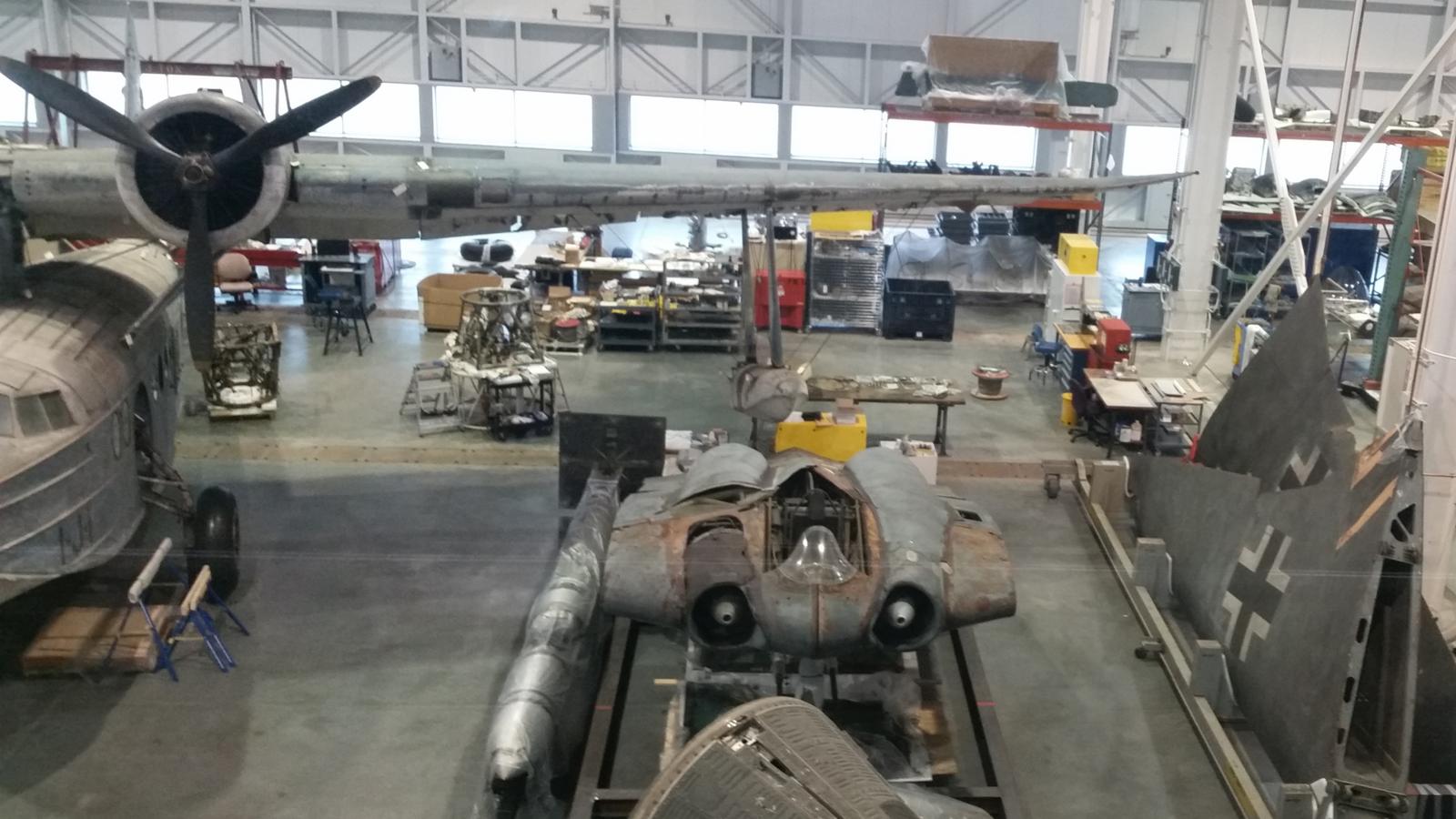
The prototype Ho 229 is currently undergoing restoration (Credit: BrettC23/Wikipedia/CC BY-SA 4.0)
Lee has a good reason to know the Ho 229 backstory so well; he’s responsible for preserving and restoring the only other Ho 229 to have been built, the third, partially completed prototype, known as the Ho 229 V3. It was taken – like many other examples of cutting-edge German aircraft design – to the US after World War Two. Along the way, it spent a brief time at the British testing facility at Farnborough, near London.
“The word revolutionary is not inappropriate when you’re talking about the Ho 229,” says Lee. “The Hortens were more advanced in this area than anyone else in the world.”
The Northrop B-2, the aircraft that is at the forefront of the US nuclear deterrent, looks at first glance like an obvious descendent of the Hortens’ design genius. So much so, that some commentators described the Ho 229 as the “world’s first stealth bomber” – though its role would have been to shoot down the fleets of Allied bombers that were attacking German industrial targets and cities.
One of the hardest things is getting an aircraft without a tail to be flyable during a stall – Russ Lee, Smithsonian Air and Space“Just getting one of these things to fly, well you had to make the wing do all the work, and end up with a plane that behaved as well as a conventional plane with a tail.”
Besides the tendency to “yaw” side to side at the best of times, a tailless plane can become virtually uncontrollable when the engine cuts out. “One of the big things with this aircraft was its stability in flight. One of the hardest things is getting an aircraft without a tail to be able to be flyable during a stall, and that’s something every aircraft has to be able to complete,” says Lee.
The Hortens were able to keep their aircraft stable by making the wing long and thin (known as a high aspect ratio wing). This spread the weight of the aircraft over a greater surface area, and also decreases the proportion of air that creates a vortex around the wing – a mini whirlwind that creates drag – slowing the aircraft down.
Radical shape
Reimar Horten may not have been fully aware that he was solving these two crucial aerodynamic problems in one fell swoop. That’s what Al Bowers, a Nasa chief scientist at the Neil A Armstrong Flight Research Center in California believes. Bowers has been testing the Hortens’ design principles for many years. Bowers says Reimar Horten’s genius was in using a ‘bell-shaped’ wing to cancel out the yawing issues an aircraft without a tail usually suffers, but which also reduced drag.
The Ho 229’s wings are radically different to the kind of elliptical shape which was thought to generate the most lift and reduce drag (look at the wing of a World War Two Spitfire fighter below, an example of a conventional elliptical wing).
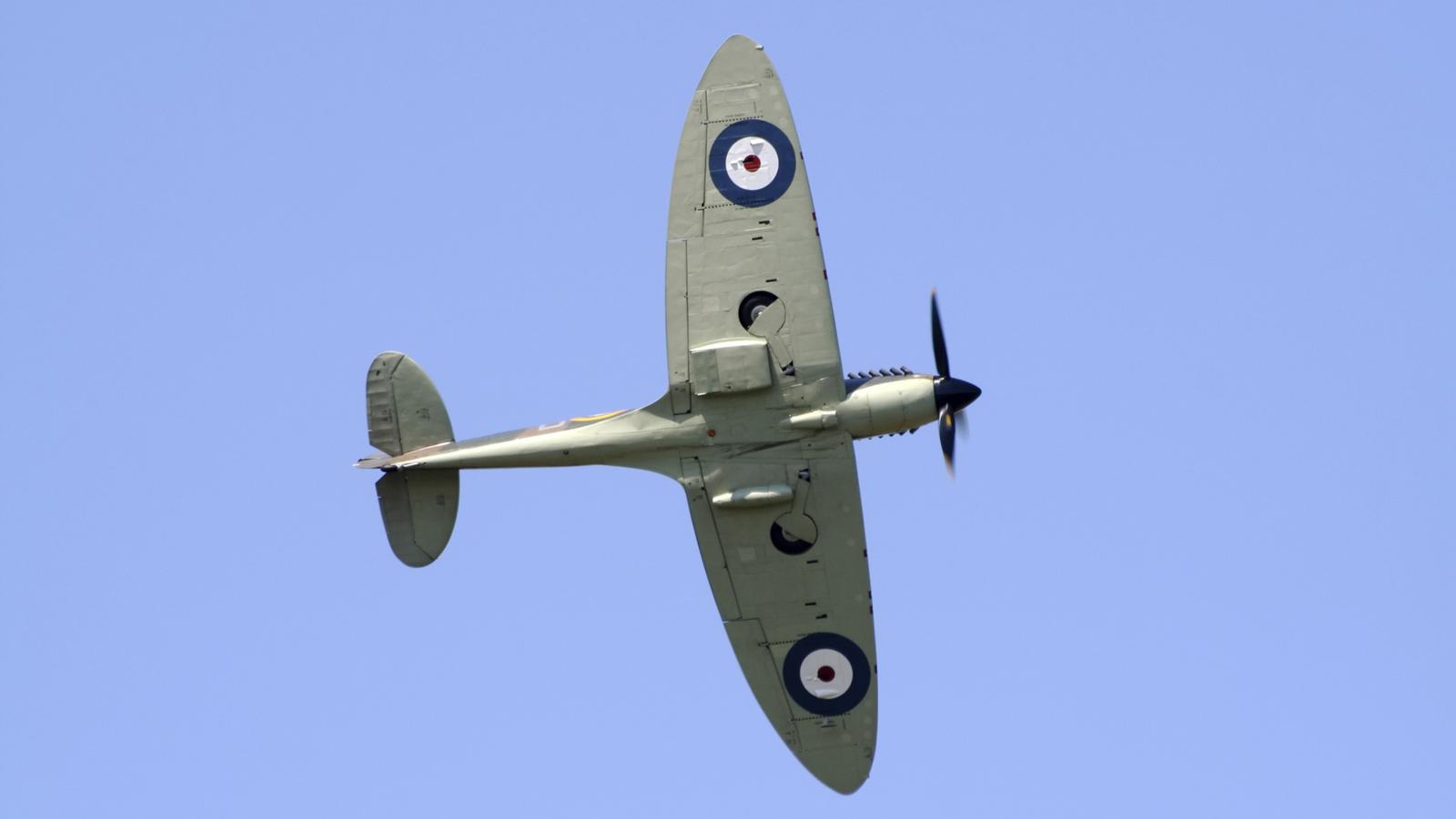
In the 1940s, most aircraft had elliptical wings, like the Spitfire seen here (Credit: iStock)
Horten’s wing design echoed the principles of another pioneering German designer, Ludwig Prandtl, who was the first aerodynamic scientist to stress that the shape of a wingtip could massively affect an aircraft’s flying ability. He’d also come up with the bell-shaped wing in the early 1930s but had done so to reduce drag, not realising that it would also solve the yawing problems in a tailless aircraft. The wing, in many ways, is doing what a bird’s wing does in flight; evolution hasn’t yet felt the need to put an upright tail on a bird, after all.
“The Ho 229 was decades ahead of its time,” says Bowers. “I believe it will be shown as the progenitor of the future of aviation.”
Flying wing designs gained some credence in the 1950s, mostly due to the efforts of Jack Northrop, who had been inspired by seeing some of the Horten’s sports gliders in the 1930s. The captured Ho 229 may also have encouraged him. Northrop’s unsuccessful YB-35 flying wing bomber design of the late 1940s, was hamstrung by massive vibration problems caused by the propeller-driven engines, showing that the Hortens were right to have used jets in the Ho 229. Northrop’s later jet-propelled YB-49 design used jet engines, and while it never went into service, it paved the way for the company’s B-2 Spirit stealth bomber decades later, a design which certainly shares some physical similarities with the Ho 229.
Reimar Horten was on the right track. He never saw the full potential of his ideas – Al Bowers, NasaBowers has been using the principles in the Ho 229 and from Prandtl’s earlier experiments into a Nasa design, the Prandtl-D flying wing concept, an unmanned flying wing design that could one day be used to explore Mars.
The Prandtl-D would be used on Martian research missions, possibly launched from a high-altitude glider, flying under its own power for some 10 minutes before gliding down to land on the planet’s surface. The Prandtl-D won’t be anywhere as big as the Ho 229 however – it’s expected to have a wingspan of only 2ft and weigh little more than 1.3kg (3lb).
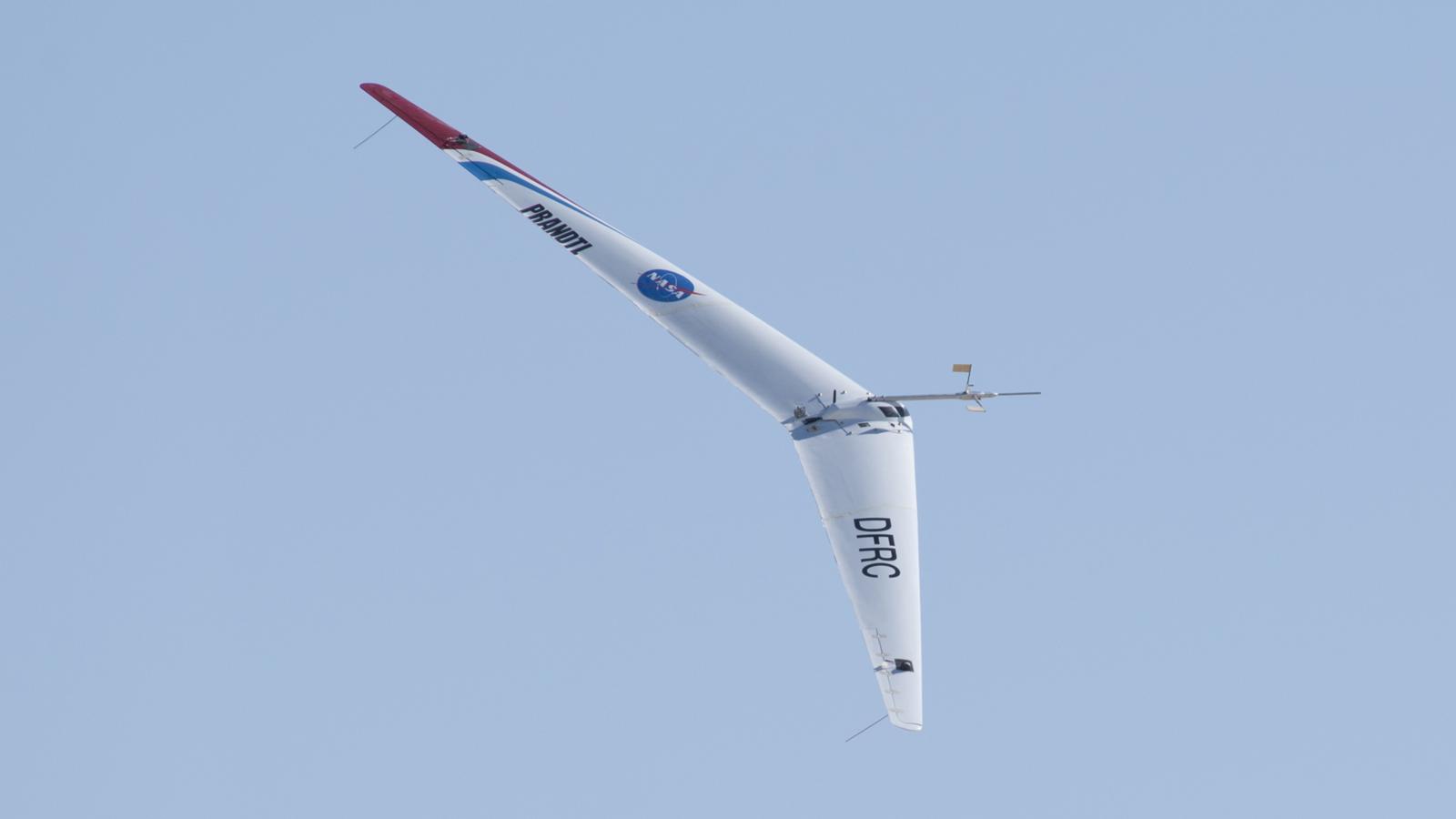
The Ho 229's design has influenced a Nasa project for a small flying wing which could explore Mars (Credit: Tom Tschida/Nasa)
“We believe that Prandtl’s solution (and Horten’s) is the answer we’ve been looking for all along,” says Bowers. “It explains so many things about the flight of birds, and minimising drag, and superior efficiency possible in future aircraft. It is my belief that we can improve aircraft efficiency by at least 70%. And my own work is just a scratch of the surface. Reimar Horten was on the right track. He never saw the full potential of his ideas. Yet I suspect if he could see where we are today, he would be pleased. Perhaps not so pleased by the pace of our progress, but that we are finally listening.”
As for the Smithsonian’s example of this inspired design? Lee says the work to preserve this pioneering design is gradual and painstaking, and unlikely to be finished until the early 2020s. Then, this inspiring, overlooked design will be on public display – and the Hortens’ aerodynamic genius can be appreciated by a wider audience.


Ingen kommentarer:
Legg inn en kommentar
Merk: Bare medlemmer av denne bloggen kan legge inn en kommentar.