onsdag 1. mars 2017

Helicopter - From the Energy Voice

New gearbox checks ordered for

Super Puma 225s

Europe’s aviation safety body has ordered another round of inspections on the gearboxes of Airbus 225 helicopters.
European Aviation Safety Authority (EASA) is specifically asking operators to check the main gearbox oil cooler for the presence of a certain metallic particle.
It says that if the particle is detected during the checks, operators must notify the EASA and Airbus.
Also, they must not allow the aircraft to resume flights until “corrective action” is agreed by the EASA.

Airbus Super Puma 225s were grounded following a crash in Norway on April 29, 2016, that led to the deaths of 13 people, including Iain Stuart of Aberdeenshire.
The EASA lifted flight suspensions on the aircrafts in October, but the UK and Norwegian civil aviation authorities have kept their restrictions in place.
The EASA said the gearbox oil cooler checks need to be carried out within 10 flight hours of the airworthiness directive’s publication, which came on Friday.
For newly-installed gears, the inspection must be conducted before 300 flight hours are exceeded.
The new airworthiness directive also affects the AS332L2 model.
Airbus put out its own alert service bulletin on Friday calling for the inspections to be carried out.
A spokesman for Airbus said: “This new inspection further enhances the protective measures currently in place and are part of the wider safety case addressing EC225/AS332 L2 operations worldwide.”
He said Airbus’s priority was to ensure that all findings are “properly taken into account to guarantee safety”.
The spokesman added: “We remain committed to sharing information in full transparency with our customers and all relevant stakeholders.”
Earlier this month, the Accident Investigation Board of Norway said it would publish a new “preliminary” report into the causes of last year’s fatal helicopter crash in Norway on the anniversary of the tragedy.
The aircraft had been on a return journey from Statoil’s Gullfaks B platform to Flesland Airport near Bergen when its main rotor suddenly detached.
The crash claimed the life of 41-year-old Mr Stuart, 10 other passengers and the two crew.
Investigators suspect the accident was caused by a fatigue fracture in one of the gears.

Icelandair 80 år - Påminnelse fra Geir Vitnæs

Sjekk denne linken for tidslinje: goo.gl/l8qtYg

Keflavik 1971 - Canadair CL-44 - Foto: Per Gram
Hangaren i bakgrunnen var en del frekventert av 3`er folk av spesielle årsaker
 
Keflavik 1975 - DC-8-63 - Foto: Per Gram
I bakgrunnen EC121 som ble byttet ut med P-3. I -75 var det F-102 på basen.
 

Helikopter - Nytt Super Puma AD - Rotor&Wing

EASA Orders Main Gearbox Oil Cooler Inspection on Some Super Pumas

By S.L. Fuller | February 27, 2017
Check EASA`s Airworthiness Directive here: http://tinyurl.com/jas8g8u
Maintenance, Repair & Overhaul
CHC_Helicopter_Scotia_Eurocopter_AS-332L2_Super_Puma_Mk2An EASA Airworthiness Directive (AD) for the Airbus Helicopters AS332L2 and EC225LP calls for a one-time inspection of the main gearbox oil cooler and the reporting of all findings to EASA. Issued on Feb. 25 and effective March 1, the directive stems from the fatal Airbus Super Puma accident in Norway last April.
 
 
 EASA considers the directive “an interim measure and further AD action may follow.” The required action (unless accomplished previously) is as follows:
“Before any second stage planet gear of the main gearbox epicyclic module exceeds 300 flight hours since first installation on any helicopter, or within 10 flight hours after the effective date of this AD, whichever occurs later, inspect the oil cooler for the presence of particles in accordance with a specific, approved flushing method,” the directive said.
“If during the inspection, any 16NCD13 particle is found, before next flight, report to both Airbus Helicopters and EASA; do not resume flights until corrective action(s) are agreed by EASA. Within three days after the inspection as required by the first paragraph of this directive, report inspection results to EASA.”

Norwegian + Ryanair = Sant - DN

Norwegian-sjef Bjørn Kjos blir omfavnet av Ryanair-sjef Michael O'Leary. Foto: Gunnar Lier

Luftfart

Ryanair håper på Norwegian-samarbeid fra sommeren av

I sommer kan et samarbeid mellom lavprisselskapene Ryanair og Norwegian om langdistanseruter bli en realitet, ifølge Ryanair-sjef Michael O'Leary.
Konsernsjefen deltok på et pressemøte i København tirsdag, der han opprinnelig var for å snakke om at selskapet vurderer å opprette en dansk flybase.
Irske Ryanair har flere kortdistanseruter i Europa enn Norwegian, og mener Norwegian kan tjene på å samarbeide med Ryanair om å fly passasjerer til de byene der de har langdistanseruter til USA fra.
– Det er ikke fordi vi vil ha mer trafikk på våre korte ruter. Grunnen til at vi gjerne vil hjelpe dem, er at vi gjerne vil se at deres langdistanseruter lykkes, sier Ryanair-sjefen.

Administrerende direktør i Norwegian Bjørn Kjos sa i januar at de to selskapene arbeidet med å få på plass en "avtale som var god for begge parter" med Ryanair. Innholdet var imidlertid noe uklart.

Norwegian bekrefter

Tirsdag kveld bekrefter Norwegians kommunikasjonssjef Lasse Sandaker-Nielsen overfor NTB at samarbeidsavtalen skal være slik O'Leary beskriver. Han kan imidlertid ikke love at den kommer på plass allerede innen sommeren.
–Vi jobber med å få på plass en avtale som innebærer at våre passasjerer på langdistanse kan fly videre med Ryanair. Dette er en avtale vi håper på å få på plass i løpet av året, sier Sandaker-Nilssen.
I praksis vil dette bety at en Ryanair-passasjer kan fly til London eller Cork, for deretter å fly videre med Norwegian til for eksempel USA.
Sistnevnte er mulig etter at Norwegian har åpnet opp interkontinentale ruter fra Irland etter at datterselskapet Norwegian Air International (NAI) nylig fikk flytillatelse fra USA etter tre års kamp.

Vil fortsatt konkurrere

Både Ryanair og Norwegian understreker at dette ikke er en lavprisutgave av Star Alliance-samarbeidet. De to selskapene skal ikke samarbeide om ruter der begge flyr, ifølge Sandaker-Nielsen.
–Dette vil kun gjelde ruter vi ikke betjener. Det vi er opptatt av er at kunden får flere valgmuligheter, sier han.
O'Leary mener en av fordelene med samarbeidet er at de kan danke ut de dyrere selskapene.
– Hvis de lykkes, kan de dyrere selskapene komme til å stå svakere, og det kan på sikt være bra for oss. Men ellers finnes det ingen fordeler for Ryanair med et slikt samarbeid, sier O'Leary.

IT-systemene krangler

Årsaken til at samarbeidet drøyer, til tross for at begge parter er enige, er at de har en jobb foran seg med å få IT-systemene til å kommunisere.
–Vi har ulike IT-systemer som ikke snakker sammen, sier Sandaker-Nielsen.

SAS og dets irske datterselskap - Nettavisen

SAS vil fly fra Storbritannia innen november
 
 
© Johan Nilsson / 

 TO NYE BASER: SAS har som mål å ha det irske selskapet i drift fra 1. november. SAS' irske datterselskap skal være operativt innen november i år. Nye ruter skal gå mellom Storbritannia, Spania og Norge, skriver avisen Irish Times.
– Den første ruten vil gå fra London Heathrow til Skandinavia. Vi ser også på fritidsreiser til Spania, opplyser Mikael Wångdahl til Irish Times.
Det er en ny, irsk luftfartstillatelse (AOC) som skal gjøre det mulig for SAS å opprette to baser i London og Spania. SAS har som mål å ha det irske selskapet i drift fra 1. november.
Selskapet opplyste i begynnelsen av februar at det bare er et mindretall av avgangene som skal flyttes til de nye basene. Det vil i hovedsak dreie seg om ruter til feriemål hvor SAS møter sterk konkurranse fra lavprisselskaper.
 
LES også: Forbundsleder langer ut mot SAS-beslutning
 
Opprettelsen av basene vil gjøre det mulig å ansette medarbeidere på vilkår som medfører lavere kostnader for selskapet. Også i forbindelse med framleggelsen av årsregnskapet i desember luftet SAS muligheten for å flagge ut deler av flåten til andre land.
SAS har allerede begynt ansettelsesprosessen, og rundt 40 ansatte vil ha sin arbeidsplass i Irland fra oppstarten. Senere i år vil selskapet ansette piloter og kabinpersonale.
Andre flyselskaper opererer allerede 37 ruter for SAS under en leasingavtale. Planen har vært at de nye basene skal være på plass innen neste vintersesong, noe det nå ser ut til at selskapet klarer å få til.
Konkurrenten Norwegian opprettet et irsk datterselskap allerede for tre år siden for langdistanseflyginger. Nylig kunngjorde selskapet at det starter 24 nye transatlantiske ruter fra irske flyplasser. Wångdahl understreker at beslutningen om å etablere seg i Irland, ikke har noe med Norwegian å gjøre.

F-16 som drone etter QF-4 som pensjoneres - Avionics


QF-16 First Flight at Holloman Air Force Base


QF-16 2
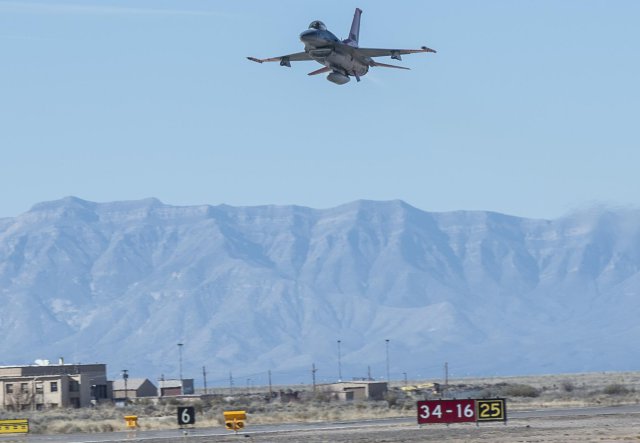
The QF-16 drone took its first flight at Holloman Air Force Base Feb. 10, 2017. The manned sortie was the first for the QF-16 at Holloman AFB since the retirement of the QF-4 Phantom in 2016. 
“The first flight is significant because it is the first step for us in standing up the QF-16 program,” said Lt. Col. Ronald King, the commander of Detachment 1, 82nd Aerial Targets Squadron. “Manned flying is critical in our development of the remote control and unmanned mission capabilities necessary for us to provide QF-16 full-scale aerial targets to our Defense Department and foreign military sales customers.”
The upgrade to the QF-16 allows customers to test weapons systems in real-world scenarios before reaching the battlefield.
“Our mission stays the same,” King said. “However, the QF-16 increases the capabilities we can offer our customers. The QF-16 is a fourth-generation fighter, while the QF-4 was a third-generation fighter. The QF-16 offers more realistic threat replication in performance, maneuverability and capabilities.”
The QF-16 can fly manned or unmanned, depending on the mission and customer’s needs.
“Our flying missions at Holloman are driven by our customer’s requirements,” King said. “Sometimes, when a system is brand new, we may just be flying straight and level with no maneuvers. As a system matures, the complexity of the missions will increase to test and validate the new system.”
 A QF-16 drone sits on the flightline before its first flight at Holloman Air Force Base, N.M., Feb. 10, 2017. Lt. Col. Ronald King, the commander of Detachment 1, 82nd Aerial Targets Squadron, piloted the drone during the first flight since the 82nd ATRS transitioned from QF-4 Phantoms to QF-16s.  systems. (U.S. Air Force photo/Senior Airman Emily Kenney)
A QF-16 drone sits on the flightline before its first flight at Holloman Air Force Base, N.M., Feb. 10, 2017. Lt. Col. Ronald King, the commander of Detachment 1, 82nd Aerial Targets Squadron, piloted the drone during the first flight since the 82nd ATRS transitioned from QF-4 Phantoms to QF-16s. systems. (U.S. Air Force photo/Senior Airman Emily Kenney)
The 82nd ATRS is part of the 53rd Weapons Evaluation Group at Eglin AFB, Florida. The group provides the personnel and infrastructure to test and evaluate weapons utilized by the combat air forces of the U.S. and its allies. It operates the only full-scale aerial targets in the DOD. In accordance with U.S. law, Title 10, Section 2366 of the U.S. Code, a missile system must undergo lethality testing before it can enter full-scale production. The 82 ATRS maintains DOD’s sole capability to execute the Title 10 requirement with full-scale aerial targets.
Top Photo: A QF-16 drone flies over Holloman Air Force Base, N.M., Feb. 10, 2017. Lt. Col. Ronald King, the commander of Detachment 1, 82nd Aerial Targets Squadron, piloted the drone during the first flight at Holloman since the transition from QF-4 Phantoms to QF-16s. – U.S. Air Force photo/Senior Airman Emily Kenney

Boeing is pressing on with the Super Hornet Block 3 - AW&ST


Boeing’s Souped-Up Super Hornet Adds Smart U.S. Navy Firepower


As President Donald Trump signals he may reconsider the mix of F-35Cs and F/A-18s for the carrier air wing of the 2020s and beyond, Boeing is pitching an upgraded “Block 3” Super Hornet designed to add firepower and act as a smart node on the U.S. Navy’s future network.
While the service’s first F-35Cs will come online in 2018, the F/A-18 E/F Super Hornet will make up at least half of the carrier air wing through the 2040s. The challenge is to keep the Super Hornet, an airframe originally designed in the 1990s, relevant and effective against advanced threats into the middle of the century.
That issue is nothing new for Boeing, but the discussion about the next step for Super Hornet has shifted in the past few years. While the “Advanced Super Hornet” Boeing proposed in 2013 focused on stealth, the new and improved Block 3 is designed to optimize the Navy’s integrated network architecture, says Dan Gillian, Boeing F/A-18 and EA-18 program manager.
The big question for the carrier air wing through the 2030s, says Gillian, is:  “How can the Super Hornet evolve in a complementary way with the E-2D [Hawkeye] and Growler to help address some of those carrier gaps?”
Boeing believes the Navy could detail a plan to procure the Super Hornet Block 3 as soon as the fiscal 2018 budget proposal, expected later this spring. A fiscal 2019 buy would mean Boeing could have aircraft off the production line in the early 2020s, Gillian notes.
The revived conversation about the advanced Super Hornet is emerging just weeks after Trump made headlines by pitting the naval strike fighter against Lockheed Martin’s F-35. In a blow to Lockheed, he asked Boeing to price out the cost of building a “comparable” Super Hornet as a possible alternative to the F-35C carrier variant, and Secretary of Defense James Mattis has since ordered a review comparing the two aircraft.


However, Gillian would not say definitively whether Block 3 could replace the F-35C in the carrier air wing. Boeing is focused on “complementary capability,” and ultimately the Navy will decide the right mix of each platform, he stresses.
“We are supporting Block 3 as a key piece of solving the carrier air wing capability problem,” he says. “Our job is to present solutions to solve their warfighting problems.”
Gillian envisions a Block 3 Super Hornet working in tandem with the stealthy F-35C, Growler’s full-spectrum jammer and E-2D’s early-warning capability to dominate the skies. The addition of a long-range infrared sensor (IRST) will allow Block 3 to detect and track advanced threats from a distance, while conformal fuel tanks (CFT) will extend range by 100-120 nm. The CFTs are designed to replace the extra fuel tanks Super Hornets currently sling under the wing, reducing weight and drag and enabling additional payload.
These changes allow a fully loaded Block 3 Super Hornet to operate in conjunction with a stealthy F-35, providing air cover and greater magazine depth.
“You can have an F-35 in its very stealthy way doing a deep-strike mission with Super Hornet providing air superiority at that same range, or you can have Super Hornet carrying large standoff weapons that F-35 cannot carry, with F-35 providing some air cover,” Gillian says. “You get very mission-flexible, so range is important.”


Certain features of the 2013 proposal, such as the enclosed weapons pod and internal IRST sensor, were dropped from the 2016-17 package because Boeing’s analysis determined the Super Hornet was “stealthy enough”—it can fly full-up and still be survivable. Boeing engineers found they needed to make design compromises to significantly reduce the aircraft’s radar cross-section—for instance, by restricting payload.
“At some point we drew a line that would allow us to be stealthy enough in a balanced survivable way to be effective, and that is what we think we have,” Gillian says. “The F-35 is a stealthier airplane, but we have a balanced approach to survivability, including electronic warfare and self-protection.”
Block 3 also features an advanced computing infrastructure designed to take advantage of the future carrier air wing’s sophisticated sensor architecture. The aircraft will have an advanced cockpit system with a large-area display for improved user interface, a more powerful computer called the Distributed Targeting Processor Network (DTPN), and a bigger data pipe for passing information known as Tactical Targeting Network Technology (TTNT). TTNT is already a program of record for Growler and E-2D, and DTPN is also fielded on the Growler.
“You have your IRST sensor, you have other sensors in the carrier air wing, you need a big pipe to move that information around, then you need a big computer to be able to fuse all that information together,” Gillian says. “Block 3 Super Hornet needs to be a smart node on the network capable of crunching and passing data across the network to other assets.”
This advanced computing architecture ensures the Super Hornet, Growler and E-2D can talk to each other and pass critical threat data over the same network in combat. However, the F-35 is not on TTNT; rather it uses the smaller-bandwidth Link 16 network to pass and receive data from fourth-generation aircraft.
The result is that while the F-35C can communicate with the rest of the carrier air wing, passing large amounts of data may be more difficult.
While improving fifth-to-fourth generation connectivity is an ongoing discussion, “I think the question is: how does F-35 plug in with everybody else?” Gillian says. “If everybody else is on TTNT, there seems like an obvious answer there.”
The Navy could probably add TTNT to the F-35’s Link 16 functionality, but the fighter cannot broadcast on any Link 16 waveform without compromising its stealth, because Link 16 is not a low-probability-of-intercept waveform. The F-35 can pass large amounts of data to other F-35s via the stealthy Multifunction Advanced Data Link, which most other aircraft cannot currently access.
Another difference between the 2016 and 2013 offerings is that Boeing is offering to deliver a 9,000-hr. airplane straight off the production line, Gillian says. Combined with the company’s ongoing effort to extend the existing Super Hornets to 9,000 hr. from 6,500, this will help the Navy maintain inventory and boost readiness, he says.
Although the Navy has not publicly committed to Block 3, Gillian thinks the service is very interested in the capability.
“I believe there is a general acceptance of the fact that we need to advance the Super Hornet, because it is going to be a front-line fighter [from the] 2020s into the ’40s,” Gillian says. “We believe we have good alignment on the Block 3 Super Hornet systems that address key carrier air wing gaps in a complementary way with the F-35, E-2D and Growler.”