Formålet med bloggen er å bidra til informasjon om luftfart av alle slag. Også litt om ubåter og forsvarsspørsmål. Nyheter vil du finne her også, en del på engelsk som er det mest brukte luftfartsspråket. Har du selv noe som bør komme ut, så send meg en mail til per.gram@hesbynett.no - Politikk på alle nivåer over hele verden er i kaos. Voldsomme endringer kan finne sted på kort tid, som også kan få innvirkning på forsvarsdisposisjoner. Det må kommenteres.
Information is only available from news, social media or unofficial sources
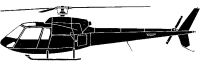
Narrative: Eurocopter AS 350B3 Ecureuil was destroyed when it impacted open field terrain in foggy/low visibility conditions in Verdal, Trøndelag. Two occupants died and one occupant sustained serious injuries.
Bildet er sakset fra Adressa. Fotograf ukjent. Guffne forhold for flyging.
– Vi
har fått bekreftet et helikopterhavari ute på et jorde.
Det
forteller vaktleder Roger Gjersvold ved Midt-Norge 110-sentral
bekrefter til NRK.
Det
var klokka 10:42 at politiet fikk melding om at et helikopter hadde
havarert i et utmarksområde like utenfor Verdal sentrum.
– Det
er et helikopter som har gått i bakken ved Stiklestad, utenfor
Verdal. Det har skjedd i utmark, utenfor tettbebygd område, sier
operasjonsleder Solfrid Lægdheim hos politiet.
Det
er satt i gang en stor redningsaksjon der alle nødetatene deltar.
– Det
er for tidlig å gå ut med skadeomfanget til de som er involvert,
sier Lægdheim.
A
B-52H Stratofortress is parked on the flightline at Barksdale Air Force Base in
May 2020 (US Air Force)
China
has warned the US’s plans to regularly base six of its nuclear-capable B-52
bombers at RAAF Base Tindal may “trigger
an arms race in the region”.
The
country’s foreign ministry spokesperson, Zhao Lijian, urged the US and
Australia to abandon what it branded an “outdated Cold War zero-sum mentality”
and “narrow geopolitical mindset”.
“Such a
move by the US and Australia escalates regional tensions, gravely undermines
regional peace and stability, and may trigger an arms race in the region,”
Lijian said.
He
added the countries should “do more things that are good for regional peace and
stability and mutual trust among all parties.”
It follows a report by Four
Corners on Monday that revealed Washington will build dedicated facilities in
the NT, including a ‘squadron operations facility’ and parking areas for the
aircraft. While the aircraft is a regular visitor to Australia, the development
means B-52s will effectively be regularly based here.
The
upgrades to Tindal that will allow it to house B-52 are expected to cost $22.5
million and be financed by the US government.
The
US Air Force appeared to confirm the plans telling the ABC, “The RAAF’s ability
to host USAF bombers, as well as train alongside them, demonstrates how
integrated our two air forces are.”
However,
both the federal government and territory governments have played down any
concerns the new facility at Tindal could escalate relations in the region.
Minister
for Northern Australia, Madeleine King, called the base upgrade a “welcome
investment” that would be good for the community and jobs.
Meanwhile, the Northern Territory’s Deputy Chief Minister, Nicole
Manison, added the move wouldn’t be a cause for concern.
“I
think everybody acknowledges that the Northern Territory has always been … a
defence place,” Manison said.
“I
think territorians are very comfortable with that, they understand our
strategic location, and generally are very supportive of that defence
investment.”
The B-52H
Stratofortress is a long-range, heavy bomber that can perform a variety of
missions, including nuclear and conventional bombing alongside maritime
surveillance.
The US
currently has a fleet of 76, and the aircraft type has been in operation for
more than 60 years. During the first Gulf War, it dropped 40 per cent of the
coalition force’s weapons.
It has
an unrefueled combat range in excess of 14,000km.
“The
B-52 is capable of dropping or launching the widest array of weapons in the
U.S. inventory,” states the US Air Force’s website.
“This
includes gravity bombs, cluster bombs, precision-guided missiles and joint
direct attack munitions.
“Updated
with modern technology, the B-52 is capable of delivering the full complement
of joint-developed weapons and will continue into the 21st century as an
important element of our nation’s defences.
“The
Air Force currently expects to operate B-52s through 2050.”
It
comes after the US sent six of its batwing, B-2 Spirit stealth bombers to Amberley this year to
train with RAAF F-35s.
The
UFO-like Spirit can also carry nuclear weapons and is thought to be the most
expensive aircraft ever made, valued at around $2 billion each.
Their
visit amounted to the biggest-ever deployment of the US’s most important
military jet to Australia, with the country’s active fleet only numbering 20.
It came
as the US House Speaker Nancy Pelosi visited Taiwan. China retaliated by
testing ballistic missiles over Taipei for the first time.
Haag domstolen har avgjort at disse øyene er ulovlige og er i farvann som er åpent for internasjonal ferdsel. Kina aksepterer ikke det og hevder at øyene er bygget på deres kontinentalsokkel, hvilket det ikke er hold for. (Red.)
New photos show China’s artificial islands are highly developed military bases
The reclaimed reefs and rocks house airfields, radar installations and possible missile silos.
By RFA Staff 2022.10.31
In this Oct. 25, 2022 aerial photo, buildings and communication structures are seen on the artificial island built by China in Mischief Reef in Spratly Islands, South China Sea. China has progressively asserted its claim of ownership over disputed islands in the South China Sea by artificially increasing the size of islands, creating new islands and building ports, military outposts and airstrips.
Photo: Ezra Acayan/Getty Images
New images have emerged showing airfields and other structures on some of China’s artificial islands in the South China Sea that the U.S. said had been “fully militarized.”
Getty Image’s photographer Ezra Acayan obtained access to flights near a number of reefs and rocks that China has reclaimed and turned into military bases with radar stations, airstrips and artillery installations.
The photos taken on Oct. 25 show another dimension of the Chinese artificial islands, up to now mostly captured on satellite images.
U.S. Indo-Pacific commander, Adm. John C. Aquilino, said in March that China had fully militarized at least three artificial islands including Mischief Reef, Subi Reef and Fiery Cross, all in the Spratly archipelago that Beijing claims “historical rights” over.
Life on Fiery Cross
The Getty photos provide extensive details of the People’s Liberation Army (PLA) facilities on Mischief Reef, Gaven Reefs, Subi Reef, Cuarteron Reef, Fiery Cross Reef and Hughes Reef - six of the 15 Spratly features occupied by China.
Fiery Cross Reef appears to be one of the most developed, with a fully operational airfield, hangars, other large buildings and radomes, or domes with radar equipment inside.
A new type of building spotted on Fiery Cross, as well as on Mischief and Subi Reefs, is a garage-like structure that may be sheltering missile launchers, according to analysts.
“My guess is that the sea-facing garages are for angled cruise missile launchers,” Tom Shugart, adjunct Senior Fellow at the Center for a New American Security, wrote on Twitter.
Another analyst, Tyler Rogoway, editor of The War Zone defense news portal, said they could “be used to house, service, and rapidly deploy” launchers used to fire surface-to-air, anti-ship, or surface-to-surface missiles.
Shugart also noted some other details such as “a car driving around Fiery Cross and someone walking down a street.”
“It's not crowds, but it's also not nothing,” he wrote.
Three weeks ago Chinese state mediareported that there is a growing population of more than 5,000 “officers and soldiers stationed” on islands and reefs that China occupies in the South China Sea.
In this Oct. 25, 2022 aerial photo, a aircraft is seen on the tarmac of the artificial island built by China in Mischief Reefthe in Spratly Islands, South China Sea. (Photo: Ezra Acayan/Getty Images)
Radomes and gun turrets
In one of the pictures of Fiery Cross, a KJ-500 airborne early warning and control aircraft is visible on the runway.
“The image of a KJ-500 on the runway is compelling and confirms that the PLA is still regularly flying aerial patrols off the islands,” Greg Poling, director of the Asia Maritime Transparency Initiative at the Center for Strategic and International Studies (CSIS) told RFA.
“That has been ongoing since 2020,” he added.
According to The War Zone’s Rogoway, the KJ-500 and other intelligence-gathering and submarine-hunting aircraft “frequently operate from the airfield there.”
Radomes, gun turrets and close-in weapon systems for detecting and destroying incoming missiles and aircraft are common features on all the artificial islands.
On Subi Reef, the main runway is being blocked by several objects, possibly vehicles, or carts.
“This is an unsafe act, hostile to anyone else flying in the area” as pilots of an aircraft in true distress may not see the blockade and crash, according to Shugart.
“This once again puts the lie to the idea these islands were built for the navigational safety of all,” the Fort Hood-based analyst said.
“They're military bases, period.”
In this Oct. 25, 2022 aerial photo, buildings, airstrips and communication structures are seen on the artificial island built by China in Mischief Reef in Spratly Islands, South China Sea. (Photo: Ezra Acayan/Getty Images)
China and five other parties claim parts of the South China Sea including the features which, according to the U.N. Convention on the Law of the Sea, are reefs and rocks and not islands.
By law, reefs and rocks have much more limited rights to natural resources than islands.
Beijing has developed at least seven artificial islands, creating 1,295 hectares (3,200 acres) of new land since 2013, according to the CSIS Asia Maritime Transparency Initiative.
On a trip to Washington in 2015, China’s leader Xi Jinping said “China does not intend to pursue militarization" of the artificial islands in the South China Sea but critics say they greatly expand the offensive capability of the PLA and threaten other countries in the vicinity.