fredag 26. februar 2016

Helicopters - What`s the matter with Bristow? - Avionics

Nigerian Oil Asked to Nix Bristow Contracts Ahead of Accident Investigation

A Nigerian news source reported today that the country’s oil production companies have been ordered to cease all contracts with Bristow Helicopters while an investigation continues into the Feb. 3 nonfatal crash of an S-76 C++ offshore transport helicopter.
Nigeria’s THISDAY said it obtained a Feb. 14 letter from the National Petroleum Investment Management Services to Total Upstream Nigeria, Ltd., an oil production sharing contract company. In the letter, NAPIMS directs all production sharing contract and joint venture companies “to terminate all aviation contracts awarded to Bristow Helicopters in accordance with the provisions of the aviation contracts”. 
“We are aware that a number of our clients have received a letter from the National Petroleum Investment Management Services (NAPIMS) requesting termination of Bristow’s services,” Bristow told R&WI. ”We have engaged the authority and other government officials on the matter.”
Bristow added it is in full compliance of all Nigerian Civil Aviation Authority regulatory requirements and Sikorsky operating directives, and continues to fully cooperate with Nigeria’s Accident Investigation Bureau in its investigation into the Feb. 3 accident.
Additionally, Bristow is conducting additional safety assurance checks on the Sikorsky S-76 fleet as a precautionary measure prior to returning the aircraft to service. It said the Nigerian Civil Aviation Authority has performed a comprehensive audit, and has authorized Bristow to start test flights of the S-76 C++.
On Feb. 3, a Bristow helicopter captain successfully ditched a Sikorsky S-76C++ in the Atlantic Ocean after departing from an offshore platform. All nine passengers and both crewmembers were rescued alive. The previous August, another Bristow S-76C crash in Nigeria claimed the lives of two pilots and four of the 10 passengers on board. Nigerian authorities have issued a temporary suspension of Bristow’s S-76 fleet and have begun investigating the cause of the most-recent accident.

Airship revival - BBC Video

Exploring a re-creation of the Hindenburg airship


Check out video here: http://tinyurl.com/huudms9
9 hours ago
It is nearly 80 since the Hindenburg airship - the world's largest ever aircraft at the time - flew for the first time in March 1936. Some 14 months later it exploded on a transatlantic flight to New Jersey.
In Germany's Zeppelin museum, visitors can explore a re-creation of part of the Hindenburg.
The BBC Travel Show's Rajan Datar explores the reproduction and finds out about the future of airship travel.
(Archive video: British Pathe)

Heli-Expo - Rotor&Wing


4
Days to the show
Heli-Expo
Feb. 26, 2016 | Issue 3
3 Questions With Airbus' Chris Emerson
Chris Emerson on June 1 became president and chief executive of Airbus
 Helicopters Inc. [Booth 9651] and head of Airbus Helicopters North America
 Region, overseeing Airbus Helicopters' subsidiaries in the U.S. and Canada.
(He succeeded Marc Paganini, who led the Grand Prairie, Texas-based U.S.
subsidiary for more than 12 years.) Emerson previously was SVP and head of
marketing for Airbus' airliner unit. We asked Emerson about the current market
in North America and Airbus' response to it... More...
News and Announcements
Robinson Optional Fuel Tank Available for R66
Robinson Helicopter Company [Booth 3501] is offering an optional 43-gallon
auxiliary fuel tank for its R66 Turbine helicopter, extending the helicopter’s
range by as much as 200 nm, the company said. The fuel tank mounts on a
fiberglass tray that... More...
HeliFab S76 Fuel Tank Receives EASA Approval
HeliFab, which works alongside Arrow Aviation [Booth 2804], recently received
EASA approval for its S76 Auxiliary Fuel Tank. The tank already had...
&nbsnbsp;More...
AAR Launches Rotorcraft Business Division
Global aerospace and defense contractor AAR [Booth 2604] now offers a broad
range of aftermarket support services for helicopter operators, including parts
sales, engineering and total life-cycle support programs, under its new Rotorcraft
Services business division... More...
Tradewinds Becomes Chopper Spotter Dealer
Tradewind International, LLC, [Booth 6847] is now an official dealer for Chopper
Spotter, a machine to safely move light and medium helicopters on the ground.
The Chopper Spotter is available in three versions... More...

Gripen E closer to rollout - AIN

AIN Defense Perspective Logo
February 26, 2016
View in browser   •   Subscribe   •   Email Editor   •   AINonline.com
image
Bullish Saab Sets Rollout Date For Gripen E
Saab will roll out the first Gripen E version at Linkoping, Sweden on May 18, said Richard Smith, the company’s head of marketing and sales for the combat aircraft. In a bullish briefing at the Singapore Airshow last week, Smith said that thanks to the 60 new-build E/F jets for Sweden, plus the Brazilian Gripen order and other surveillance and submarine programs, the Swedish company’s backlog was at an all-time high of $13.5 billion. The Gripen thus has a guaranteed long-term future, and the sales goal was “at least 300 more,” Smith said.
Smith described the “huge technical transfer program” associated with the Brazilian acquisition of Gripen. This includes 50 key projects in four categories, and is an expanded version of the model used in South Africa’s Gripen deal. Last October, the first 48 of an eventual 350 Brazilian engineers arrived in Sweden to work on the project. Fifteen of the expected 36 Gripens to be acquired by Brazil will be built by Embraer at a Development Center to be established at Gaviao Peixato. The center will also help develop the two-seat Gripen F and integrate weapons. There had been no slow-down of the Brazilian program, despite that country’s recent economic difficulties, Smith told AIN.  Preliminary design of a Sea Gripen version had been completed, with a potential Brazilian requirement in mind, Smith said. “Now we must do a market analysis,” he added. Read More

Eric "Winkle" Brown videos from AVweb

The phrase "witness to history" is an overused one in the obituary writer's vocabulary and probably just as often overstates the departed's life role. But in the case of Eric "Winkle" Brown, it's barely adequate to describe the man. As you read in this week's news columns, Brown died this week at the age of 97. Given his occupation as the most well-known flight test pilot in the U.K.—and the world for that matter—it's a testament to raw skill, preparation, instinct and, I bet he'd say some luck, that he lived to that age. Interestingly, Brown says his small stature--that's how he got the nickname "Winkle"--may have saved him in at least one crash. Only U.S. readers with a smattering of aviation history knowledge will know of Brown's career as a Royal Navy pilot involved in many of the U.K.'s major test programs during World War II and immediately after it.
I never met Brown, but know of him vicariously through reading and filmed interviews. What I found most interesting about those interviews is his incredible recall of detail and ability to put a story's key frames into meaningful perspective even a non-aviation viewer can grasp. He was at the intersection of so many critical events in aviation that in any reading of history, he'll pop up Zelig-like nearly everywhere. In this video, he tells the story of a test program to land the DeHavilland Mosquito on the decks of aircraft carriers.
Well into the program, he began to wonder why the Royal Navy wanted to do that. A chance meeting with Barnes Wallis—he of the dam busters bomb fame—revealed that the Brits planned to attack Japanese capital ships with skip bombs from carrier-launched Mosquitos in the Pacific. The war against Japan ended before they sailed.
But for a quirk of fate, Brown would be known as the first pilot to exceed Mach 1, rather than a then-unknown Air Force captain named Yeager. Brown had been the principal pilot on a project called the Miles M.52 and as the U.S. Air Force later did, the test team was slowly inching its way toward the Mach 1 mark. Without explanation, the program was summarily canceled and the acquired data and design work was sent to the U.S. One key technical element from the M.52 was the all-flying tail, which is how the X-1 team eventually overcame the shock wave problem on the X-1's tail. The rest, as they say, is history and you can hear Brown talk about it in this interview. Here's another nice BBC piece on Brown. Among Brown's many firsts was the first landing of a jet aboard a carrier in 1945. He ended his career with 2407 shipboard traps, a record that will likely stand for a long time.
Fair warning about clicking on these links. Be prepared to spend an hour or two watching these and other interviews. And if you do that, you'll understand why Brown so richly deserves mention in this space. I doubt if we'll see his like again.

Lange flyruter - Teknisk Ukeblad

VERDENS LENGSTE FLYRUTE
Boeing 777-200LR fra Emirates. (Foto: Emirates)

VERDENS LENGSTE FLYRUTE

Tirsdag starter verdens lengste flyrute

Emirates overtar både første- og andreplassen i løpet av mars.
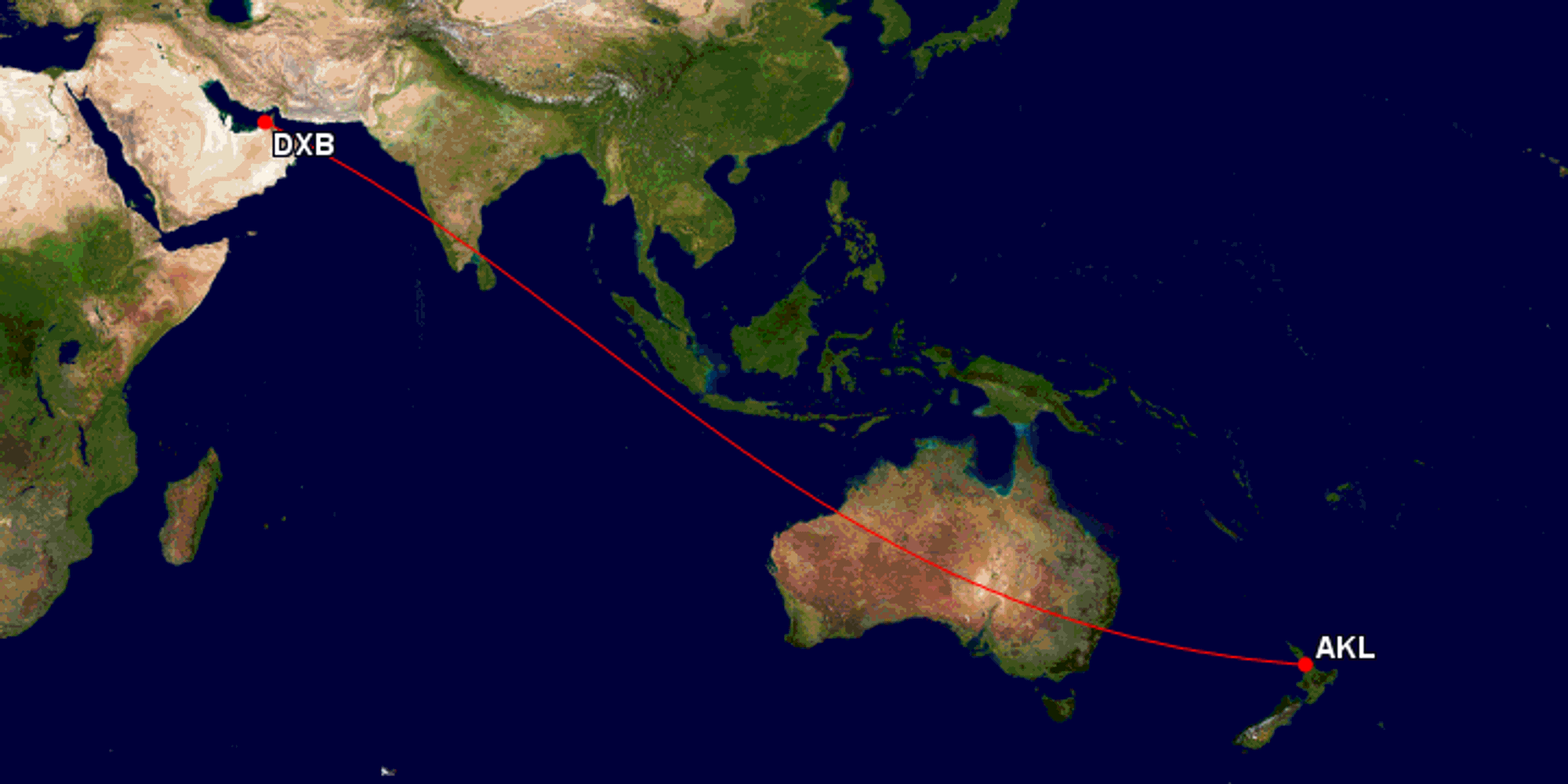
1. mars starter Emirates direkterute mellom Dubai og Auckland.
Det betyr at norske passasjerer nå kan komme seg fra Oslo til New Zealand med kun én mellomlanding, og dessuten at Emirates nå overtar verdens lengste nonstop flyrute:
Korteste distanse mellom flyplassene i Dubai i De forente arabiske emirater (DXB) og Auckland (AKL) er 7.668 nautiske mil (14.201 kilometer).

Også nest lengst

Det som fram til tirsdag er verdens lengste flyrute uten mellomlanding, er Qantas' rute mellom Sydney (SYD) og Dallas-Forth Worth lufthavn (DFW).
Dette er flyruta som overtar som verdens lengste.
Dette er flyruta som overtar som verdens lengste. Foto: Great Circle Maker
Denne ruta er 7.454 nautiske mil (13.805 kilometer) og har eksistert siden 2011.
I tillegg starter Emirates nå opp enda ei langrute som med ørliten margin også er lengre enn SYD-DFW:
Fra 31. mars skal selskapet fly direkte mellom Dubai og Panama City, en strekning på 7.463 nautiske mil (13 821 kilometer).
Denne flyruta starter 31. mars og blir den nest lengste.
Denne flyruta starter 31. mars og blir den nest lengste. Foto: Great Circle Maker
Denne langruta skulle egentlig blitt startet opp 1. februar i år, men har tydeligvis ikke vært noen umiddelbar suksess og ble altså utsatt to måneder.

Over 17 timer

Emirates har fire daglige flygninger til New Zealand fra før, tre med A380-800 og én med B777-300ER, men disse flyr via Australia.
Emirates setter inn sine Boeing 777-200LR på begge de nye flyrutene.
Flyselskapet har hele 155 Boeing 777 i flåten. Ti av dem er langdistanseversjonen 200LR som har 216 økonomiseter, 42 seter i businessklasse og 8 i første klasse.
For de av oss som må ta til takke med et av de 216 bakerste setene, kan det være interessant informasjon at flytiden vil være nærmere 16 timer østover fra Dubai til New Zealand, og i overkant av 17 timer i motsatt retning.
B777-200LR brukes også på det som nå altså rykker ned til verdens fjerde og femte lengste flyruter:
Deltas rute mellom Atlanta og Johannesburg (ATL-JNB, 7.333 nm/13.581 km) og Ethiads rute mellom Abu Dhabi og Los Angeles (AUH-LAX, 7.291 nm/13.503 km).

Comeback for SQ21

Men så sant ikke Emirates åpner ytterligere nye langruter, er det ikke så lenge de vil inneha flyruta som kan betegnes som verdens lengste.
Mest konkret i skrivende stund er at Singapore Airlines i 2018 skal gjenåpne den kjente flight SQ21, direkteruta mellom Singapore og New York som ble lagt ned høsten 2013 etter ni års drift.
Korteste distanse mellom Changi (SIN) og Newark (EWR) er 8.285 nautiske mil (15.344 kilometer).
Men det flys litt omvei for å utnytte jetstrømmene. Den reelle distansen som flys anslås av Singapore Airlines selv til om lag 8.700 nautiske mil (16.112 kilometer).

A350-900ULR

Singapore Airlines er lanseringskunde på A350-900ULR om to år.
Singapore Airlines er lanseringskunde på A350-900ULR om to år. Foto: Airbus
Planen er å starte opp igjen om når Singapore som første selskap tar i bruk den nye Airbus 350 XWB med forlenget rekkevidde.
Singapore har bestilt sju A350-900ULR (Ultra-Long Range) og skal i 2018 også gjenoppta direkteflygningene mellom Singapore og Los Angeles (7.621 nm/14.114km).
I tillegg har selskapet planer om å fly direkte fra Changi til flere amerikanske byer.
Selv om flyene er blitt mer effektive, har de ikke blitt nevneverdig raskere. Det vil fortsatt ta 18-19 timer å fly mellom Singapore og New York.
Men også i de nye A350-flyene blir det ikke noe lavere enn businessklasse, slik det var om bord i A340-500-flyene som ble benyttet tidligere på denne flyruta.

Qatar Airways

Det er minst to andre flyruter som er på trappene og som begge vil bli lengre enn de nye Emirates-rutene.
Også Emirates-rivalen Qatar Airways har annonsert planer om å fly direkte til Auckland. Fra Doha (DOH) er dette en distanse på 7.848 nautiske mil (14.535 kilometer).
Qatar har dessuten varslet at de planlegger å sette inn noen av sine B777-200LR på ei ny rute til Santiago (SCL) i Chile, en distanse på 7.791 nm (14.429 km).

Glidefly til 90 000 fot? - Curt Lewis


This glider will fly 90,000 feet higher than most aircraft


This summer, two pilots sandwiched in a 36-inch-wide cabin could take the Perlan 2 glider to 90,000 feet, higher than most aircraft have flown. To reach such heights, the glider will ride stratospheric waves-powerful and little-understood currents that flow over mountain ranges.

It will be flying in uncharted and unstable aeronautic territory, and between the rigors of thin air and blistering ultraviolet radiation, the slightest miscalculation could be disastrous. If successful, the Perlan 2 could expand the parameters of high-altitude flight, enhance climate science, and provide new insights on planetary exploration. All without burning a drop of jet fuel.

"This area has the most intense turbulence outside what you'd get in a hurricane or a cyclone. It's like you're in a washing machine." - Morgan Sandercock, project manager.

How It Works

Assisted launch: A 20 horsepower tow plane will use a cable to lift the glider up to 10,000 feet. Perlan 2's pilots will then detach from the aircraft and continue their ascent using air currents and lithium-ion battery-powered flight instruments.

Tight quarters: Engineers built the 3-by-10-foot pressurized fuselage as small as possible to minimize drag and weight during flight. The cabin is circular (rather than the oval shape of most aircraft), so air pressure will push equally on all sides.

Treated windows: At 90,000 feet, the glider will be exposed to the deteriorating effects of solar radiation. A coating on the polycarbonate windows will absorb the rays. It will also help protect against frigid temperatures and maintain the Perlan 2's structural integrity. If the windows crack, the cabin will depressurize and the pilots' lungs will explode inside their chests.

Unique wings: Lightweight carbon-fiber wings help the glider to fly in the low-density air of the upper stratosphere. The airfoil-its aerodynamically shaped, 84-foot wingspan-maximizes efficiency and provides the ideal ratio of lift to drag.

Steady Flying: Along with a control stick, pilots will use ailerons and elevators-the movable sections of each wing-and a rudder to navigate turbulence. These help control the glider's pitch, roll, and yaw.


If the windows crack, the cabin will depressurize and the pilots' lungs will explode inside their chests.
Safe Descent: Without an engine to modulate its speed, the Perlan 2 will rely on air brakes, which flip open and create drag to safely land. In case of a midflight emergency, the pilots can also deploy an 11-foot-diameter drogue parachute, often used by high-speed air crafts.

Science Mission: The glider will be the first to collect scientific data on the powerful-and unpredictable-stratospheric waves. Aviation experts will use this research to forecast the waves more accurately, eventually enabling passenger planes to operate in the upper atmosphere, where they could fly farther and faster on less fuel (thanks to the reduced drag).

Martian Analog: The glider's flying conditions will be similar to those found on Mars, and the team hopes to share any insights the craft gleans from its flight. "Somebody will build an airplane for Mars someday, and we'll have a wealth of data for that person," says Ed Warnock, the project's CEO.

Climate Data: The flight has additional scientific implications. When the waves stretch high enough, they break, and chemicals from the troposphere are thrust into the stratosphere, where they can remain for decades. No one knows the effects of this atmospheric cocktail, and whatever data the Perlan 2 collects could help sharpen the forecast of humanity's effects on climate change.