Formålet med bloggen er å bidra til informasjon om luftfart av alle slag. Også litt om ubåter og forsvarsspørsmål. Nyheter vil du finne her også, en del på engelsk som er det mest brukte luftfartsspråket. Har du selv noe som bør komme ut, så send meg en mail til per.gram@hesbynett.no - Politikk på alle nivåer over hele verden er i kaos. Voldsomme endringer kan finne sted på kort tid, som også kan få innvirkning på forsvarsdisposisjoner. Det må kommenteres.
For andre gang på 20 år legges en flyplass ned i Norge
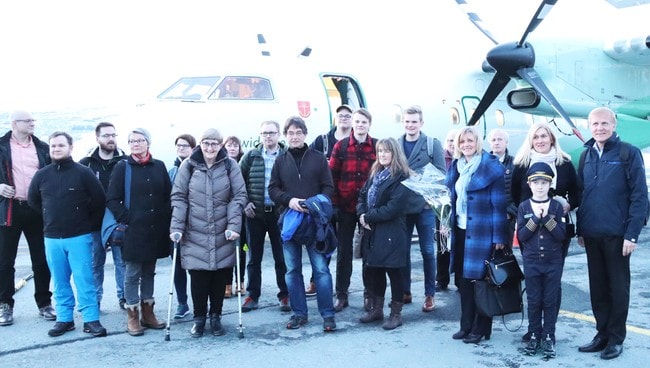
Klokken 19.59 fredag kveld var det duket for historiens siste flyavgang fra Narvik lufthavn Framnes. – En mørk dag, sier varaordføreren i Narvik.
Kabinansatt Barbro Boquist Lindberg og kapteinene Odd Thomassen og Rolf Fossgård la ikke skjul på at var vemodig å fly historiens siste flyavgang fra Framnes.
Foto: Ole Dalen / NRK
Det ble tårer, kake og flere ekstrarunder rundt Narvik da det aller siste Widerøe-flyet tok av fra Framnes lufthavn Narvik like før klokka 20 fredag kveld. – Det er vemodig både for passasjerene og oss i besetningen, sier kabinansatt Barbro Boquist Lindberg.
Det begynte i det små i 1972, men i 1975 var det full drift og rutetrafikk fra Narvik lufthavn Framnes. Nå er 42 års drift forbi. – Det har vært både opp- og nedturer. De aller fleste som er her i dag har jobbet på en oppsigelse i fem år. Det er såpass lenge siden flyplassen ble vedtatt nedlagt, sier driftssjef Bernt Mathisen.
Det var i Nasjonal Transportplan for 2014–2023 at Avinor fikk i oppdrag fra Samferdselsdepartementet å legge ned Narvik lufthavn Framnes. Som kompensasjon skulle Hålogalandsbrua korte ned reisetiden for narvikværingene til Harstad/Narvik lufthavn Evenes. – Vi er en veldig sammensveiset gjeng. Alle virkelig har stått på. Sikkerheten må ivaretas helt frem til siste fly går, sier Mathisen.
Klar for siste avgang fra Narvik til Bodø fredag kveld.
Foto: Ole Dalen / NRK
Kortbaneflyplasser er regionale flyplasser med kort rullebane, typisk 800–1500 meter, og begrensede systemer for instrumentert innflygning.
Sist gang en flyplass ble avviklet i Norge var da Moss lufthavn Rygge ble lagt ned i november i fjor. Oslo lufthavn Fornebu ble lagt ned høsten 1998, og erstattet av Gardermoen.
For varaordfører i Narvik, Geir-Ketil Hansen (SV), er dette en mørk dag. Hansen mener forutsetningen for nedleggelsen av lufthavnen, ikke er innfridd. – Jeg beklager veldig sterkt at lufthavnen legges ned i dag. Avtalen var at Framnes skulle drives frem til Hålogalandsbrua ble åpnet, og det skjer først om ett år. Dette har Narvik kommune tatt opp med samferdselsministeren flere ganger, hevder Hansen.
En marsipankake ved reisens slutt.
Foto: Ole Dalen / NRK
Hålogalandsbrua, som skal krysse Rombaken 2 kilometer utenfor Narvik sentrum, gjør strekningen til Bjerkvik 18 kilometer kortere, og korter derfor ned på reisetiden til Evenes med 20 minutter, til om lag 45 minutter. Byggestart var i 2013. – Det står i stortingsvedtaket at flyplassen skal drives frem til 2016, men da var forutsetningen at brua var ferdig. Når brua ble forsinket på grunn av forskjellige årsaker, kunne samferdselsministeren sørget for at flyplassen ble drevet fram til brua ble åpnet. Dette vil påføre oss lengre reisevei og store samfunnskostnader, sier Hansen.
Det er i hovedsak innbyggere i Narvik og Ballangen, samt deler av Tysfjord og Hamarøy kommuner, som har benyttet seg av Framnes.
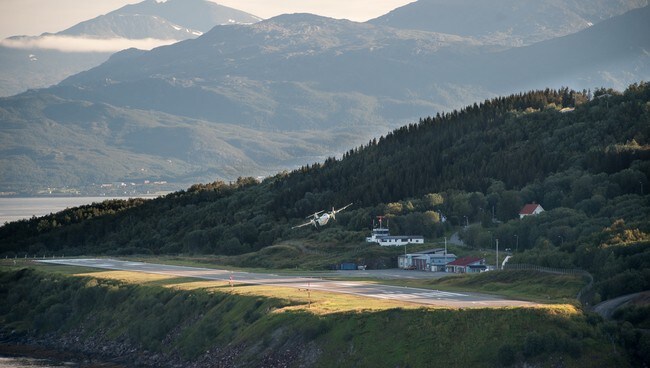
Widerøes maskin tar av fra Narvik lufthavn klokken 07.40 2. september 2015. Snart er Framnes historie.
Foto: Harald Harnang
Harstad/Narvik lufthavn Evenes skal bygges ut i tida fremover, mye som følge av flyttingen av flystasjonen fra Andøya. Siste fly til Narvik lufthavn tar av fra Bodø klokken 19.05, og returnerer klokken 19.59. Da opphører Widerøes konsesjon. – Framnes har betydd mye for Narvik og Ofoten, og burde vært i drift i minst ett år til, avslutter Geir-Ketil Hansen til NRK.
Solvik-Olsen:– Merkelig uttalelse
Samferdselsminister Ketil Solvik-Olsen.
Foto: Astrid Husø / NRK
Samferdselsminister Ketil Solvik-Olsen (Frp) synes det er merkelig at varaordføreren reagerer på at flyplassen stenger all den tid Geir-Ketil Hansen selv var med og sørget for vedtaket i Stortinget i 2012. – Der ble det tatt høyde for at Hålogalandsbrua kunne blitt forsinket, men siste dato for konsesjon ble satt til 31.3 2017, og det kan ikke Hansen snike seg unna.
Når det gjelder påstanden om økte samfunnskostnader ved å påføre reisende lengre reisevei minner Solvik-Olsen om at det også ville kostet samfunnet penger å videreføre subsidiene til Framnes. – En flyplass med svært tynt passasjergrunnlag, sier samferdselsminister Ketil Solvik-Olsen.
The first AirbusA319neoperformed its maiden flight March 31, Airbus announced in a statement.
The smallest member of the A320neo family, powered by CFM International LEAP-1A engines, took off from Hamburg and landed in Toulouse after a five-hour flight.
The flight crew was able to assess the general handling of the aircraft and to check the main systems, Airbus said. The A319neo, registered as D-AVWA, will be based in Toulouse in order to complete its flight test program.
Airbussaid in February that production of the A320 family of single-aisle airliners was “essentially sold out to 2022.” The Toulouse-based manufacturer plans to ramp upproductionof A320 family aircraft to 69 a month in 2019.
The A319neo is the smallest member of the A320neo family. Airbus said the aircraft offers its operators “superior short field performance in hot and high conditions.” It can accommodate up to 160 passengers.
The first Boeing787-10, BOE1, completed its first flight from the Boeing facility in North Charleston, South Carolina, on March 31. The flight took off at 9:30 a.m. local time and landed at 2:35 p.m., just over five hours later.
Boeing test & evaluation captains Tim Berg and Mike Bryan piloted the aircraft. The flight reached 20,000 ft. at a speed of 383 kts., or 441 mph.
In a post-flight press conference Berg and Bryan said they “enjoyed the whole day. “Berg said, “We had a great plan, we had a great team and we had a great jet. We did exactly what we wanted to and it performed exactly like we thought it would. And that’s about as perfect as it gets for a test pilot.”
The weather in Charleston had been dubious through the morning, with heavy cloud cover and spits of rain. At about 9 a.m., the clouds parted and the sun appeared, creating an ideal window for the aircraft’s takeoff.
At about 9:20 a.m., the -10 appeared before thousands of Boeing employees and guests and made a slow taxi/photo shoot before rounding the runway start point and commencing with its takeoff into a now clear and blue sky.
Singapore Airlinesis the global launch customer for the 787-10 and has ordered 30 of the aircraft, with intent to buy another 19, according to Boeing VP and GM 787 Airplane Development Ken Sanger. Boeing expects to begin deliveries in the first half of 2018.United Airlinesis the North American launch customer and has ordered 14 of the variant, with the first delivery expected in Q4 2018. All totaled, nine customers have ordered 149 787-10s to date, including Air France-KLM (7 on order), Air Lease Corporation (25), All Nippon Airways (three), British airways (12), Etihad Airways (30), EVA Air (18), and US lessor GECAS (10).
The 787-10 is an 18-foot (5.5-m) stretch of the 787-9, and is powered by Rolls Royce Trent-1000 TEN engines. It has a range of 6,430 nautical miles, a MTOW of 560,000 pounds (254,000 kg) and a cruise speed of Mach 0.85. It can seat 330 passengers.
Så denne på Gatow ved Berlin. Noen videoer ligger på nettet; ganske spektakulære greier. Raketten brant i 8 sekunder og den tyske varianten kostet på 60-tallet 60 000 mark per skudd.
F- 100 http://tinyurl.com/m64p9ve og F-104http://tinyurl.com/kmvbbks
Crew on tragic Rescue
116 never got emergency warning it was about to crash due to technical
glitch
The
Irish Mirror has learned an audible message should have blasted out in the
cockpit telling the pilot to “pull up” when satellite navigation detected it was
too close to the island
Irish Lights Vessel Granuaile anchored off Black Rock Island Co Mayo last week as the Rescue 116 recovery operation continues. PHotograph: Chris Radburn/PA Wire
Crew onboard tragic
Rescue 116 never got a last-minute emergency warning that it was about to hit
rocks because of a technical glitch, it is claimed today.
Blackrock Island in Co
Mayo, which the doomed chopper clipped before it was due to refuel, was not on
the digital map that directs a crucial safety system.
The Irish Mirror has
learned an audible message should have blasted out in the cockpit telling the
pilot to “pull up” when satellite navigation detected it was too close to the
island.
A source said last night:
“Without this vital warning, an experienced crew would not have known there was
an obstacle in their flight path until they were close enough to see it with
their own eyes through darkness.
“But the system didn’t
recognise Blackrock because it was not recorded on its
database.”
Read
More
Now a TD has demanded it
becomes a central part of the investigation into the crash which killed Captain
Dara Fitzpatrick, Captain Mark Duffy and winchmen Ciaran Smith and Paul
Ormsby.
The source added: “The
software package needs regular updates to ensure all hazards such as lighthouses
and small islands are identified.
“The Enhanced Ground
Warning Proximity System is designed to tell crew when they are approaching high
ground in time to manoeuvre away from the obstacle.”
R116 left Dublin Airport
at 11.03pm on March 13. The last message from the crew to Air Traffic Control
stated that it was doubling back to refuel at Blacksod Bay on the
mainland.
Read
More
It had begun to descend
ahead of its landing when the tail section of the aircraft clipped the western
side of nearby Blackrock Island.
The possibility that a
technical glitch may have caused the tragic accident is now a major cause of
concern for many working within the Coast Guard.
Many are privately
pushing for a full review of the satellite navigation system and its software
after the loss of their four colleagues and friends.
Read
More
The company which
provides helicopter search and rescue services to the Coast Guard – CHC – said
in a statement: “Given that the tragic accident of R116 is to a formal
investigation by the Air Accident Investigation Unit, we are bound by the
associated annex 13 protocols, as such it would not be appropriate for us to be
drawn into questions of a technical nature.”
Sinn Fein’s transport
spokeswoman said: “Whether or not a technical fault caused this has to be
thoroughly investigated.
“It goes without saying
we need to find out what, if anything, contributed to the accident. If this is
found to be the cause of the accident, it must be addressed as a matter of
urgency.”
Aviation Week Editors Jen DiMascio, Lara Seligman and Graham Warwick talk with Marine Lt. Col. David Berke. The team at Aviation Week has reported on the F-35 program for years from a programmatic and technical perspective. But Berke, who has flown the F-22, the F-35 and the F-18, tells them why the F-35 is a superior aircraft.
Mar 13, 2017James Drew|Aerospace Daily & Defense Report
Candidates to upgrade the B-52's 1961-vintage TF33 low-bypass turbofan include the GE Aviation CF34-10, Pratt & Whitney TF33 Engine Enhancement Package and Rolls-Royce BR700: U.S. Air Force
Engine manufacturers are lining up to upgrade or replace theBoeingB-52H’s outdated and inefficient Pratt & Whitney TF33 low-bypass turbofan engines to keep the mighty Cold War bomber flying beyond 2050.
U.S. Air Force Vice Chief of Staff Gen. Stephen Wilson told Congress on March 8 that the service must explore options for replacing the TF33, which powered the first H-model B-52 flight on March 6, 1961, almost six decades ago.
GE Aviation, Pratt & Whitney andRolls-Roycetell Aviation Week they are actively engaged with the Air Force about the re-emerging requirement, offering ready-made commercial derivative engines or, in Pratt’s case, a TF33 upgrade package.
Their proposals come after the Air Force and Boeing proposed swapping the TF33 for eight modern, 17,000-19,000-lb.-thrust-class regional/business jet engines instead of earlier four-engine alternatives, which were deemed too risky because of the necessary structural modifications and airflow changes around the bomber’s nuclear-armed weapons.
The service once proposed a quartet ofCF6high-bypass turbofans, which are derived from the Lockheed C-5 Galaxy’s TF39 (pictured being tested by a B-52). It also considered the 757-class PW2040 and RB211 series. But recent analysis points to an eight-engine solution to limit airframe modification.
That would require at least 608 powerplants for today’s operational feet of 76 B-52Hs, plus several sets of spares.
The Air Force has not commissioned or conducted any wind tunnel or flight tests of candidate engines in the past several years. But market research suggests there are enough engine options on the commercial market to warrant a competition.
A request for information issued in 2014 sought alternative solutions that achieve 10-25% better fuel consumption and 15-25 years of use between schedule depot overhauls. On Feb. 3, the government issued another RFI, this time seeking TF33 replacements, specifying “regional/business-size jet engines.”
“Acquisition strategies are in the process of being formed for both the purchase of the engine and the integration on the aircraft,” a service spokesman said on March 13. “If the Air Force decides to fund a re-engine program in the future, it will assess all procurement options to create the best value for the government.”
GE Aviation is a longtime propulsion system supplier for the Air Force’s bomber force, including the four-engine Boeing B-1B (F101-102) andNorthrop GrummanB-2A (F118-100). The company says it supports the Air Force’s B-52 re-engining plan and would offer the 18,000-lb.-thrust-class CF34-10, developed from the TF34/CF34 family.
The smaller 9,000-lb.-thrust TF34-100 powers the service’s Fairchild Republic A-10 “Warthog” attack aircraft. The latest commercial CF34-10 series powers the BrazilianEmbraer 190, 195 and Lineage 1000 and ChineseComac ARJ21regional jets.
“While no GE engines have been demonstrated on the B-52, the CF34-10 is an economical eight-engine replacement,” says Karl Sheldon, GE vice president and general manager of large military turbofan engines. “We are excited to compete for the opportunity to fly the CF34 on this strategic asset.”
Pratt & Whitney Engine Enhancement Package
Nobody has more experience with the 56-year-old TF33 than the original designer and manufacturer, P&W.
The company says it could offer a new commercial engine, but believes an upgrade makes the most sense.
“Commercial engines offer advantages of higher fuel savings, extended mission range, reduced aerial refueling and minimized overhaul maintenance,” a company spokesman says. “However, all commercial engines in this class require increased ability to support the B-52H electric and hydraulic load requirements, and would also require extensive airframe integration and flight testing.”
The firm’s engine enhancement package would address the TF33’s performance, durability, reliability, fuel consumption and time between scheduled overhauls as much as possible without needing to buy new. “The TF33 currently meets all B-52H power and performance specifications and would not require any changes to the aircraft structure,” the company says.
P&W is pitching this as the “affordable option.” Digitally-controlled commercial propulsors would also need to be militarized and hardened against electromechanical pulses resulting from nuclear explosions as well as cyberattacks.
Rolls-Royce BR700
Headquartered in Indianapolis, British engine maker RR’s U.S. division has already had “several conversations” with the Air Force about a B-52 propulsion upgrade. The company would offer something from its BR700 series, which already powers the Air Force’s Gulfstream V/C-37A personnel transport fleet and theBombardierE-11A Battlefield Airborne Communications Node—based on the Global Express.
The alternatives in the B-52’s thrust class are the BR715 and BR725 series, but the company has not decided which to offer.
“A decision has not been reached yet, as we await the specific requirements,” says Thomas Hartmann, RR’s senior vice president for U.S. customer business. “We are confident we can meet the technical and availability requirements.”