After Boeing crashes,
jet design rules to get tougher for all
By Marcelo
Rochabrun and Tim Hepher

BRASILIA/PARIS, Oct 29 (Reuters) - Planemakers worldwide face tougher
scrutiny and changes in the way aircraft are certified in the aftermath of
two fatal crashes of Boeing 737 MAX jets, leading regulators have told
Reuters.
Tuesday marks one year since the deadly crash of a Lion Air jet, which
Indonesian investigators linked in part to violent seesaw movements triggered
by flawed anti-stall software.
The MCAS software, activated by a single faulty sensor and omitted from
training manuals, has led to calls for tighter regulation as well as
improvements in the training of pilots.
"The certification process will change; I think so," the head of
the U.S. Federal Aviation Administration, Steve Dickson, told Reuters late on
Monday at an airlines meeting in Brazil.
Boeing BA.N 737 MAX aircraft have been grounded around the world since March
following a second fatal crash, this time involving a plane operated by
Ethiopian Airlines.
Speaking to airlines earlier, Dickson also emphasized a need to raise
standards for airplane pilot training globally.
A recent report by international regulators, commissioned by the FAA, faulted
processes at both the U.S regulator and Boeing.
But the impact of the crisis is likely to be felt worldwide, including at
Boeing's rival Airbus and new entrants from Russia to China and Japan, as
regulators step up efforts to ensure that risks are correctly identified
right from the drawing board.
"We are going to make it harder," Patrick Ky, executive director of
the European Union Aviation Safety Agency (EASA), told Reuters when asked
about the future of certification in general, without naming countries or
companies.
"In the future we may ask to have a larger set of data which will be
used in the certification case than today," he added.
In part, that will involve using new technology to run simulations to spot
flaws that may be missed in flight testing.
But regulators are also expected to take a close look at one of the key
tenets of aviation safety, an obscure piece of regulation known as the
"Changed Product Rule".
Under this rule, manufacturers revamping an old design like the 737 only need
to comply with latest regulations on systems undergoing major changes, which
means risks must be understood.
For the rest of the aircraft, the original standards still apply, which in
the case of the 737 date back to the 1960s.
That is no problem when risks are small, officials say.
But this month's international regulatory panel report said the rule did not
adequately address the cumulative effects of individual changes on small
systems.
"In general, the analysis was limited to areas that changed, re-using
prior certification basis to complete the process," former Boeing
engineer Peter Lemme wrote in a blog on Tuesday, citing a series of flawed
assumptions used in the design.
BIG PICTURE
The Joint Authorities Technical Review (JATR) also found Boeing had missed
the big picture by focusing on whether individual systems like MCAS complied
with regulations, without also taking a top-down view of the impact on the
whole aircraft.
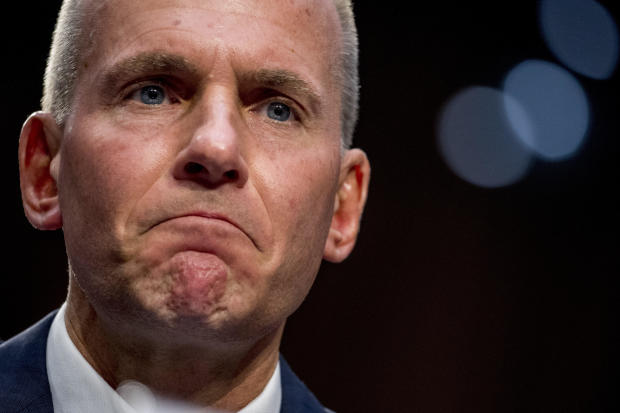
Boeing's chief executive was due to tell a Senate committee on Tuesday that
it made mistakes over the MAX.
It has also said it is committed to working with regulators in reviewing the
recommendations in the JATR report.
One regulator told Reuters a review of the Changed Product Rule would be
among the main changes stemming from the crisis.
That could have implications for airplane design after years in which global
planemakers have focused on upgrading existing models before tackling
costlier clean-sheet designs.
"There is nothing wrong with derivatives; it is just (a question of) how
we certify with full confidence the way in which modifications are made from
an existing type," Ky said.
Others say regulators are likely to check each other's homework more actively
than in the past, while preserving a convention that allows the home
regulator for each planemaker to take the lead, such as the FAA for Boeing or
EASA for Airbus.
Safety officials don't expect this to lead to meddling by foreign regulators
on routine design changes. But post-MAX, agencies are likely to be vigilant
when the risks warrant it.
The JATR also broke with tradition by suggesting companies should design
systems with an over-arching vision of safety in mind, not just ensure their
work complied with regulations.
Some saw this as a rare rebuff to the decades-old framework of aviation
safety, which depends on thousands of rules and regulations with its own
United Nations agency to oversee them.
One engineer outside the United States voiced concern about the move, saying
record-low accident rates demonstrated there was no conflict between
compliance and safety. But the JATR said the process as it stood had not
managed to identify every risk.
(Additional reporting by
Jamie Freed, Eric M. Johnson, David Shepardson, Tracy Rucinski; Editing by
Mark Potter)
'We
know we made mistakes': Boeing CEO to face the Senate
On Tuesday, the one-year anniversary of the crash of Lion Air Flight 610, the
first of two fatal crashes of Boeing's 737 Max, Boeing (BA) CEO Dennis
Muilenburg is scheduled to testify before the Senate Commerce, Science, and
Transportation Committee concerning the company's design, development, and
certification of the aircraft.
It's one of two scheduled Congressional public hearings this week where
Muilenburg will be in the in the hot seat. On Wednesday, members of the House
of Representatives Transportation and Infrastructure Committee are scheduled to
hold a hearing to question the CEO. Muilenburg previously turned down the House
Committee's earlier invitation to testify.

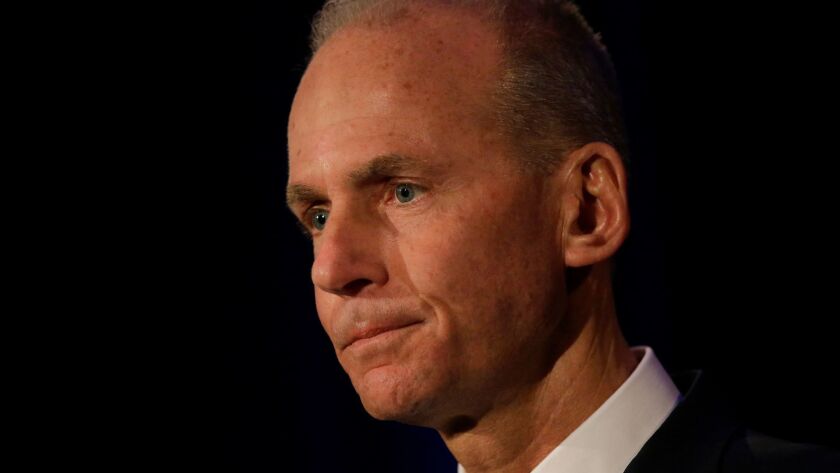
Boeing Co Chief Executive
Dennis Muilenburg speaks during a news conference at the annual shareholder
meeting in Chicago, Illinois, U.S., April 29, 2019.
"We know we made mistakes and got some things wrong. We own that, and we
are fixing them. We have developed improvements to the 737 MAX to ensure that
accidents like these never happen again," Muilenburg is expected to say,
according to remarks prepared ahead of Tuesday's hearing.
John Hamilton, Vice President and Chief Engineer for Boeing's Commercial
Airplanes, who served as the company's President of Engineering at the time of
the crashes, is also slated to testify during both hearings.
'Erroneous signals'
Mulienburg will be tasked with balancing testimony that assures global
regulators, victims' families, its customers, and the flying public that the
company's proposed Max changes are aggressive enough to avoid future risks
associated with the aircraft's design, yet insignificant enough to trigger the
imposition of additional liability on the company. Lawmakers are reportedly
prepared to question whether Boeing was aware of risks associated with the
Max's Maneuvering Characteristics Augmentation System, or MCAS system. They
will also ask whether employees felt pressure to skirt safety enhancements in
efforts to get the plane to market quickly.
"We know that both accidents involved the repeated activation of a flight
control software function called MCAS, which responded to erroneous signals
from a sensor that measures the airplane's angle of attack," Muilenburg's
prepared remarks say.

Aerial photos showing
Boeing 737 Max airplanes parked at Boeing Field in Seattle, Washington, U.S.
October 20, 2019. Picture taken October 20, 2019.
Lawmakers questioning the executives will be armed with recently released
investigative reports issued by U.S. and international regulators. The reports
place varying degrees of fault on the plane manufacturer.
Indonesian officials who examined the Lion Air crash placed blame on Boeing,
the F.A.A., and a Florida-based parts supplier, as well as Lion Air flight and
maintenance crews. A group of international regulators from the U.S., Canada,
the European Union, Australia, Japan, Brazil, Singapore, China, Indonesia, and
United Arab Emirates, tasked with examining only the Federal Aviation
Administration's (FAA) certification process, concluded the process should
ensure fail-safe design principles that minimize reliance on pilot action as a
primary means of risk mitigation. The National Transportation Safety Board
(NTSB) found that the accident pilots' responses to MCAS were inconsistent with
Boeing's assumptions, and recommended tools to effectively alert pilots to
airplane failures to improve response timeliness.
'A race to the bottom'
Former cockpit designer, NTSB investigator, and F.A.A. Human Performance
Program Scientist, Dr.
Alan Diehl, told Yahoo Finance the certification process
started to decline in effectiveness 40 years ago when Congress deregulated the
airline industry.
"In 1978, the Congress in this country deregulated the airlines, and what
that meant was that fairly quickly, people who were going to be in the
business, whether it was the airlines or the manufacturers, realized that was
going to be a bottom line endeavor," Diehl told Yahoo Finance. "This
was a race to the bottom to try to deliver the cheapest products and services
that we can."
One of the first things that happened under deregulation, Diehl said, was to
promote automation systems that would permit the operation of heavier aircraft
with two, rather than three, pilots. To save on costs, automation became
increasingly important to manufacturers so that cockpits could be designed to
eliminate the flight engineer, or third pilot, he said. A commission to study
the issue, empaneled by President Ronald Reagan, published findings concluding
that two-pilot cockpits were as safe as those with three.
"Automation can be very beneficial from a safety standpoint, but you know
it's a two edged sword," Diehl
said. "You need to be very careful to examine both the system safety
issues, and ergonomic issues when we're certifying these aircraft."

Founder of Lion Air Group
Rusdi Kirana walks with Indonesia's Transport Minister Budi Karya Sumadi and
Indonesia's Coordinating Minister of Economic Affairs Darmin Nasution, as they
inspect the facilities of Batam Aero Technic (BAT) at Hang Nadim International
airport in Batam island, Indonesia, August 14, 2019
As a result of the 737 Max crashes, Boeing agreed to modify all Max planes in
order to change the way its MCAS operates. During the two fatal flights the
system processed and acted upon errant sensor data, that in turn automatically
pushed the nose of the plane down. The system was installed on the Max to prevent
engine stalls. In theory, the system would counteract a change in the plane's
center of gravity caused by Boeing's decision to design the plane with larger
engines placed farther forward on the fuselage than on previous 737s. The
system was activated in both the Lion Air crash as well as the crash of
Ethiopian Airlines Flight 302, approximately five months later.
Boeing said to date it had flown more than 814 test flights with the updated
software, and conducted "numerous" simulator sessions with 545 participants
from 99 customers and 41 global regulators.
Max planes were grounded by the FAA on March 13 following an Ethiopian Airlines
crash. Shortly after takeoff from Jakarta, Indonesia, on October 29, Lion Air
Flight 610 crashed into the Java Sea. Ethiopian Airlines Flight 302 crashed
shortly after takeoff from Addis Ababa, Ethiopia, on March 10.
In a press release on Monday, Boeing said it had made "robust"
improvements to the Max flight control software, including a system that will
now compare information from two, rather than one sensor, before activating,
and activate only once, and only when both sensors agree. In addition, an
override of MCAS will occur when a pilot takes control.
"These changes will prevent the flight control conditions that occurred on
the Lion Air 610 and Ethiopian Airlines 302 flights from ever happening
again," the company said in a press release Monday. On its website
Tuesday, Boeing recognized the Lion Air crash anniversary and the Ethiopian
crash. "We mourn those whose lives were lost on Lion Air Flight 610 and
Ethiopian Airlines Flight 302 and offer our deepest sympathies to their
families and friends. We will always remember," Boeing stated.
Boeing has continued to express its target date for returning the Max to service
by the end of the year. However, all U.S. airlines have either pushed their
scheduled Max service into 2020, or declined to commit to a date.
In its third quarter earnings for the period ending September 30, Boeing
reported the accumulation of an additional $900 million in costs due to
grounding of the aircraft. The Max has been grounded worldwide since March 13.
The added expense brought Boeing's total costs associated with the grounding to
$9.2 billion.
Aviation
Safety Bill Targets Challenges Posed by Flight Automation
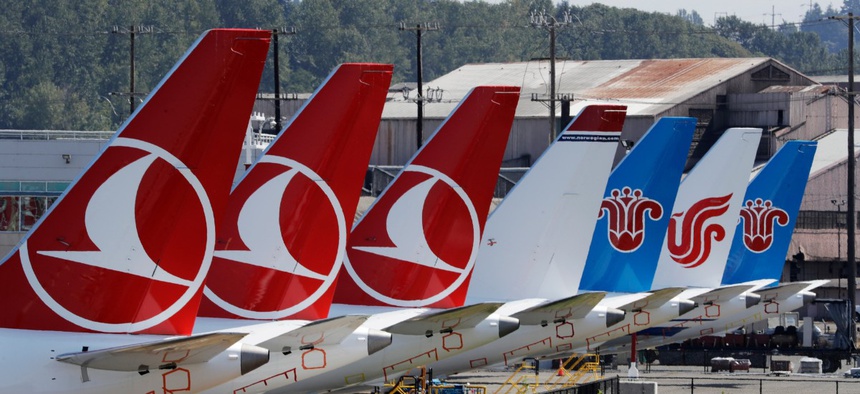
The tails of several of
the dozens of grounded Boeing 737 MAX airplanes line the edge of a parking area
adjacent to Boeing Field Aug. 15 in Seattle.
It comes on the heels of two tragic commercial aircraft crashes that killed 346
in the last year.
Two senators penned legislation to directly address challenges around the
automated systems that contributed to two separate crashes of Boeing 737 Max 8
aircraft that occurred over the last year, killing hundreds and grounding Max
flights indefinitely.
The Aviation Automation and Human Factors Safety Act of 2019, introduced Thursday
by Sens. Maria Cantwell, D-Wash., and Tammy Duckworth, D-Ill., aims to
establish a Federal Aviation Administration Center of Excellence dedicated to
addressing dangers posed by increased automation and pilot response and also
implements new and old aviation safety recommendations targeting flight
automatics.
"As we continue to learn more from the multiple investigations into Lion
Air Flight 610 and Ethiopian Airlines Flight 302, clear opportunities to
improve aviation safety and protect the traveling public have emerged,"
Duckworth said in a statement. "We have a solemn obligation to the
families of the 346 individuals who lost their lives to learn the lessons of
these tragedies and prevent such events from ever occurring again."
Last October, Lion Air Flight 610 plummeted into the Java Sea, minutes after
taking off from Jakarta, Indonesia. In March, Ethiopian Airlines Flight 302
also crashed shortly after takeoff. Everyone on board both flights perished in
the crashes. Black box data from both aircraft suggests that the deadly
incidents were partially due to a newly introduced automated system, known as
the Maneuvering Characteristics Augmentation System, or MCAS, which many pilots
struggled with or knew little about when the crashes occurred.
In September, the National Transportation Safety Board published seven safety
recommendations informed by its investigation of both incidents. Cantwell and
Duckworth's act would mandate the FAA's implementation of the board's
recommendations. The bill would improve safety assessments and incorporate
design enhancements to boost pilots' understanding and ability to work with
automated systems and components on all Boeing 737 Max aircraft, specifically,
as well as other transport-category airplanes. The aim is "to minimize the
potential for, and safety impact of, pilot actions that are inconsistent with
manufacturer assumptions."
The legislation also calls for the development of tools and methods that use
insights from industry and human factors experts to improve the validation of
pilots' assumptions using the technology, as well as diagnostic tools to help
accelerate pilot responses when systems fail. On top of NTSB's suggestions, it
also seeks to implement recommendations from the Transportation Department Inspector
General's 2016 report aimed at reducing dangers associated with the increased
use of flight deck automation.
If passed, the aviation safety act would also institute the creation of an FAA
Center of Excellence to be "focused on flight automation and human factors
in commercial aircraft." The center could receive appropriated funds that
the FAA administrator deems necessary. It would be tasked with enhancing
collaboration across the government, academia and the commercial aircraft and
airline industries and also lay out research goals in areas relating to the
increased reliance on automation in commercial aircraft.
The bill also mandates the establishment of safety management systems for
aircraft manufacturers. Cantwell noted that she'll consider additional
legislation, based on her ongoing review of forthcoming recommendations from
those investigating the crashes.
"As aviation systems become increasingly complex and rely more on
automation, our manufacturers and federal regulators need to remain on the
cutting edge of innovation to keep travelers safe." Cantwell said.
"The flying public deserve nothing less."
Cantwell serves as ranking member on the Senate Commerce Committee, which, on
Tuesday is asking Boeing's CEO about the two crashes.
Back to Top
|