onsdag 30. oktober 2019

X-37B tilbake etter nær to år i rommet - AVweb

X-37B Comes Home After Two-Year Mission

0


The U.S. Air Force’s unmanned X-37B Orbital Test Vehicle successfully completed its fifth mission on Sunday, landing at NASA’s Kennedy Space Center Shuttle Landing Facility after 780 days in orbit. The X-37B was launched on Sept. 7, 2017, from Cape Canaveral Air Force Station, Florida, onboard a Space X Falcon 9 booster. The longest the vehicle, which was originally built for a 270-day duration, had previously spent in orbit was 718 days.
“This program continues to push the envelope as the world’s only reusable space vehicle,” said Air Force Rapid Capabilities Office director Randy Walden. “With a successful landing [on Sunday], the X-37B completed its longest flight to date and successfully completed all mission objectives. This mission successfully hosted Air Force Research Laboratory experiments, among others, as well as providing a ride for small satellites.”
Since its first launch in April 2010, the X-37B test program has logged a total of 2,865 days in orbit. According to the Air Force, the program is designed to perform “risk reduction, experimentation and concept of operations development for reusable space vehicle technologies.” A sixth mission for the X-37B is planned for 2020.

GA - Autoland for småfly - Garmin video - AVweb


Garmin Announces Emergency Autoland


0
 
Garmin says it is forever changing aviation with its Emergency Autoland system, which is the third layer of autonomous automation in the Autonomi suite that’s built into the G3000 integrated flight deck. In an emergency the pilot and passengers can engage Autoland with a single button push (or the system will activate itself if it senses the pilot has checked out), it determines the most optimal airport and runway, flies a precision GPS approach and landing to that runway all while taking into account weather, terrain, obstacles and aircraft performance capabilities.

That’s an Autoland-equipped G3000 suite in the 2020 Piper M600 SLS turboprop single.

Once activated, other factors taken into consideration when identifying the most suitable field (with a hard surface and a GPS approach with vertical guidance) include runway length and the amount of fuel onboard, plus it communicates the emergency on the appropriate ATC or Unicom facility. The system is only intended for use during an emergency—pilot incapacitation, as one example—and it can be disconnected at any time with the autopilot disengage switch.
So passengers don’t have to sift through all that data that’s usually shown on the G3000 flight displays, Autoland provides simple on-screen visual cues and verbally communicates the intentions even advising how to talk on the radio should they want to, and how to operate the cabin door once the system has the airplane and the engine stopped. The automation—which includes autothrottle—automatically controls the cabin pressurization system, the flaps, the landing gear and has automatic braking.

The MFD in the G3000 switches to plain-language mode when Autoland is activated.

If the aircraft needs additional time to properly commence the instrument approach to landing, Autoland automatically climbs and it can fly a standard holding pattern, while the autothrottle manages speed and altitude. Once on the runway, automatic braking is applied and the system tracks the runway centerline while bringing the aircraft to a stop.
Garmin’s Autonomi includes autopilot-based functionality including Electronic Stability and Protection (ESP), Emergency Descent Mode (EDM) and now the third layer, which is Emergency Autoland. Garmin says the Autoland will soon be available as part of the G3000 flight deck on the Piper M600 SLS and also on the Cirrus Vision Jet models for 2020. At press time, both are pending final FAA certification, and the system will be blanketed under the specific aircraft’s type certification. Click the link below for an exclusive flight demo video of the Autoland in a 2020 Piper M600 from sister publication Aviation Consumer magazine.


Elfly - Kina med 4-seter - Curt lewis

China Successfully Flies First 4-Seat Electric Aircraft


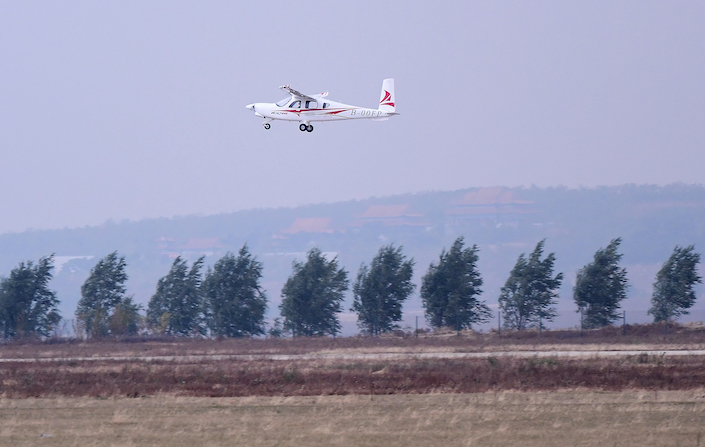
China successfully flew its first four-seat electric aircraft in the northeastern city of Shenyang, Xinhua News Agency reported. The maiden flight could help the country attain global leadership in battery-powered airplanes.

Named the RX4E, the electric airplane features a takeoff weight of 1,200 kilograms and is able to fly as far as 300 kilometers on a single charge. The flight range could be extended as battery technology improves. The flight took place just four days after China completed a test flight of its fifth C919 prototype plane.

The electric aircraft is powered by a 70 kWh battery to achieve larger power storage capacity, Xinhua reported. The plane is 77% made of lightweight and corrosion-resistant carbon materials.

"The RX4E aircraft has a great market space and prospect and will be used in short-distance transport, pilot training, sightseeing, aerial photography and aerial mapping," said Zhao Tienan, deputy head of Liaoning General Aviation Research Institute, which is developing the electric aircraft.


SAS med navigasjonsproblem - Curt Lewis


Incident: SAS B738 at Oslo on Oct 29th 2019, navigation system problem

A SAS Scandinavian Airlines Boeing 737-800, registration LN-RRJ performing flight SK-4675 from Oslo (Norway) to Alicante,SP (Spain), was climbing out of Oslo when the crew stopped the climb at FL290 and decided to return to Oslo due to a problem with one of the navigation systems. The aircraft entered a hold at FL100 and landed safely back in Oslo about 45 minutes after stopping the climb.

The aircraft remained on the ground for about one hour, then departed again and reached Alicante with a delay of about 2 hours.

The airline reported a technical problem related to the navigation system prompted the return to Oslo. A part was replaced, the passengers remained seated in the cabin, and the aircraft departed again.

MAX og Muilenburgs redegjørelse for kongressen - Og mye mer - Curt Lewis

Flight Safety Foundation Responds to Latest 737 MAX Hearings


ALEXANDRIA, Virginia — In a statement released today in response to the latest congressional hearing involving the Boeing 737 MAX grounding, Flight Safety Foundation President and CEO Dr. Hassan Shahidi said: “We commend Congress, the Federal Aviation Administration, Boeing, and the many airworthiness and accident investigation authorities for their rigorous review of these terrible tragedies. One thing is clear: The wonder of human flight can never be risk free, as those involved in designing, manufacturing, certifying, flying, and maintaining increasingly sophisticated aircraft cannot eliminate the prospect of human error. What we can and must do is apply lessons learned from these accidents and the resulting investigations and technical reviews to ensure the world’s safest form of transportation becomes even safer. What we cannot do is make airworthiness decisions based on politics or speculation, nor undermine the carefully built system of strong oversight, prudent delegation and reciprocal recognition in certification.”


Flight Safety Foundation is an independent, nonprofit, international organization engaged in research, education, advocacy and communications to improve aviation safety. The Foundation’s mission is to connect, influence and lead global aviation safety.

Boeing CEO tells Congress company knew of test pilot's 737 Max concerns


Boeing CEO Dennis Muilenburg told a congressional hearing Tuesday he was aware in early 2019, prior to the second deadly crash of the 737 Max last March, that a test pilot had raised questions about the safety of the jet. But Muilenburg said he was only told in the past few weeks of the details of the pilot's text messages and emails.

The messages, which date back to November 2016, were given to Department of Justice investigators in February, but were not released to the Federal Aviation Administration or other regulators until after the second 737 Max crash, months after their discovery. The messages also alluded to Boeing's possible efforts to hide safety concerns from the FAA other other regulators.

Senator Ted Cruz, a Republican of Texas, questioned why Boeing didn't flag the messages detailing the test pilot's concerns when Congress held meetings on the issue earlier this year.

"I was involved in the document collection process, but I relied on my team to get the documents to the appropriate authorities," Muilenburg testified Tuesday. "I didn't get the details of the conversation until recently."

Tuesday was the one-year anniversary of the first of two crashes involving Boeing 737 Max jets that killed a total of 346 people. Testifying to the Senate Commerce Committee, Muilenburg was repeatedly questioned about what Boeing knew about the safety issues of the 737 Max and when it knew of them.

The CEO told Congress the aircraft company knows it made mistakes and is throwing everything into fixing the jet. Muilenburg apologized numerous times to family members for the crash and said he had called the FAA to explain that the company's disclosure to regulators should have been better.

"We have learned and are still learning from these accidents," Muilenburg said. "We know we made mistakes and got some things wrong. We own that, and we are fixing them."

Senator Tammy Duckworth, a Democrat from Illinois, said Boeing has not told the truth to Congress. "You knew back in 2016 that this was happening," Duckworth said.

Senators also criticized how the FAA regulates aircraft safety. "We are committed to participating in reform efforts," Muilenburg said.

About a dozen family members of those lost in the two 737 Max crashes were seated in the third row behind Muilenburg. Prior to the meeting, family members were warned against displaying pictures of those who had died in the crashes.

As Muilenburg walked into the hearing, Nadia Milleron, the mother of Samya Stumo, loudly demanded the right to hold up a picture of the crash victims. Capitol police said the family members would be ejected and arrested if they did not comply with the Senate's rules.

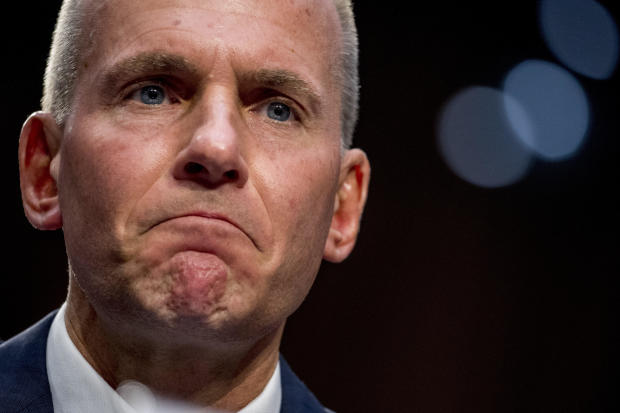
Standing before reporters shortly before the testimony, Muilenburg was much more reserved than in past statements about the Max crashes. He apologized to family members of the 346 people who died in the two crashes and said that he understood that the crashes happened on his watch.

Muilenburg said he didn't have knowledge of any plans by Boeing's board to force him to step aside when the problems with the 737 Max are fixed. But he said he was confident Boeing would be able to get the 737 Max, which has been grounded since mid-March, certified to fly again. Muilenburg has previously said it believes the planes could be ready to fly again by the end of the year.

"We have studied both crashes and we know what to fix," he said in a brief statement to reporters before addressing a Senate panel. "Once the Max returns to fly, it will be the safest airplane in the sky."

Roland Rehhorn and his wife Joan lost their 24-year-old daughter Angela in the Ethiopian Airlines crash. They told CBS News they didn't believe Muilenburg when he apologized. "If he's sorry, he would have resigned," Rehhorn said.

The couple brought their daughter's remains home from Africa just one week ago.

"It has torn me apart. Angela and I were so close," Rehhorn said.

Muilenburg will testify again on Wednesday before the House Transportation Committee.

The appearances in Washington, D.C., come as Boeing faces investigations by the Senate Commerce Committee and the House Transportation Committee as well as a criminal probe by the Justice Department. Boeing is also being sued by families of some of the 346 people who died in the crash of a Max off the coast of Indonesia on October 29, 2018, and another in Ethiopia on March 10, 2019.

In an exclusive interview with CBS News in May, Muilenburg apologized to the victims' families.

"I do personally apologize to the families, as I've mentioned earlier we feel terrible about these accidents, and we apologize for what happened, we are sorry for the loss of lives in both accidents," he said.

https://www.cbsnews.com/news/boeing-ceo-testimony-dennis-muilenburg-faces-congress-hearing-today-livestream-2019-10-29/

Back to Top


Senators grill Boeing CEO over 737 Max jet involved in 2 crashes


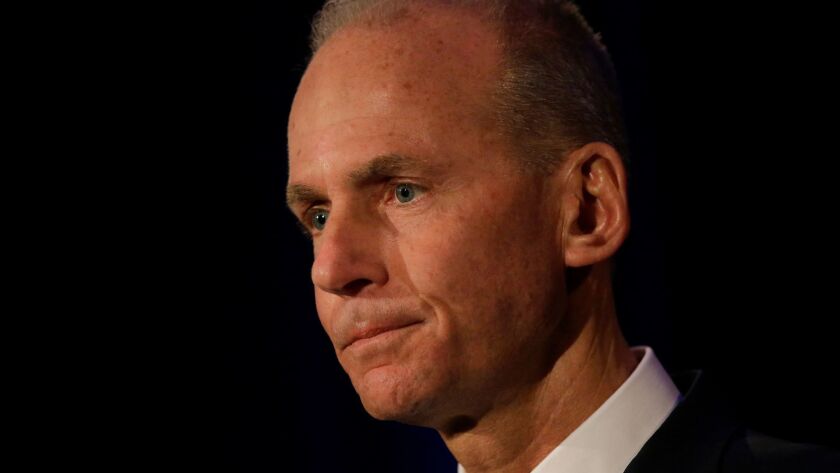
Boeing Chief Executive Dennis Muilenburg speaks at a news conference April 29 after the Boeing Annual General Meeting in Chicago.

Boeing CEO Dennis Muilenburg faced tough questioning from senators Tuesday about two crashes of 737 Max jets and whether the company concealed information about a critical flight system from regulators.

"We have made mistakes, and we got some things wrong," Muilenburg conceded.

Some members of the Senate Commerce Committee clashed with Muilenburg, cutting him off when they believed he was failing to answer their questions about a key flight-control system implicated in both crashes.

Boeing successfully lobbied regulators to keep any explanation of the system, called MCAS, from pilot manuals and training. After the crashes, the company tried to blame the pilots, said Sen. Richard Blumenthal (D-Conn.).

"Those pilots never had a chance," Blumenthal said. Passengers "never had a chance. They were in flying coffins as a result of Boeing deciding that it was going to conceal MCAS from the pilots."

Muilenburg denied that Boeing had ever blamed the pilots. He added that Boeing has always trained pilots to respond to the same effect caused by an MCAS failure - a condition called runaway trim - which can be caused by other problems.

The CEO and Boeing's chief engineer for commercial airplanes, John Hamilton, spent about 80 minutes at the witness table. The committee then heard from two safety officials who helped shape reports about the Boeing plane.

The hearing took place exactly one year after a 737 Max crashed off the coast of Indonesia and more than seven months after a second crash in Ethiopia. It was the first congressional testimony by a Boeing executive since the crashes, which together killed 346 people.

Indonesian investigators say Boeing's design of MCAS contributed to the crash of a Lion Air Max last October. Ethiopian authorities are continuing to investigate the second crash, involving a plane flown by Ethiopian Airlines, which led to a worldwide grounding of the plane.

"Both of these accidents were entirely preventable," said Committee Chairman Roger Wicker (R-Miss.).

More than a dozen relatives of passengers who died in the accidents attended the hearing. Wicker invited them to stand and hold up large photos of their relatives, which they had carried into the room. Muilenburg turned in his seat to look at them.

In Indonesia, the CEO of Lion Air vowed Tuesday to follow recommendations from a probe into the disaster. Relatives of victims scattered flowers on waters where the aircraft went down a year ago.

Muilenburg told senators that Boeing is in the final stages of updating flight software to improve safety by adding redundancy - tying MCAS to a second sensor and second computer at all times, and making the system's ability to push a plane's nose down less powerful.

Chicago-based Boeing hopes to win Federal Aviation Administration approval by year end to return the plane to flight. The FAA is also coming under scrutiny for relying on Boeing employees to perform some certification tests and inspections. It's an approach FAA has followed for many years.

"We need to know if Boeing and the FAA rushed to certify the Max," Wicker said.

The committee didn't get an answer to that question. Sen. Jon Tester (D-Mont.) indicated he won't wait for one, accusing Boeing of cutting corners on safety.

"I would walk before I was to get on a 737 Max," Tester told Muilenburg. "When issues like this happen, it costs your company huge."

Other senators seized on internal messages and emails from 2016 by a senior Boeing test pilot, who reported "egregious" problems while testing MCAS on a flight simulator and said he "unknowingly" lied to regulators. Boeing turned over the messages to the Justice Department early this year but didn't tell the FAA or Congress until this month.

Muilenburg said Boeing hasn't been able to question the test pilot, who now works for Southwest Airlines, "and we're not quite sure" what he meant in the messages. The CEO noted that the man's lawyer said he was describing problems with a simulator, not MCAS itself.

"That could be the case," Muilenburg said. "We don't know."

Sen. Ron Johnson (R-Wis.) asked why Boeing didn't ground the plane immediately after the first accident, when it knew that MCAS was involved. Why did it take another crash?

"We have asked that question over and over," Muilenburg said. "If we knew everything back then that we know now, we would have made a different decision."

https://www.latimes.com/business/story/2019-10-29/boeing-max-jet-ceo-congress

Back to Top


After Boeing crashes, jet design rules to get tougher for all

By Marcelo Rochabrun and Tim Hepher


BRASILIA/PARIS, Oct 29 (Reuters) - Planemakers worldwide face tougher scrutiny and changes in the way aircraft are certified in the aftermath of two fatal crashes of Boeing 737 MAX jets, leading regulators have told Reuters.

Tuesday marks one year since the deadly crash of a Lion Air jet, which Indonesian investigators linked in part to violent seesaw movements triggered by flawed anti-stall software.

The MCAS software, activated by a single faulty sensor and omitted from training manuals, has led to calls for tighter regulation as well as improvements in the training of pilots.

"The certification process will change; I think so," the head of the U.S. Federal Aviation Administration, Steve Dickson, told Reuters late on Monday at an airlines meeting in Brazil.

Boeing BA.N 737 MAX aircraft have been grounded around the world since March following a second fatal crash, this time involving a plane operated by Ethiopian Airlines.
Speaking to airlines earlier, Dickson also emphasized a need to raise standards for airplane pilot training globally.

A recent report by international regulators, commissioned by the FAA, faulted processes at both the U.S regulator and Boeing.

But the impact of the crisis is likely to be felt worldwide, including at Boeing's rival Airbus and new entrants from Russia to China and Japan, as regulators step up efforts to ensure that risks are correctly identified right from the drawing board.

"We are going to make it harder," Patrick Ky, executive director of the European Union Aviation Safety Agency (EASA), told Reuters when asked about the future of certification in general, without naming countries or companies.

"In the future we may ask to have a larger set of data which will be used in the certification case than today," he added.

In part, that will involve using new technology to run simulations to spot flaws that may be missed in flight testing.

But regulators are also expected to take a close look at one of the key tenets of aviation safety, an obscure piece of regulation known as the "Changed Product Rule".
Under this rule, manufacturers revamping an old design like the 737 only need to comply with latest regulations on systems undergoing major changes, which means risks must be understood.

For the rest of the aircraft, the original standards still apply, which in the case of the 737 date back to the 1960s.

That is no problem when risks are small, officials say.

But this month's international regulatory panel report said the rule did not adequately address the cumulative effects of individual changes on small systems.

"In general, the analysis was limited to areas that changed, re-using prior certification basis to complete the process," former Boeing engineer Peter Lemme wrote in a blog on Tuesday, citing a series of flawed assumptions used in the design.

BIG PICTURE
The Joint Authorities Technical Review (JATR) also found Boeing had missed the big picture by focusing on whether individual systems like MCAS complied with regulations, without also taking a top-down view of the impact on the whole aircraft.

Boeing's chief executive was due to tell a Senate committee on Tuesday that it made mistakes over the MAX.

It has also said it is committed to working with regulators in reviewing the recommendations in the JATR report.

One regulator told Reuters a review of the Changed Product Rule would be among the main changes stemming from the crisis.

That could have implications for airplane design after years in which global planemakers have focused on upgrading existing models before tackling costlier clean-sheet designs.
"There is nothing wrong with derivatives; it is just (a question of) how we certify with full confidence the way in which modifications are made from an existing type," Ky said.
Others say regulators are likely to check each other's homework more actively than in the past, while preserving a convention that allows the home regulator for each planemaker to take the lead, such as the FAA for Boeing or EASA for Airbus.

Safety officials don't expect this to lead to meddling by foreign regulators on routine design changes. But post-MAX, agencies are likely to be vigilant when the risks warrant it.

The JATR also broke with tradition by suggesting companies should design systems with an over-arching vision of safety in mind, not just ensure their work complied with regulations.

Some saw this as a rare rebuff to the decades-old framework of aviation safety, which depends on thousands of rules and regulations with its own United Nations agency to oversee them.

One engineer outside the United States voiced concern about the move, saying record-low accident rates demonstrated there was no conflict between compliance and safety. But the JATR said the process as it stood had not managed to identify every risk.

(Additional reporting by Jamie Freed, Eric M. Johnson, David Shepardson, Tracy Rucinski; Editing by Mark Potter)


'We know we made mistakes': Boeing CEO to face the Senate

On Tuesday, the one-year anniversary of the crash of Lion Air Flight 610, the first of two fatal crashes of Boeing's 737 Max, Boeing (BA) CEO Dennis Muilenburg is scheduled to testify before the Senate Commerce, Science, and Transportation Committee concerning the company's design, development, and certification of the aircraft.

It's one of two scheduled Congressional public hearings this week where Muilenburg will be in the in the hot seat. On Wednesday, members of the House of Representatives Transportation and Infrastructure Committee are scheduled to hold a hearing to question the CEO. Muilenburg previously turned down the House Committee's earlier invitation to testify.


Boeing Co Chief Executive Dennis Muilenburg speaks during a news conference at the annual shareholder meeting in Chicago, Illinois, U.S., April 29, 2019.

"We know we made mistakes and got some things wrong. We own that, and we are fixing them. We have developed improvements to the 737 MAX to ensure that accidents like these never happen again," Muilenburg is expected to say, according to remarks prepared ahead of Tuesday's hearing.

John Hamilton, Vice President and Chief Engineer for Boeing's Commercial Airplanes, who served as the company's President of Engineering at the time of the crashes, is also slated to testify during both hearings.

'Erroneous signals'
Mulienburg will be tasked with balancing testimony that assures global regulators, victims' families, its customers, and the flying public that the company's proposed Max changes are aggressive enough to avoid future risks associated with the aircraft's design, yet insignificant enough to trigger the imposition of additional liability on the company. Lawmakers are reportedly prepared to question whether Boeing was aware of risks associated with the Max's Maneuvering Characteristics Augmentation System, or MCAS system. They will also ask whether employees felt pressure to skirt safety enhancements in efforts to get the plane to market quickly.

"We know that both accidents involved the repeated activation of a flight control software function called MCAS, which responded to erroneous signals from a sensor that measures the airplane's angle of attack," Muilenburg's prepared remarks say.


Aerial photos showing Boeing 737 Max airplanes parked at Boeing Field in Seattle, Washington, U.S. October 20, 2019. Picture taken October 20, 2019.

Lawmakers questioning the executives will be armed with recently released investigative reports issued by U.S. and international regulators. The reports place varying degrees of fault on the plane manufacturer.

Indonesian officials who examined the Lion Air crash placed blame on Boeing, the F.A.A., and a Florida-based parts supplier, as well as Lion Air flight and maintenance crews. A group of international regulators from the U.S., Canada, the European Union, Australia, Japan, Brazil, Singapore, China, Indonesia, and United Arab Emirates, tasked with examining only the Federal Aviation Administration's (FAA) certification process, concluded the process should ensure fail-safe design principles that minimize reliance on pilot action as a primary means of risk mitigation. The National Transportation Safety Board (NTSB) found that the accident pilots' responses to MCAS were inconsistent with Boeing's assumptions, and recommended tools to effectively alert pilots to airplane failures to improve response timeliness.

'A race to the bottom'
Former cockpit designer, NTSB investigator, and F.A.A. Human Performance Program Scientist, Dr. Alan Diehl, told Yahoo Finance the certification process started to decline in effectiveness 40 years ago when Congress deregulated the airline industry.

"In 1978, the Congress in this country deregulated the airlines, and what that meant was that fairly quickly, people who were going to be in the business, whether it was the airlines or the manufacturers, realized that was going to be a bottom line endeavor," Diehl told Yahoo Finance. "This was a race to the bottom to try to deliver the cheapest products and services that we can."

One of the first things that happened under deregulation, Diehl said, was to promote automation systems that would permit the operation of heavier aircraft with two, rather than three, pilots. To save on costs, automation became increasingly important to manufacturers so that cockpits could be designed to eliminate the flight engineer, or third pilot, he said. A commission to study the issue, empaneled by President Ronald Reagan, published findings concluding that two-pilot cockpits were as safe as those with three.

"Automation can be very beneficial from a safety standpoint, but you know it's a two edged sword," Diehl said. "You need to be very careful to examine both the system safety issues, and ergonomic issues when we're certifying these aircraft."


Founder of Lion Air Group Rusdi Kirana walks with Indonesia's Transport Minister Budi Karya Sumadi and Indonesia's Coordinating Minister of Economic Affairs Darmin Nasution, as they inspect the facilities of Batam Aero Technic (BAT) at Hang Nadim International airport in Batam island, Indonesia, August 14, 2019

As a result of the 737 Max crashes, Boeing agreed to modify all Max planes in order to change the way its MCAS operates. During the two fatal flights the system processed and acted upon errant sensor data, that in turn automatically pushed the nose of the plane down. The system was installed on the Max to prevent engine stalls. In theory, the system would counteract a change in the plane's center of gravity caused by Boeing's decision to design the plane with larger engines placed farther forward on the fuselage than on previous 737s. The system was activated in both the Lion Air crash as well as the crash of Ethiopian Airlines Flight 302, approximately five months later.

Boeing said to date it had flown more than 814 test flights with the updated software, and conducted "numerous" simulator sessions with 545 participants from 99 customers and 41 global regulators.

Max planes were grounded by the FAA on March 13 following an Ethiopian Airlines crash. Shortly after takeoff from Jakarta, Indonesia, on October 29, Lion Air Flight 610 crashed into the Java Sea. Ethiopian Airlines Flight 302 crashed shortly after takeoff from Addis Ababa, Ethiopia, on March 10.

In a press release on Monday, Boeing said it had made "robust" improvements to the Max flight control software, including a system that will now compare information from two, rather than one sensor, before activating, and activate only once, and only when both sensors agree. In addition, an override of MCAS will occur when a pilot takes control.

"These changes will prevent the flight control conditions that occurred on the Lion Air 610 and Ethiopian Airlines 302 flights from ever happening again," the company said in a press release Monday. On its website Tuesday, Boeing recognized the Lion Air crash anniversary and the Ethiopian crash. "We mourn those whose lives were lost on Lion Air Flight 610 and Ethiopian Airlines Flight 302 and offer our deepest sympathies to their families and friends. We will always remember," Boeing stated.

Boeing has continued to express its target date for returning the Max to service by the end of the year. However, all U.S. airlines have either pushed their scheduled Max service into 2020, or declined to commit to a date.

In its third quarter earnings for the period ending September 30, Boeing reported the accumulation of an additional $900 million in costs due to grounding of the aircraft. The Max has been grounded worldwide since March 13. The added expense brought Boeing's total costs associated with the grounding to $9.2 billion.

Aviation Safety Bill Targets Challenges Posed by Flight Automation
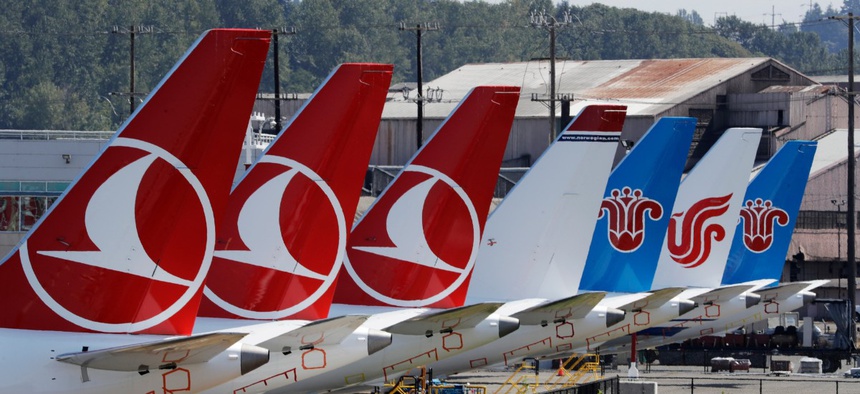

The tails of several of the dozens of grounded Boeing 737 MAX airplanes line the edge of a parking area adjacent to Boeing Field Aug. 15 in Seattle.

It comes on the heels of two tragic commercial aircraft crashes that killed 346 in the last year.

Two senators penned legislation to directly address challenges around the automated systems that contributed to two separate crashes of Boeing 737 Max 8 aircraft that occurred over the last year, killing hundreds and grounding Max flights indefinitely.

The Aviation Automation and Human Factors Safety Act of 2019, introduced Thursday by Sens. Maria Cantwell, D-Wash., and Tammy Duckworth, D-Ill., aims to establish a Federal Aviation Administration Center of Excellence dedicated to addressing dangers posed by increased automation and pilot response and also implements new and old aviation safety recommendations targeting flight automatics.

"As we continue to learn more from the multiple investigations into Lion Air Flight 610 and Ethiopian Airlines Flight 302, clear opportunities to improve aviation safety and protect the traveling public have emerged," Duckworth said in a statement. "We have a solemn obligation to the families of the 346 individuals who lost their lives to learn the lessons of these tragedies and prevent such events from ever occurring again."

Last October, Lion Air Flight 610 plummeted into the Java Sea, minutes after taking off from Jakarta, Indonesia. In March, Ethiopian Airlines Flight 302 also crashed shortly after takeoff. Everyone on board both flights perished in the crashes. Black box data from both aircraft suggests that the deadly incidents were partially due to a newly introduced automated system, known as the Maneuvering Characteristics Augmentation System, or MCAS, which many pilots struggled with or knew little about when the crashes occurred.

In September, the National Transportation Safety Board published seven safety recommendations informed by its investigation of both incidents. Cantwell and Duckworth's act would mandate the FAA's implementation of the board's recommendations. The bill would improve safety assessments and incorporate design enhancements to boost pilots' understanding and ability to work with automated systems and components on all Boeing 737 Max aircraft, specifically, as well as other transport-category airplanes. The aim is "to minimize the potential for, and safety impact of, pilot actions that are inconsistent with manufacturer assumptions."

The legislation also calls for the development of tools and methods that use insights from industry and human factors experts to improve the validation of pilots' assumptions using the technology, as well as diagnostic tools to help accelerate pilot responses when systems fail. On top of NTSB's suggestions, it also seeks to implement recommendations from the Transportation Department Inspector General's 2016 report aimed at reducing dangers associated with the increased use of flight deck automation.

If passed, the aviation safety act would also institute the creation of an FAA Center of Excellence to be "focused on flight automation and human factors in commercial aircraft." The center could receive appropriated funds that the FAA administrator deems necessary. It would be tasked with enhancing collaboration across the government, academia and the commercial aircraft and airline industries and also lay out research goals in areas relating to the increased reliance on automation in commercial aircraft.

The bill also mandates the establishment of safety management systems for aircraft manufacturers. Cantwell noted that she'll consider additional legislation, based on her ongoing review of forthcoming recommendations from those investigating the crashes.

"As aviation systems become increasingly complex and rely more on automation, our manufacturers and federal regulators need to remain on the cutting edge of innovation to keep travelers safe." Cantwell said. "The flying public deserve nothing less."

Cantwell serves as ranking member on the Senate Commerce Committee, which, on Tuesday is asking Boeing's CEO about the two crashes.


Back to Top


Nordflåtens undervannsstyrke demonstrerer sin slagkraft - Barents Observer


Akula-class nuclear-powered submarine. Photo: Thomas Nilsen
Russian subs honing stealth skills in major North Atlantic drill, says Norwegian intel
At least eight nuclear-powered submarines sailed out from their homeports on the Kola Peninsula last week, the Norwegian military intelligence says to NRK.
By
75968
October 29, 2019
The aim of the massive operation is to get as far out to the North Atlantic as possible without being discovered by NATO, the intelligence service informs to NRK. Such maneuvers haven’t been seen from the Northern Fleet since the days of the Cold War.
The operation started early last week, before Russia’s Foreign Minister Sergey Lavrov and Commander of the Northern Fleet, Vice-Admiral Aleksandr Moiseyev visited Kirkenes in northern Norway last Friday.
Lavrov had bilateral talks with his Norwegian counterpart Ine Eriksen Søreide and the two said at the following press conference that security situation in northern Europe was one talking point.

Sergey Lavrov and Ine Eriksen Søreide at the joint press conference in Kirkenes last Friday. Photo: Thomas Nilsen
On Saturday, the Barents Observer reported about two of the Sierra-class submarines of the Northern Fleet sailing towards the Norwegian Sea for deep-sea dive tests and weapon tests. The two submarines are the «Pskov» and «Nizhny Novgorod», both built with a titanium-hull.
Eight of the ten submarines now at sea are nuclear-powered, the intelligence service says to NRK.
The intelligence service claim to have «a decent control» over where the submarines are in the sea.
·         Two nuclear submarines are west of the Bear Island, between Svalbard and Finnmark, the northernmost part of mainland Norway.
·         Two submarines are south and east of the Bear Island, guarding the entrance to the eastern part of the Barents Sea.
·         Two Sierra-class nuclear submarines are training in the northern part of the Norwegian Sea.

Bjørnøya (Bear Island) is halfway between mainland Norway and Svalbard. Photo: Thomas Nilsen
Normally, the ballistic missile submarines are patrolling the eastern Barents Sea or under the ice-cap in the Arctic.
It is known that the Delta-IV class sub «Karelia» on October 17th launched a ballistic missile from the Barents Sea as part of the annual large-scale strategic missile drill, as reported by the Barents Observer. 

Russian Delta-IV submarine in the Barents Sea. Photo: Thomas Nilsen

NRK reports that the operation is supposed to last for 60 days. If so, the submarines will be back in port before New Years celebrations and the Russian Orthodox Christmas.
The Norwegian intelligence service informs to NRK that Russia with the operation is aimed at showing the United States that the country is able to threaten the east coast by protecting the bastion in such a way that the ballistic missile submarines can launch nukes targeted at the USA.
Russia wants to test NATO’s ability to discover and handle such operation, the intelligence service tells NRK.

Commander of the Russian Northern Fleet Vice-Admiral Aleksandr Moiseyev (left) and Norway’s Chief of Defense Admiral Haakon Bruun-Hanssen in Kirkenes on October 25th. Photo: Thomas Nilsen

Uregjerlige passasjerer - SAS med 1000 tilfeller i året - Check-In

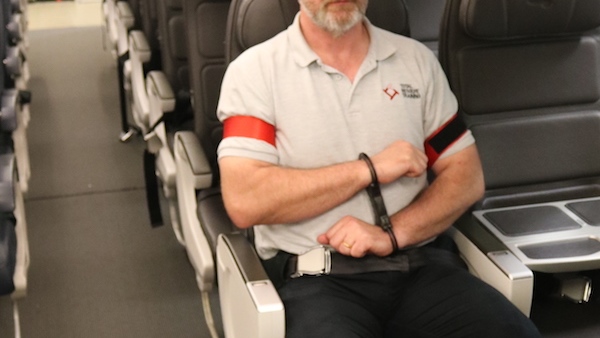
FNogle passagerer kan blive så voldsomme, at det er nødvendigt for flyselskaberne at fastspænde dem undervejs. (Foto: Total Resolve | PR)

1.000 uregerlige SAS-passagerer om året

De såkaldte uregerlige passagerer er et stigende problem for flyselskaberne, og SAS skærper nu indsatsen ved at udlevere foldere til passagererne.
Det hører ikke længere til sjældenhederne, at flyselskaberne ufrivilligt må sætte passagerer af undervejs på grund af episoder, der er med til at skabe utryghed for både flypersonale og passagerer.