fredag 29. oktober 2021

Hvilket fly flyr den første kommersielle ruten? - El eller hydrogen? - Cranfield er på jobben - FINN


Cranfield Aerospace aiming for world-first zero emission aircraft conversion by 2025

October 27, 2021

Sjekk video her: https://tinyurl.com/79vn835s 

A hydrogen-powered aircraft converted by Cranfield Aerospace Solutions’ (CAeS) could make its first commercial flights by 2025.

CAeS is leading a consortium backed by the UK government funding from the Aerospace Technology Institute to create a hydrogen propulsion system fuel cell system for a nine-seat Britten-Norman Islander which is currently being worked on in one of CAS’ hangars.

FINN spoke to chief strategy officer Jenny Kavanagh and CEO Paul Hunt the CEO to find out more about the project.

“The world’s first, truly green, certified aircraft for passenger service”

Kavanagh explained: “Essentially we’re going to be ripping out the conventional engines and replacing them with a fuel cell electric motor and gaseous hydrogen tanks. The end goal is to create the world’s first, truly green, certified aircraft for passenger service by 2025.”

The company has focused on hydrogen as opposed to full battery electric due to extend flight durations. “We…very quickly came to the conclusion that even with optimistic battery energy densities, you’re not going to get much more than 30 minutes flight time with this aircraft, which doesn’t even meet minimum diversion requirements,” added Kavanagh.

Hydrogen propulsion – better for revenue purposes

“We quickly went to hybrid electric, which could get the range and under certain circumstances even reduce carbon emissions. We, again, came to the realisation that for two very, very strong reasons that wasn’t going to cut it either: one being that utilisation is incredibly important to operators, especially the smaller ones, so the more sectors that you can get crammed into a day the better for revenue purposes.”

“If you’re having to recharge your batteries in between flights, that’s not going to work for them and, secondly if this industry is going to get to net zero by 2050, you have to just stop emitting carbon. Hydrogen very, very quickly became the only credible technology to consider.”

Britten-Norman Islander: “commercially viable” first aircraft

Paul Hunt explained the choice of aircraft for the project as “a very commercially viable first step”. He said the aircraft was well-liked by operators who typically used it for “short hops.” He added that the aircraft choice matched the maturity of the technology at the current point in time and described the project’s phased approach: “Once you’ve done that, the quickest way to get to commercial fair paying passengers in a fully certified zero emissions aircraft. We can then, in phase two of our programme, scale that up. At that point, that would probably be a 19-seat sized aircraft still fairly small, but scaling up the power requirement, but at the same time importantly moving to, most likely, liquid hydrogen to give the range needed that the larger aircraft are typically used for.”

“By the end of phase two, we’ll have a propulsion system fully certified and that’s a technical, but manageable, challenge. Phase three, we can then say ‘Well now is the time to optimise an aircraft design,’ 19 seat, or around about that sort of size to wrap that optimized design around the certified propulsion system.”
Net zero ambitions – more likely to be achieved via conversions

Hunt said ambitions to achieve net zero by 2050 were more likely to be met through conversion of existing aircraft rather than redesigning new ones. He explained: “We feel that there’s an urgency to what needs to be done here in greening aviation. The quickest way is converting, we know that, we’ve been around for 30 years in the aerospace industry working with the regulator. We understand if you want to get things done quickly, if you go with a whole new aircraft and a whole new propulsion system, you’re creating a hugely complex hurdle to get over with the regulator, so speed
means go for a conversion. But, ultimately, to optimise the solution, you need to get both the propulsion system and the aircraft designed together and, from our point of view as a company,
aspiring to design and manufacture aircraft, it just makes sense to de-risk it and move it into stages.”

Certification and hydrogen supply will be among biggest challenges

One of the biggest challenges for the project will be certification, with the ambition of getting the aircraft ready to fly commercial passengers by 2025. Kavanagh said Cranfield had been dealing with regulators for nearly 30 years and knew that the approach would be to approach the issue with understanding of their issues. The project has been undertaken through an innovation hub. “Essentially we are having to learn along with them and to some extent they’re learning from us as well,” she added.

Getting hydrogen to aircraft operators in both remote parts of the UK and the rest of the world is likely to be another challenge, although Kavanagh explained the process would both power aviation and could power other industries. She said work to explore the benefits of hydrogen production was already ongoing in Scotland, the Isle of Wight, among other areas.

She explained: “I’m not going to say it’s simple, because any new fuel supply is not simple, but the beauty of green hydrogen, especially gaseous hydrogen, is that there is a relatively simple process by which you can have a wind turbine or solar panels and create renewable electricity that you can then convert into hydrogen “

“It has two-fold advantages: one, the hydrogen acts as a storage for any excess electricity that you can then use to turn back into electricity when you need it, or it can be used as a fuel for local ground transportation or indeed for aviation as well.”


Drone - MQ-4C Triton oppgradert med ny konfigurasjon - Defenseworld.net


MQ-4C Triton Drone Completes First Flight in Multi-Intelligence Configuration


MQ-4C Triton drone

An MQ-4C Triton drone finished its first flight in the highly upgraded multi-intelligence configuration known as integrated functional capability four (IFC-4).

Triton is the U.S. Navy’s premier high-altitude, long-endurance (HALE), maritime intelligence, surveillance and reconnaissance (ISR) platform. It is designed and manufactured by Northrop Grumman.

The multi-intelligence configuration of Triton will completely revolutionize how the U.S. Navy and Royal Australian Air Force conduct maritime patrol and reconnaissance missions,” said Doug Shaffer, vice president and program manager, Triton programs, Northrop Grumman. “Multi-intelligence capabilitiies, coupled with Triton’s long-range sensors and 24-hour endurance, will enable an unprecedented amount of maritime situational awareness to inform real-time decision making at tactical to strategic levels.”

Northrop Grumman is working closely with the Navy to progress Triton toward initial operating capability (IOC) and world-wide deployments. The multi-intelligence configuration will also enable the Navy to retire the EP-3E Aries as Triton will be able to assume the intelligence collection missions currently conducted by the Aries.

This hugely important milestone for our Triton Multi-INT program is the culmination of over five years of intense engineering, integration and test, and represents the efforts of the hundreds of team members who have worked so tirelessly to achieve this Herculean task,” said Capt. Dan Mackin, Persistent Maritime Unmanned Aircraft Systems program manager. “The Multi-INT capability that the U.S. Navy and Royal Australian Air Force have procured through Northrop Grumman, our Naval Warfare Centers and our GFE partners is like no other – 360 degree AESA maritime radar, full-motion EO/IR video streaming, high-altitude, long-endurance, full-spectrum signals intelligence and the pipes to send multiple data types to ships, aircraft and intelligence community ground stations allow our forces to hold adversaries at risk and protect the peace which is so vital to our national interest.”

The U.S. Navy is currently operating two Tritons in the Pacific region in the baseline configuration as part of an early operational capability deployment. The Triton program expects to achieve IOC in 2023, and the Navy will eventually maintain five 24/7 operational orbits with a planned 68-aircraft program of record.


Tyrkia, S-400 og F-35 - Defenseworld.net


Det nye for undertegnede er, i følge Erdogan,  at Tyrkia har betalt et forskudd på 1,4 milliarder dollar for fly de ikke fikk. I skrivende stund ser det ut til at Tyrkia vender seg mot Russland for kjøp av fly, håndvåpen og ubåter. (Red.)


U.S., Turkey Hold F-35 Dispute Resolution Meeting

  • Our Bureau
  • 10:31 AM, October 28, 2021
  • 561


    Lockheed Martin F-35A fighters

The U.S. and Turkey held another round of talks to resolve the dispute over the latter’s removal from the F-35 program for buying S-400 missile systems.

DoD Spokesman Lt. Col. Anton Semelroth said top Pentagon officials Andrew Winternitz and Melissa Benkert met a delegation from Turkey’s Defense Ministry on October 27 to conduct “dispute resolution discussions to address remaining issues resulting from Turkey's removal from the F-35 program, which was finalized on September 23."

"The meeting demonstrates the commitment of the U.S. government to conclude respectfully Turkey's prior involvement in the F-35 program," Semelroth said in a statement. "Discussions were productive, and the delegations plan to meet again in the coming months in Washington, D.C.," he added.

On Wednesday, Turkish President Recep Tayyip Erdogan said he will bring up the F-35 issue during his meeting with U.S. counterpart Joe Biden during the COP26 climate summit which starts this Sunday.

Turkey made $1.4 billion in payments for F-35 fighter jets, Erdogan pointed out, jets which the U.S. never delivered. "We need to discuss with them how this will be repaid to us," he said.

Erdogan earlier said the U.S. proposed the sale of F-16 fighter jets as compensation for Turkey's payment for the F-35s.

In a letter to Biden and U.S. Secretary of State Antony Blinken, 11 members of the House of Representatives cited "a profound sense of concern" over Turkey’s alleged purchase of 40 new Lockheed Martin F-16s and 80 F-16 modernization kits, a Reuters report said Wednesday. The U.S. lawmakers added that they were confident Congress would block any such exports.

Norsk Flygerforbund på Stortinget i går


…er på Stortinget i dag sammen med Norsk FlygerforbundJoBjørn Skatval og Katinka Sporsem for å møte Senterpartiets representanter i transportkomiteen. Tema: FOT-anbudet som nå er ute. Det haster med å rydde opp i bruk av underleverandører på FOT-rutene, slik vi ser den forrige regjeringen åpnet for på Florø. Vi møtte heldigvis stor forståelse!


Good Night


torsdag 28. oktober 2021

Boeing trenger å gi seg selv fighting spirit etter det dårlige regnskapet - Museum of Flight

Det skal sies at museet er verdt et besøk der det ligger ved Boeing Field sør for Seattle, hvor våre P-8A går inn i slutt/utstyrsfasen før de flys hjem via NAS Patuxent River. Museet har som utgangspunkt Red Barn, Boeings opprinnelige verksted og produksjonslokaler. (Red.)


Boeing's Big LRed Beaps

Published Oct 28, 2021 11:15:00 AM

[As appeared in the Fall 2021 issue of Aloft]

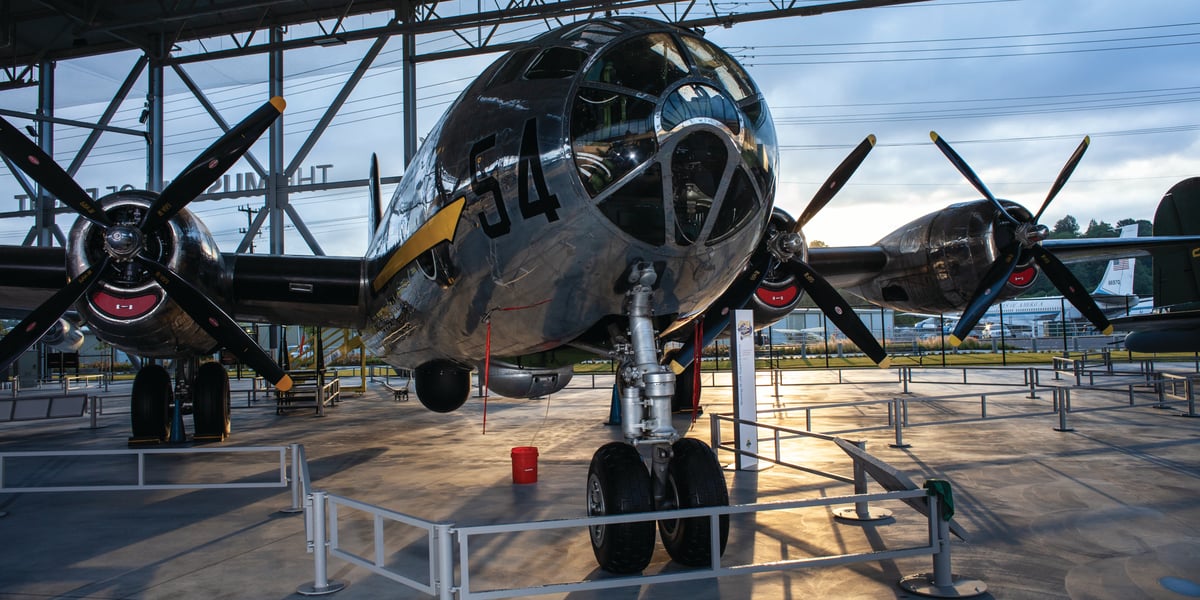
Before this issue went to press, I had the opportunity to tour the B-17 and B-29 in the Collection. I've been in B-17s before, but I had never stepped foot in a Superfortress. Have I mentioned that I love working at The Museum of Flight?

As I entered the nose of the B-29, what struck me immediately was how much room is in the cockpit. It is enormous compared to the Fortress. As Evan and I chatted about the aircraft, he said something that drove home the differences between the two planes. The B-17 was 1930s tech, while the B-29 was engineered in the 1940s, he said. That may not sound like much, but between the time the B-17 began flying and the B-29 entered service, aviation changed rapidly and the two planes were light years apart technologically.

The B-17 first flew on July 28, 1935. The big bomber, known as the Model 299, represented some of America's greatest technological advances in aviation. It was Boeing's first military aircraft with a flight deck instead of an open cockpit, had retractable landing gear, variable pitch propellers, sported five .30 caliber machine guns mounted in clear "blisters" and was fast—232 miles per hour fast. As the design matured, the armament increased to up to 13.50 caliber machine guns, the crew grew to 10 and it carried a bomb load of nearly 8,000 pounds for short-range missions. All that hardware came with a price; the last model, the B-17G, cruised at just 150 miles per hour.

However, the plane was cramped, unpressurized and drafty. In early model Forts, the waist gunners were subjected to bone-chilling temperatures from the open windows where their guns were mounted. They fired over open sights—only the top and ball turret gunners had optical sights. But it was still a reliable and rugged plane, and it was the mainstay of the American bombing campaign in Europe from 1942 until the end of the war.

The B-29 was another animal altogether. It made its first flight on September 21, 1942, and represented Boeing's innovation in aircraft design. The Superfortress was one of the most technologically advanced airplanes of World War II. Gone were the gunners wielding handheld machine guns. Now they used remote-controlled turrets guided by a computerized central fire control system. Two crew areas were pressurized, negating the need for the bulky shearling suits worn in B-17s and B-24s. And, despite having a maximum takeoff weight double than that of the B-17, the B-29 cruised at 220 miles per hour. Everything about the plane said, "leaps forward."

Now, here's the kicker. The B-29 came with a hefty price tag for all its innovations. It's estimated that the Superfortress design and development cost the United States three billion dollars, a billion more than the vaunted Manhattan Project that produced the world's first nuclear bomb. Stranger still, by 1950—just five years after the war's end—the B-29 was reclassified as a medium bomber by the Air Force! Aviation technology was making leaps yet again.

[Explore the Aloft archives at this link: https://bit.ly/3Bpti0x]

Airbus og Boeing med veldig forskjellige økonomiske resultater - Aviation24.be og Curt Lewis


Airbus reports nine-month 2021 results reflecting strong performance

By

 André Orban

28 October 2021

·         424 commercial aircraft delivered in 9m 2021

·         9m financials reflect deliveries as well as efforts on cost containment and competitiveness

·         Revenues € 35.2 billion; EBIT Adjusted € 3.4 billion

·         EBIT (reported) € 3.4 billion; EPS (reported) € 3.36

·         Free cash flow before M&A and customer financing € 2.3 billion

·         2021 guidance unchanged for commercial aircraft deliveries, updated for EBIT Adjusted and FCF before M&A and customer financing


Boeing posts $109 million Q3 loss amid jet production issues

Boeing Co. lost $109 million in the third quarter as it struggled with production problems that have held up deliveries of the 787, a large plane popular on long international airline routes.

Boeing said Wednesday it is building about two 787s a month and expects to stay at that low rate until deliveries resume. Problems including fuselage flaws are expected to cause $1 billion in "abnormal costs," the company said, including a $183 million charge recorded in the third quarter.

CEO David Calhoun said on CNBC that the company will resume 787 deliveries by following the same process of working with regulators that it used to bring back the 737 Max after two deadly crashes and a worldwide grounding. It took 18 months for Boeing to win regulatory approval of fixes to the Max, including changes to a flight-control system that played a role in the crashes.

Calhoun declined to predict when airlines will resume receiving new 787s. As long as those deliveries are stopped, Boeing is losing a key source of cash.

China was Boeing’s biggest market for the Max before the crashes, and the company is still waiting for regulators there to let the plane fly again. If that approval doesn’t come in the next six to 12 months, the company will have to trim plans to boost Max production, Calhoun said.

Boeing is currently building 19 Max jets a month at a plant near Seattle, and aims to boost that to 31 a month early next year, a goal that Cowen aerospace analyst Cai von Rumohr called "ambitious."

Boeing also took a $185 million charge in the third quarter for its troubled Starliner space capsule. The company plans to try to launch the capsule in another test flight next year.

The Chicago-based company offered a hopeful outlook for aircraft sales, saying that the rollout of vaccines against COVID-19 and easing of global travel restrictions will boost demand for planes.

The $109 million loss attributable to shareholders compared with a loss of $449 million in the same quarter last year, when the pandemic caused demand for new planes to collapse.

The most recent loss amounted to 19 cents per share, but the loss excluding special items was wider, at 60 cents per share. Wall Street expected an adjusted loss of 20 cents per share, according to a FactSet survey of 16 analysts.

Von Rumohr called it a deck-clearing quarter. While the core loss was wider than expected, cash outflow was not as bad as feared, he said in a note to clients.

Boeing’s commercial airline business suffered an operating loss of $693 million even as revenue rose 24% to $4.46 billion. Boeing delivered 85 jets, mostly Maxes, to airlines and other customers in the quarter, up from 28 a year earlier.

The company’s defense and space division earned $436 million and its services wing earned $644 million, providing a sense of stability during all the turmoil in the commercial-airplanes business.

Boeing’s total revenue was $15.28 billion, far short of the $16.70 billion forecast by analysts. Two years earlier, before the pandemic, quarterly revenue was $19.98 billion.