Formålet med bloggen er å bidra til informasjon om luftfart av alle slag. Også litt om ubåter og forsvarsspørsmål. Nyheter vil du finne her også, en del på engelsk som er det mest brukte luftfartsspråket. Har du selv noe som bør komme ut, så send meg en mail til per.gram@hesbynett.no - Politikk på alle nivåer over hele verden er i kaos. Voldsomme endringer kan finne sted på kort tid, som også kan få innvirkning på forsvarsdisposisjoner. Det må kommenteres.
While Heli-Expo's organizers have moved to embrace eVTOLs, updates on a number of rotorcraft programs have stolen the headlines. Listen in to hear from Aviation Week's Guy Norris and Tony Osborne on the ground in Anaheim, California.
Helikoptervraket ligger på 300m dyp og lar seg ganske sikkert heve slik at en kan finne årsaken til ulykken. Det er foreløpig ikke lokalisert. Heldigvis er det levende vitner. Det har også slått meg at det kan være "settling with power". Det vil overlevende flygere kunne fortelle om. Uansett; kun en spekulasjon dette også. Jeg tror videre at flygernes informasjon er nok til IKKE å sette helikoptertypen på bakken.
off Sotra island, about 29 km W of Bergen - Norway
Phase:
En route
Nature:
Training
Departure airport:
Bergen-Flesland Airport (BGO/ENBR)
Destination airport:
Bergen-Flesland Airport (BGO/ENBR)
Investigating agency:
NSIA
Confidence Rating:
Information is only available from news, social media or unofficial sources
Narrative: A Bristow Norway AS Sikorsky S-92A SAR helicopter, callsign "NORSAR6", crashed during a SAR training flight working for Equinor in the sea west of Sotra island, about 29 km west of Bergen.
The first five were hoisted up by Royal Norwegian Air Force AgustaWestland AW101 Mk.612 SAR Queen 0268, callsign "SAVER50" from Sola and flown to Haukeland University Hospital in Bergen. The sixth person was lifted up and flown to Haukeland University Hospital by a rescue helicopter from Florø. One of the six occupants died, One is critically injured, One seriously injured and the remaining three are lightly injured. The accident investigation board has sent up 4 investigators, 2 of them will go to the hospital to talk with witnesses, remaining 2 will go with the police to the crash site. Sikorsky has announced that they are ready to assist the Norwegian accident investigation board if that is neede.
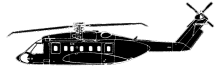
En Bristow S-92A fotografert av Bristow for lenge siden. Helikopteret på bildet er ikke relatert til ulykken, antakelig.
Nødsignal/nødpeilesender detektert og leting pågår nå for fullt.
Bristow opererer S-92A, en helikoptertype som har vært i fokus den seneste tiden fordi det har vært problmer med levering av reservedeler.
Det er for tidlig å si om helikopteret har forulykket. Uansett så vil dette skape store problemer for oljebransjen som ikke har sett seg råd til å satse på flere ehelikoptertyper enn S-92A etter Turøy ulykken.
Det opplyses at SAR Queen har plukket opp 5 av 6 av de som var ombord. Den siste jobber de med å få opp nå. Det har åpenbart vært et havari.
Et militærhelikopter med fem soldater om bord er savnet i USA etter at det ikke har ankommet militærbasen i California som planlagt.
En leteaksjon er i gang, og militæret har bedt sivile redningstjenester om støtte, skriver ABC News. Helikopteret er av typen Sikorsky CH-53E Super Stallion og tilhører marineinfanteriet.
Helikopteret var på vei fra en militærbase nær Las Vegas i Nevada til Miramar ved San Diego.
French startup Beyond Aero has announced it flew a crewed LSA-sized demonstrator aircraft based on a ULA G1 using a hydrogen-electric propulsion system. It’s the first step in eventually creating a hydrogen-powered business aircraft. The little plane, dubbed the Bleriot, took off from Gap-Tallard, France, in early January with test pilot Paul Prudent at the controls. After a lap around the field, Prudent went on to complete an initial flight test program that included 10 takeoffs and landings and two longer flights over the next six weeks to validate the 85-kW propulsion system.
The motor was powered using a ratio of two-thirds gaseous hydrogen to one-third on battery power. It stores 1.2 kg of hydrogen in three onboard tanks compressed to almost 5,000 psi. “This successful flight test campaign underscores the feasibility of the manufacturer’s powertrain architecture, with the goal of making possible, certifiable and profitable, the first electric business aircraft designed for hydrogen propulsion within the decade,” the company said.
Just
days after pilots were warned of conflicting air traffic control (ATC)
instructions while overflying parts of Somalia, a traffic collision avoidance
system (TCAS) advisory was triggered between a Qatar Airways Boeing 787 and Ethiopian Airlines Airbus A350 on Feb. 24.
The
Mogadishu flight information region (FIR) is significant because it acts as a
gateway for flights operating from the Middle East and Asia to southern Africa.
Since January 2023, this FIR has been reclassified as Class A controlled
airspace, a significant upgrade from its former Class G uncontrolled status.
However,
on Feb. 17-18, New Zealand-based OPSGROUP, which monitors potential risks to
airline operations, said it had
received “at least 10
reports of aircraft within the Mogadishu FIR being contacted by a ‘fake
controller’ on the same frequency, issuing conflicting instructions.” These
reports mainly related to climb and descent clearances in the northern part of
Mogadishu airspace.
The
cause of the problem is a political dispute between Somalia and Somaliland.
Somaliland is a region of Somalia that declared independence in 1991 but is not
internationally recognized as a separate country. Tensions heightened on Feb.
13 when the Somaliland Civil Aviation and Airports Authority (SLCAAA) said
Somalia had “forcibly taken over” Somaliland’s air traffic management.
SLCAAA
said it would “take every step to stop the increasing violations and
protections of its airspace.” This means air traffic controllers from Somalia
and Somaliland are both claiming to be “Mogadishu control,” according to
OPSGROUP. The Somali CAA (SCAA) is the recognized air navigation authority for
the area, including Somaliland.
Following
this recent risk alert, a TCAS alert was triggered on Feb. 24 by a lack of separation
between an Ethiopian Airlines A350 and a Qatar Airways 787. According to
Flightradar24 data, the two aircraft involved were registered ET-ATY and
A7-BCN.
Ethiopian
Airlines said flight ETH602 from Addis Ababa to Dubai was cruising at 39,000
ft. (FL390) in Somalian airspace. At 0932UTC, the Ethiopian crew received a
traffic advisory (TA) related to Qatar Airways flight QTR6U from Doha to
Entebbe, Uganda. The Qatar Airways aircraft—initially flying at FL380—was
approaching FL390 on the same airway after being cleared to climb to FL400
through datalink. The Ethiopian flight was 15 nm (27 km) from position ESTIK on
airway UB404 at the time of the advisory.
Somaliland’s
SLCAAA said the Qatar Airways flight was “wrongly told by the controllers in
Mogadishu (Somalia) to climb to 40,000 feet (FL400).”
OPSGROUP
said this incident “seems consistent with recent reports of controllers issuing
unauthorized clearances to traffic in the Mogadishu FIR.” The body advised
operators to “stick to controller-pilot data link communications (CPDLC) and
keep a good watch on 126.9 (IFBP). Be suspicious of unexpected level changes
and try a SATCOM call to Mogadishu if in doubt. “
The TCAS
traffic advisory (TA) between Qatar Airways and Ethiopian Airlines on Feb. 24
was only a caution. Ethiopian Airlines said no avoiding maneuver was made—as
substantiated by Flightradar24 Extended Mode S data, which includes TCAS
status—and the flights continued safely to their destinations. However, the
incident has been reported to the Somalian and Ethiopian CAAs for further
investigation and corrective actions.
“They
were separated about 13 nm (23 km) when the incident happened,” Ethiopian
Airlines said. “Furthermore, both traffics were implementing a strategical
lateral offset procedure (SLOP), which separated them horizontally in addition
to the vertical separation.”
The SCAA
has issued a NOTAM with protocols for aircrew to follow if they received
conflicting ATC instructions in the area, and IATA is working with ICAO’s
contingency coordination team—which brings together states and aviation
organizations—to try to solve the problem.
SLCAAA
alleges that the Mogadishu government has reneged on an agreement to split air
traffic management between two centers in Hargeisa (Somaliland) and Mogadishu
(Somalia), splitting the revenues 40:60.
On Feb.
25, the SCAA said it remains “in full control of the safety” of aircraft in
Somalian airspace. In a Feb. 13 statement, SCAA said no changes had been made
to the country’s airspace management.
OPSGROUP
has previously noted that Mogadishu’s Class A status means aircraft can use
oceanic airways for overflight, helping avoid conflict zones and higher-risk
lower flight levels.



 Information is only available from news, social media or unofficial sources


