


Boeing designs rely on pilots to react properly in a crisis, a capability that may not be so common in the future.  Chicago-based Boeing and French archrival Airbus both build jets that heavily rely on autopilot for normal flight. Boeing's long-standing design philosophy, which assumes a high level of pilot skill, will be tested in coming years as a pilot shortage forces airlines to fast-track less-experienced aviators into cockpits. Today the Chicago planemaker and French archrival Airbus both build jets that heavily rely on autopilot for normal flight. But when it comes to emergencies, the two companies historically have diverged. Airbus planes operate within narrower parameters in an attempt to limit pilot errors-like antilock brakes on a car. Boeing planes alert pilots to a potential problem, then rely on pilots to address it-like a driver steering out of a skid. For example, an Airbus plane won't allow a pilot to fly into a stall; a Boeing 737 will. Boeing's approach is set to collide with the aviation industry's need for between 560,000 and 790,000 new pilots over the next two decades. In the United States, veteran pilots are retiring, and airlines are scrambling to replace them. The International Air Transport Association predicts traffic will double to 8.2 billion passengers by 2037, with much of the growth in Asia, meaning Asian airlines also are hungry to hire. With that many new pilots, industry experts say it's critical to ensure they are properly trained and that aircraft systems reflect realistic assumptions about how pilots will react to extraordinary circumstances. "If we need 500,000 pilots in the future, the airline manufacturers have to adapt," says Bjorn Fehrm, an aeronautical and economic analyst at aviation consulting firm Leeham. "They have to adapt their aircraft, their interaction with the pilots, and the training, so that (of) 500,000 pilots, and the worst among them (is) having the worst day in the year, he can still be a safe pilot." Boeing is facing the worst crisis of its centurylong history following two crashes of the 737 Max that killed 346 people. A single sensor malfunctioned on both flights, erroneously activating a flight control system that pushed the nose of the plane down repeatedly. The crashes were preceded by a cacophony of warning lights and noises in the cockpit, which the pilots had four seconds to decipher and address. Boeing made a "flawed" assumption "with respect to how a pilot would react" when it designed the 737 Max, Boeing Chairman David Calhoun said in a Nov. 5 interview with CNBC. Calhoun said fixing that assumption and working "with that man-machine interface" is the central issue as the company develops "every next, new airplane." "We are going to have to, ultimately, almost, almost make these airplanes fly on their own," he said. "Make no mistake: I wouldn't want to get on an airplane without that pilot. Their judgment, their behavior at moments of critical importance-that's why I get on an airplane. . . .So we're going to do everything in our power to make their job easier, and it will likely increase the level of automation in the cockpit." RECRUITMENT PUSH The number of pilots in the United States has shrunk 23 percent since 1987 to 633,000. The industry laid off tens of thousands of workers, including pilots, after the 9/11 terror attacks, and it can no longer rely on the military to provide a steady stream of experienced pilots as drones are prioritized over manned flight. Aspiring airline pilots now have to pay $100,000 or more for training. While median pilot pay is $140,000, the bottom 10th earns around $66,000 a year working erratic schedules at regional carriers. Airlines in the United States and abroad are recruiting hard to deal with the shortage. United Airlines launched a program last month offering new pilots the chance to advance their careers "faster than ever," with two years and 2,000 hours at a regional airline. Chinese airlines are hiring foreign pilots for higher pay than they'd make in the United States. U.S. flight schools report that carriers are recruiting their instructors. A once-lengthy apprenticeship for pilots is shorter now, says aviation crash investigator John Cox, but that's "not necessarily a bad thing, because we've gotten better at training, and the airplanes have gotten smarter." Fehrm says he dislikes the macho attitude that says "Airbus is for the PlayStation generation, Boeing is for real pilots." Still, airlines and aerospace manufacturers are trying to strike a balance between relying on automation to avoid human errors in the cockpit, and not relying on it so heavily that pilots' manual flying skills erode. Cox says that where airlines emphasized maximum automation in the 1990s and aughts, they now push "appropriate" levels of automation. The dial-back came in response to crashes like Air France Flight 447, which went down in the Atlantic Ocean in 2009 after the autopilot failed and pilots couldn't recover. "There's some lack of basic flying skills," says Peter Gall, an aerospace engineering professor at West Virginia University. "When the automation goes awry, they don't know what to do." How Boeing's design and engineering decisions play out in the next two decades will be felt acutely in Asia. The company says it expects to deliver 17,390 jets in the continent over that period, compared to 9,130 in North America. U.S. Rep. Sam Graves, R-Mo., himself a pilot, said last month that Boeing needs to think about the "lowest common denominator" pilot when it exports its planes. But Cox says in an interview that it's not fair to stereotype overseas airlines as offering less training than U.S. ones. "Are there airlines that undertrain their pilots?" he says. "Yes. But that can be said in a number of places beyond the developing countries."Delays in Boeing Max Return Began With Near-Crash in Simulator Alan Levin  (Bloomberg) -- Boeing Co. engineers were nearly done redesigning software on the grounded 737 Max in June when some pilots hopped into a simulator to test a few things. It didn't go well. A simulated computer glitch caused it to to dive aggressively in a way that resembled the problem that had caused deadly crashes off Indonesia and in Ethiopia months earlier. That led to an extensive redesign of the plane's flight computers that has dragged on for months and repeatedly pushed back the date of its return to service, according to people briefed on the work. The company -- which initially expressed confidence it could complete its application to recertify the plane with the Federal Aviation Administration within months -- now says it hopes to do that before the end of the year. Changing the architecture of the jet's twin flight computers, which drive autopilots and critical instruments, has proven far more laborious than patching the system directly involved in 737 Max crashes, said these people, who asked not to be named speaking about the issue. The redesign has also sparked tensions between aviation regulators and the company. As recently as this week, the FAA and European Aviation Safety Agency asked for more documentation of the changes to the computers, said one of the people, potentially delaying the certification further. Developing and testing software on airliners is an exacting process. Manufacturers may have to demonstrate with extensive testing that a software failure leading to a crash would be as rare as one in a billion. "It's really complicated," John Hansman, an aeronautics and astronautics professor at the Massachusetts Institute of Technology who is not involved in the repair, said of revising aircraft software. "It totally makes sense why it's taking longer." Compared with the initial redesign of the software system involved in the crashes -- a feature known as Maneuvering Characteristics Augmentation System or MCAS -- the work on the flight computers will likely create an exponential increase in the safety tests required before it's approved, said Peter Lemme, a former Boeing engineer who worked on flight-control systems before leaving the company to become a consultant. "Where before you may have had 10 scenarios to test, I could see that being 100," Lemme said. And that doesn't account for the added time to design the software changes needed for the two computers, he said. The work on the plane originally focused on MCAS, which repeatedly pushed down the nose in both accidents as a result of a malfunctioning sensor. Pilots eventually lost control and the crashes killed 346 people, prompting a worldwide grounding of the jet on March 13. Within weeks of the first crash -- a Lion Air flight off the coast of Indonesia on Oct. 29, 2018 -- Boeing announced that it was redesigning MCAS to make it less aggressive and to prevent it from activating more than once. It was projected to be completed within months. While the fix became more complex and politically charged after the second accident -- the crash of an Ethiopian Airlines jet on March 10 -- the changes to MCAS remained self-contained and relatively simple. "I could have a bunch of graduate students and rewrite MCAS in a couple of days and be done," Hansman said. That, of course, wouldn't pass muster with FAA, he said. And it was far simpler than the extensive computer redesign that they undertook. Flight-Control Failure In the original 737 Max design review, Boeing and its overseers at FAA concluded pilots would react swiftly to flight-control failures, but that assumption has been called into question by Indonesia's final report into the crash and recommendations issued by the U.S. National Transportation Safety Board. FAA officials, stung by post-crash charges of laxity, had already begun a more rigorous review of systems on the plane. Part of assessing an aircraft's safety involves anticipating even the most remote potential failure. As a result, Boeing in June simulated what would happen if gamma rays from space scrambled data in the plane's flight-control computers. In one scenario, the plane aggressively dove in a way that mimicked what happened in the crashes on the grounded jetliner, the people said. While such a failure had never occurred in the 737's history, it was at least theoretically possible. Response Time Because at least one of the pilots who flew the scenario in a simulator found it difficult to respond in time to maintain control of the plane, it needed to be fixed, according to two people familiar with the results. The answer was to modernize what was a relatively antiquated design on the 737. Most modern, computerized aircraft -- such as more recent Boeing models and Airbus SE's jets -- use three computer systems to monitor each other, Hansman and Lemme said. By contrast, the 737 Max had two separate computers. One operated the flight systems and another was available if the first one failed, with the roles switching on each flight. But they interacted only minimally. Boeing decided to make the two systems monitor each other so that each computer can halt an erroneous action by the other. This change is an important modernization that brings the plane more in line with the latest safety technology but raised highly complex software and hardware issues. Short Circuit Simply introducing a new wire that connects the two computers, for example, raises potential safety issues, Hansman said. If a short circuit in one computer occurs, could the wire cause it to disable the second computer? And if flight data arrives in one computer a fraction of a second before or after it reaches the second one, that could create confusion for each system, according to Lemme. As Boeing and the subcontractor that supplied the flight-control computer, the United Technologies Corp. division Collins Aerospace Systems, worked through these changes, it has at times created tension. Officials from the FAA and the European safety agency expressed frustration with Boeing at a meeting last summer when company representatives didn't supply a detailed enough explanation of the changes. Work Audit A similar issue arose in early November when an audit describing work on the changes wasn't complete and the agencies ordered Boeing and Collins to revise it, according to a person familiar with the matter. Boeing, in a statement, said it provided technical documents to regulators "in a format consistent with past submissions." "Regulators have requested that the information be conveyed in a different form, and the documentation is being revised accordingly," according to the statement. "While this happens we continue to work with the FAA and global regulators on certification of the software for safe return of the MAX to service." The result has been to extend the jet's grounding. "It's absolutely the right thing to do," said Jeffrey Guzzetti, the former chief of accident investigations at the FAA. "But that is a big change to make." https://finance.yahoo.com/news/delays-boeing-max-return-began-090000943.html Back to Top |

Southwest and American pull 737 MAX until early March, nearly
a year after grounding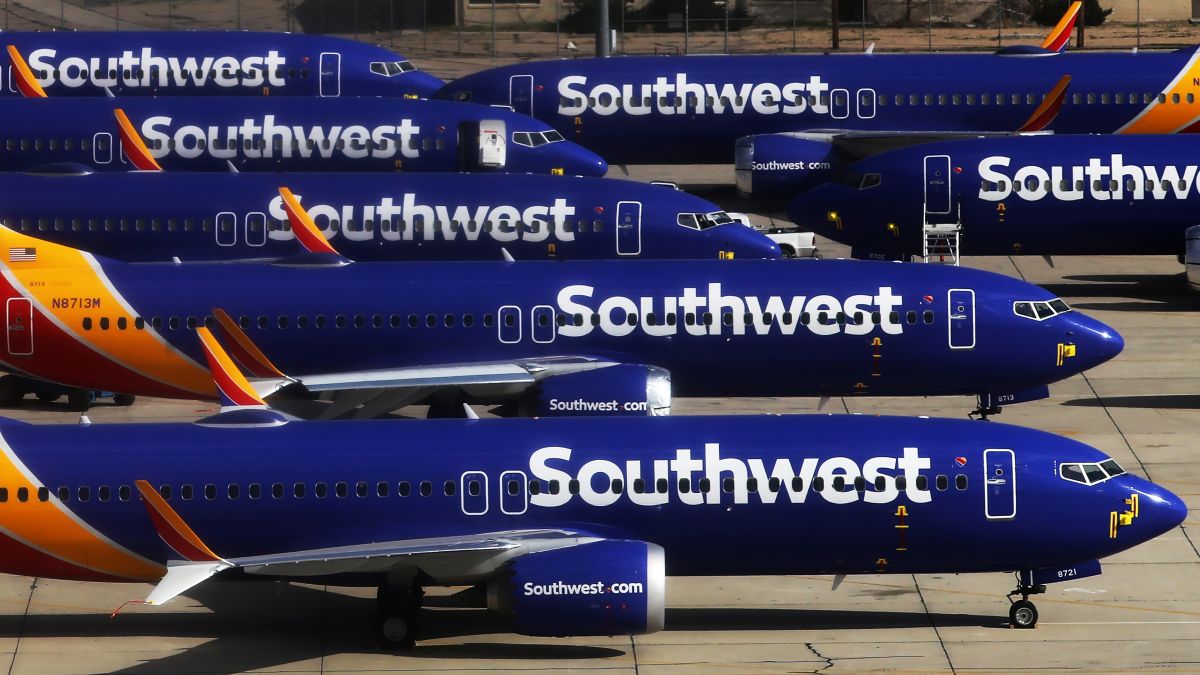 CHICAGO/WASHINGTON, Nov 8 (Reuters) - Southwest Airlines and American Airlines Group Inc said on Friday they are extending Boeing 737 MAX cancellations until early March, just shy of the one-year anniversary of an Ethiopian Airlines crash of the jet that led to a worldwide grounding. Southwest and American, the two largest U.S. operators of the aircraft, have had to scale back growth plans and are together canceling more than 300 flights a day, taking a hit to profits as they manage slimmer fleets without the 737 MAX. Southwest, which has bet its entire growth strategy on Boeing's newest single-aisle aircraft, had previously canceled all its 737 MAX flights until Feb. 8 and now expects a return to service on March 6, though it warned that the timeline could get pushed back again. Boeing Co is facing increasing hurdles in obtaining approval to return the plane to service before the end of this year as it has targeted. American said it planned to resume commercial flights on the 737 MAX on March 5, and expects to run test flights for American team members and invited guests before that date, once the aircraft is certified. United Airlines, the other U.S. 737 MAX operator, had thus far canceled flights into January, although it may yet have to extend that time frame. Reuters reported this week that U.S. and European regulators will need to return to a Rockwell Collins facility in Iowa to complete an audit of Boeing's software documentation after regulators found gaps and substandard documents. Boeing has confirmed it must submit revised documentation. That has thrown into question when Boeing would be able to complete a certification test flight. The Federal Aviation Administration has said it would not unground the planes until 30 days after that flight occurs. The 737 MAX, Boeing's best-selling plane, has been grounded since March after crashes in Indonesia and Ethiopia killed 346 people. Two U.S. officials told Reuters it is extremely unlikely - if not impossible - that Boeing will be able to win approval to return flights to service before the end of December. Just two days ago, American Chief Executive Doug Parker said he was hopeful that the aircraft would "get certified in the near future." RISING COST American has estimated that the 737 MAX grounding has cut 2019 earnings by $540 million, while Southwest estimated the total hit to its earnings between January and September at $435 million. That toll will only rise the longer the MAX remains parked. Boeing is discussing compensation with airlines but no agreement has been reached. Southwest had 34 MAX jets at the time of the March 13 grounding and was expecting delivery of another 41 jets this year. It said on Friday it still hopes to receive seven MAX deliveries in the current quarter, with the remaining shifting into 2020. But without clarity on the MAX timeline, Southwest said it could not update a previous forecast for first-quarter capacity to grow between 2% and 3%. |


Ingen kommentarer:
Legg inn en kommentar
Merk: Bare medlemmer av denne bloggen kan legge inn en kommentar.