søndag 2. august 2015

Me109 - CASA bygget, men med orginal DB 601 motor

Messerschmitt Bf.109G-4


The development history of the Bf (Me) 109 goes back as far as 1934, when the Bavarian Aircraft Works (BFW) in Augsburg which became Messerschmitt AG in 1938 started development of a lightweight fighter plane for a competition held by the Reich Air Ministry (Reichsluftfahrtministerium).
Willy Messerschmitt designed the aircraft, which was provisionally given the designation Bf 109, using all of the experience and knowledge on aircraft construction that was available at that time.
The fighter was designed and built as a low-wing monoplane, an all-metal monocoque construction with retractable landing gear, a closed cockpit, automatic leading-edge slats, landing flaps and a variable-pitch propeller.
The prototype Bf (Me) 109 V 1 made its maiden flight on 28 May 1935. By 1937, a prototype had already become the first German landplane to break the world speed record, achieving a speed of 611 km/h. (380mph).
The Bf(Me)109 went into serial production for the German Luftwaffe in 1937, becoming its standard fighter. Numerous models were built to adapt the Bf(Me)109 to the changing requirements over time. In 1938, the E model of the DB 601 engine with an overall displacement of 30 l.
In 1939, the F model, the Bf(Me)109F, was made more aerodynamic. This was followed by the largest production run to date, of the Bf(Me)109G with the higher performance DB 605 engine, starting in late 1941. The last production version built in Germany was the Bf(Me)109K, production of which started in the autumn of 1944. By the end of World War II, about 34,000 Bf(Me)109′s had been built, the largest production run of any fighter aircraft ever built.
About 1,000 more were built with a number of different engines after 1945 abroad, for instance in the former CSSR and Spain up until the end of the 1950′s.
In Spain, some remained in service with Rolls-Royce Merlin 500/45 engines as late as 1965 under the designation HA 1112.
Bf(Me)109 D-FWME “Red Seven” was originally a Spanish production aircraft with the serial number 139 and was rebuilt into a G-4 version with a DB 605A engine.
D-FWME was built as HA 1112 M-1L in Spain with the serial number 139 and the registration number C.4K-75.

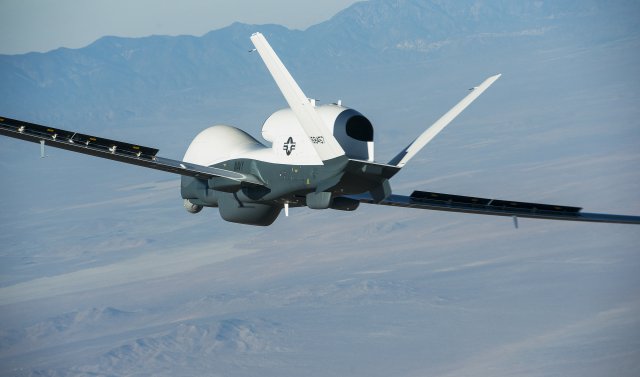
Drone - Triton Maritime Patrol UAV with new radar

MQ-4C Triton Gets Enhanced Air-to-Air Radar

Triton_Flight
U.S. Navy unmanned aircraft experts are asking Northrop Grumman Corp. to correct deficiencies in the air-to-air radar system aboard theMQ-4C Triton maritime patrol UAV before making a production decision on the Triton by the end of this year.
Officials of the Naval Air Systems Command at Patuxent River Naval Air Station, Md., announced a $39.1 million contract modification Monday to the Northrop Grumman Aerospace Systems sector in San Diego to enhance and adjust the Triton’s air-to-air radar, which is still in development and has not yet been test flown.
The contract calls for Northrop Grumman to make adjustments in the current air-to-air radar subsystem design of the Triton UAV and to demonstrate that the drone’s air-to-air radar technology, performance, and manufacturing risks have been mitigated.
Northrop Grumman and its air-to-air radar supplier, Exelis Inc. in McLean, Va., are developing a radar for the Triton that will enable the unmanned aircraft to detect other aircraft in the area for sense-and-avoid functionality, as well as for targeting.
The Triton air-to-air radar is the first of its kind, and has been a challenge for Northrop Grumman and Exelis to size such that it is small and lightweight enough to fit on the Triton UAV, Northrop Grumman officials say.
This order is part of the Triton’s system development and demonstration (SDD) phase, part of the Triton research and development that involves mature system development, integration, and demonstration to initial operational test and evaluation (IOT&E) — the last phase before full production.
Northrop Grumman is developing the MQ-4C Triton, also called the Broad Area Maritime Surveillance (BAMS) UAV, to fly maritime surveillance missions for as long as 24 hours at altitudes of more than 10 miles to enable coverage out to 2,000 nautical miles. The UAV’s suite of sensors can detect and classify different types of ships automatically.
The Triton’s SDD phase began in early 2008 with a $1.2 billion contract to Northrop Grumman to design and build two Triton UAVs with mission payloads and communications suites; one forward operating base mission control system; one systems integration laboratory; and one main operating base mission control system.
The Triton will be a crucial component of the Navy’s 21st century strategy for conducting surveillance of surface ship and submarine traffic in the vast Pacific and other oceans around the globe.
The Triton UAV will work together with the Navy’s P-8A Poseidon manned maritime patrol aircraft. The P-8 is a Boeing 737 passenger jet modified for surveillance and anti-submarine warfare (ASW) missions.
The Triton’s maritime search radar is called the Multi-Function Active Sensor (MFAS), and will provide the UAV with a 360-degree view of a large geographic area while providing all-weather coverage for detecting, classifying, tracking, and identifying points of interest.
MFAS is separate from the Triton’s air-to-air radar. The MFAS radar first flew on the Triton during testing last April.
Along with the air-to-air and MFAS radar systems, the MQ-4C also will carry an electro-optical/infrared (EO/IR) sensor that will provide still imagery and full-motion video of potential threats; an electronic support measures package to identify and geolocate radar threat signals; and an Automatic Identification System (AIS) that will detect and track vessels equipped with AIS responders.
In a continuation of the Triton SDD phase, the Navy awarded a $22.4 million contract modification to Northrop Grumman in April 2009 for aircraft wing static and load testing. Following this was $19.7 million contract to Northrop Grumman in September 2010 to perform Triton radar risk reduction flight tests.
In May 2012 Northrop Grumman won a $32.8 million modification to develop a logistics management system and switch from contractor logistics support to organic military maintenance. A December 2012 $7.2 million contract modification asked Northrop Grumman to certify the Triton’s airborne recorder to National Security Agency (NSA) guidelines.
Then in May 2013 the Navy awarded a $125.3 million modification for Northrop Grumman upgrade Triton software from Windows XP to Windows 7. This week’s software-modification contract brings total Navy spending for the Triton SDD phase to $1.3 billion. The Triton should be ready to deploy by 2017.
On Monday’s contract modification to correct deficiencies in the Triton’s air-to-air radar, Northrop Grumman will do the work in Rancho Bernardo, Calif., and should be finished by December 2016.

Maritime Patrol Aircraft - ASW Sonobuoys

Ultra Electronics Studies UAV Drop Options for Sonobuoys

UAV_Launch_ConceptUK defence electronics firm Ultra Electronics is developing a new family of miniature passive sonobuoys that could be eventually deployed from unmanned aerial systems.
The new, 12 inch-long “F” sized sonobuoys use the company’s new multi-static technology, which assesses data from other sonobuoys and other energy in the water to provide an increased probability of detection. The “F” size sonobouys retain the same standard sonobuoy diameter of 4.875 inches, but are two-thirds shorter than the 36 inch-long “A” active sonobuoys used by the US Navy on its P-8 Poseidon and P-3 Orion maritime patrol aircraft, and around one-quarter shorter than the standard passive “G” class sonobuoys, which measure 16.5 inches.
The company believes these lighter sonobuoys could pave the way toward the development of a sonobuoy pod that could be fitted to a medium-sized UAV. Company literature shows a pod developed by Northrop Grumman to carry sonobuoys fitted to a Global Hawk platform.
“A UAV would be an ideal platform for creating a sonobuoy field in the water,” said Jonathan Cooke, marketing manager for Ultra’s sonar systems division. “A maritime patrol aircraft crew can spend several hours laying a field, just the sort of dull and dirty work that UAVs were developed for.”
Ultra envisions a pod fitted with 12-36 small sonobuoys. Inside the pod would be a buoy data receiver, processor and datalink system so information from the sonobuoys could be sent back to operators, opening the way for a UAV-based anti-submarine warfare capability.
The company says it is working with a number of UAV producers on the project. The capability could be featured in the planned Unmanned Warrior demonstration, which will be part of the larger NATO multinational Joint Warrior exercise off the Scottish coast in 2016.

MH370 - Mulig flydør funnet - BBC

Flere ting er nå funnet på stranden på Reunion, også en mulig flydør melder BBC. Følg med.

MH370 search: 'Second plane part found' on Reunion

  • 17 minutes ago
  • From the section Asia
Breaking News image

A second piece of suspected plane debris has been washed ashore on the Indian Ocean island of Reunion.
The object, believed to be the door of an aircraft, was handed to the authorities after it was discovered just south of the city of St Denis.
It is said to have foreign writing on it and possibly some illustration.
A 2m-long object, also found on Reunion earlier this week, is being examined in France to establish if it is part of missing flight MH370.
The flight from Kuala Lumpur to Beijing disappeared last March with 239 people on board.

Balloon Fiesta Albuquerque October

Første uken i oktober

Air Show weekend - Folland Gnat down


lørdag 1. august 2015

Fallskjermrekord - 164 i formasjon

164 skydivers smash head-down world record in Illinois


In this photo provided by Mickey Nuttall, members of an international team of skydivers join hands... Read more
i

OTTAWA, Ill. (AP) — Traveling at speeds of up to 240 mph, 164 skydivers flying head-down built the largest ever vertical skydiving formation Friday over central Illinois, smashing the previous record.
It took the international team 13 attempts to beat the 2012 mark set by 138 skydivers. The formation, resembling a giant flower, floated above the rural drop zone in Ottawa for a few seconds before the flyers broke away, deployed their parachutes, and whooped and hollered their way to the ground to the jubilation of spectators.
"It's awesome, man," said Rook Nelson, one of the organizers. "It just goes to show that if you can get the right group of people together and the right support team and good conditions, anything is possible ... even on attempt number 13."
The team was selected after training camps in Spain, Australia and across the U.S. Seven aircraft were flown in precise formation to ensure that the jumpers de-planed at the right place, time and altitude. The record-breaking jumpers exited at 19,700 feet.
Skydiving videographers recorded the jump, flying above, below and alongside the formation. The footage enabled judges on the ground to verify the record was achieved above Skydive Chicago, the drop zone and airport about 80 miles southwest of Chicago where the event took place.
Three judges certified by the Fédération Aéronautique Internationale — the World Air Sports Federation — studied the video and photos to make sure each flyer was in a pre-determined slot in the formation and has his or her hand in the correct position.
The record was not without risks.
The skydivers flew at a minimum speed of 160 mph, and some reached speeds as fast as 240 mph. Collision at such speeds can be fatal.
Jumping from such a high altitude brings a risk of hypoxia — a condition arising from a lack of oxygen that can cause unconsciousness and other symptoms — or even death. To reduce the risk of falling sick, jumpers and pilots sucked down pure oxygen once their planes reached 14,000 feet.
And with nearly 170 canopies simultaneously flying in the sky, there's a risk of two parachutists flying into each other.
Still, of approximately 3.2 million sport skydives in the U.S. in 2014, there were 24 fatalities, according to the United States Parachute Association.
Despite the risks, flyers came from as far away as France, Britain, Dubai and Australia — one even spent three days traveling to Chicago from Reunion, off the coast of Madagascar in the Indian Ocean — to participate.
"When (record) jumps work well, it's like there's a certain peace to it all, a certain harmony to it all," said Norman Kent, a longtime skydiving videographer who filmed the jump. "And it's contagious, it's like it's in the air and you can feel it even from a distance as a cameraman."