mandag 2. oktober 2017

Droner i blandet miljø testes i USA - UAS Vision video


50-mile Central New York Drone Air Corridor Launched

Click on the video picture for full screen viewing

Officials last week launched what they touted as the first air corridor in the nation where unmanned aerial vehicles can safely fly beyond line of sight for testing and development.
The Northeast UAS Airspace Integration Research Alliance, or Nuair, officially activated the corridor by flying a manned aircraft and a small drone in airspace over and around Griffiss International Airport.
Ground-based sensors and radars developed by Gryphon Sensors, a subsidiary of Syracuse-based SRC Inc., detected and tracked both aircraft in a demonstration that allowed air traffic managers to keep the two craft a safe distance from each other.
The corridor now consists of a 5-mile circle around Griffiss, in which special sensors and radars are able to detect small drones flying at very low altitudes – something traditional radars around airports cannot do.
Nuair President and CEO Larry Brinker said the corridor will be expanded next year, with $30 million in state funding, into a 50-mile-long air space stretching from Rome to Syracuse.
Officials said construction of the full network of sensors and radars is expected to start by the third quarter of 2018.
The alliance, a collection of more than 100 for-profit and non-profit companies, is working to make Central New York and the Mohawk Valley a magnet for the growing unmanned aerial vehicle, or UAV, industry.
If you are interested in this industry, this is the place to be,” said Gov. Andrew Cuomo, whose administration has pledged up to $250 million in state funding under his Upstate Revitalization Initiative to build the corridor and promote the growth of the UAV industry in the region.
Potential uses of drones include search and rescue operations, inspection of bridges and other structures, and package deliveries.
Brinker said the Rome to Syracuse air corridor will allow manufacturers of drones and their components  and developers of unmanned air traffic control systems to safely test their hardware and systems in airways where manned aircraft also fly.
Robert Simpson, president and CEO of Syracuse-based CenterState Corporation for Economic Opportunity, said the corridor will help make Central New York home for manufacturing, research, development and testing tied to the UAV industry.
“It isn’t just the manufacture of drones,” he said. “It’s the manufacture of their components and materials and sensor systems. We have one of the strongest collection of sensor companies in the world right here.”
Craig Marcinkowski, director of strategy and business development at Gryphon Sensors, said companies do not have to wait for the entire 50-mile air corridor to be operational before moving to the area. There is a lot of testing and development that can be conducted with the five-mile corridor around Griffiss, he said.

Monarch er konkurs - Check-In

Airbus A321-fly fra Monarch Airlines i Birmingham. (Foto: Eric Salard / Wikimedia Commons)

110.000 strandet efter britisk flykonkurs

Monarch Airlines, der er Storbritanniens femtestørste flyselskab, har foretaget en finansiel nødlanding, og 110.000 rejsende i udlandet skal nu hentes hjem på anden måde.
Det britiske flyselskab Monarch Airlines har indgivet konkursbegæring. Det skriver selskabet mandag morgen på sin hjemmeside.
Selskabet bekræfter således, at følgende forretningsenheder er omfattet af konkursen:
  • Monarch Airlines Ltd
  • Monarch Holidays Ltd (ATOL Number 2275)
  • First Aviation Ltd (ATOL Number 4888)
  • Avro Ltd (ATOL Number 1939)
  • Somewhere2stay Ltd
Det betyder, at fra den 2. oktober vil der ikke længere blive gennemført rejser, da alt er blevet aflyst.
“Dette er en hidtil uset situation, og fordi der er op til 110.000 passagerer i udlandet, har den britiske regering bedt CAA (de civile luftfartsmyndigheder, red.) om at koordinere flyvninger tilbage til Storbritannien for alle Monarch-kunder, der i øjeblikket befinder sig i udlandet. Disse nye flyvninger vil ikke påføre ekstra omkostninger,” skriver Monarch til sine kunder.

Største evakuering nogensinde i fredstid
Ifølge BBC udtaler den britiske transportminister Chris Grayling, at han har beordret “den største evakuering nogensinde i fredstid.”
“Det er en meget bekymrende situation for britiske feriegæster i udlandet, og min første prioritet er at hjælpe dem med at komme tilbage til Storbritannien,” siger ministeren til BBC News.
Monarch Airlines blev etableret i 1968 og beskæftigede før konkursen 2.500 ansatte i hele koncernen. Sidste år fløj 6,3 mio. passagerer med Monarch Airlines til 40 destinationer fra lufthavnene i London-Gatwick, London-Luton, Birmingham, Leeds-Bradford og Manchester.
Selskabet har de seneste år været ejet af kapitalfonden Greybull Capital, der har forsøgt at sælge dele af virksomheden. Norwegian har blandt andet været rygtet som en af de mulige købere.

søndag 1. oktober 2017

Helicopter - More on the H225 AD - Rotor& Wing

EASA Orders New Super Puma Check in Emergency Directive

By S.L. Fuller | September 28, 2017


File photo
EASA has issued an emergency airworthiness directive for the Airbus Helicopters Super Puma. Posted Monday, the directive orders more inspections of EC225 LPs.
According to the directive, the manufacturer “identified that the control rod attachment yokes of the main rotor rotating swashplate are susceptible to crack development, due to aging phenomenon.”
If the condition goes undetected and uncorrected, EASA said it could lead to structural failure of the affected part, which could result in loss of control.
If the part has accumulated time in excess of seven years, the directive says the inspection must occur within 15 flight hours or seven days after of accumulating seven years or more. If the part already has seven years or more, the inspection is to occur within 15 flight hours or seven days after Sept. 27, which is the directive’s effective date.
Click here to read the directive.

Bloodhound on track - BBC video

Bloodhound supersonic car fires up Eurofighter engine


Check video here: http://tinyurl.com/yccfspor


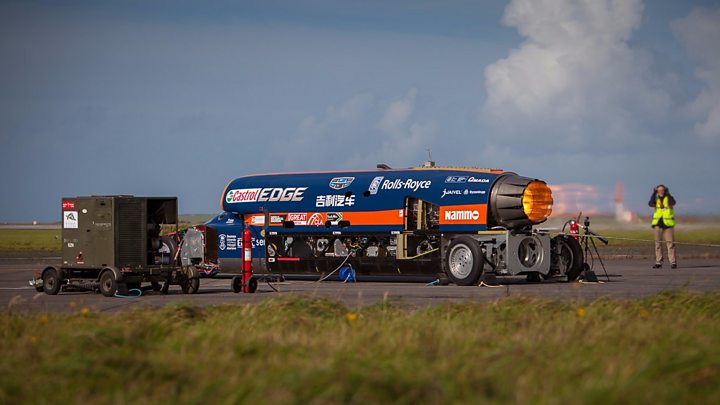
The Bloodhound supersonic car has been fired up for the first time - and worked a treat.
Engineers turned over the vehicle's Eurofighter jet engine in a "tie-down" test at Cornwall's Newquay airfield on Friday.
It worked flawlessly, sending a big orange flame out of the rear nozzle.
The intention is for the car to begin some "slow-speed" running - about 200mph (320km/h) - at the end of next month.


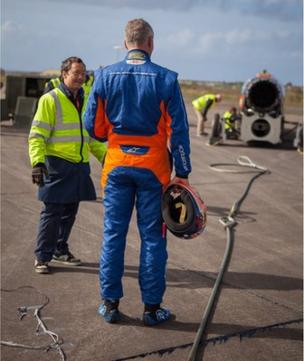
Andy GreenImage copyrightBLOODHOUND SSC/STEFAN MARJORAM
Image captionAndy Green says he has "huge confidence" now in the car's performance

The team had been concerned that the Rolls-Royce EJ200 power unit might have some operational difficulties being in a car as opposed to sitting in a fighter aircraft.
But when driver Andy Green flicked the switches in his cockpit, the engine lit up and performed exactly to its specification.
It was proof also that all the car's electronic systems, its computers, and software were working as designed.
"It's blown us away, frankly," Wing Commander Green told BBC News.
"It's given us huge confidence going forward. We now know the engine has no limits just because it's in a car. It is an EJ200 with the full performance envelope available to us, under all conditions, from stationary onwards."


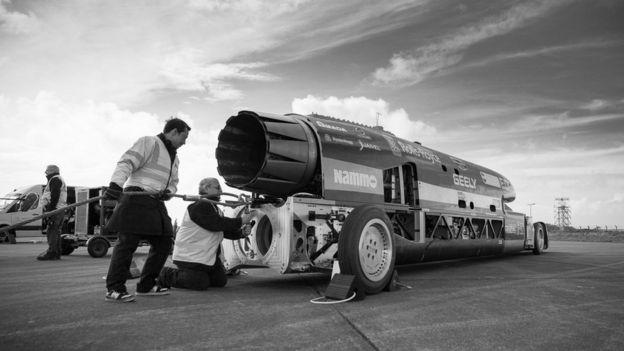
Engine testImage copyrightBLOODHOUND SSC/STEFAN MARJORAM
Image captionA very strong cable was used to keep Bloodhound static

October's slow-speed running should have paved the way for an attempt on the world land speed record in 2018, but it looks now as though the project will have to slip another year.
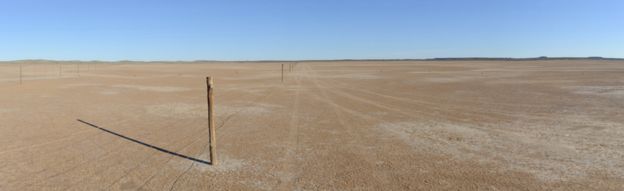
Bloodhound SSC will race in South Africa on a specially prepared, dried-out lake-bed, using both the jet engine and a rocket motor.
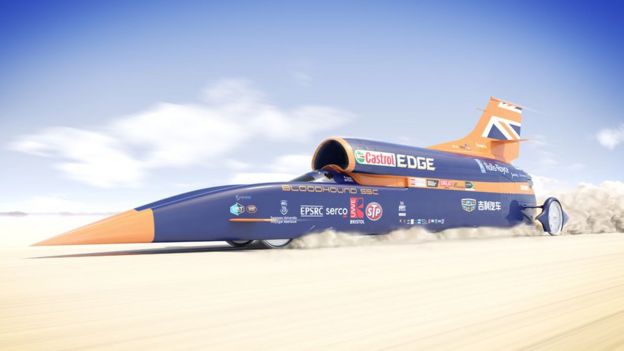
The aim is to lift the current record of 763mph (1,228km/h) to 800mph (1,288km/h), and then eventually to take it above 1,000mph (1,610km/h).
However, the conditions at Hakskeen Pan in Northern Cape are really only suitable for running in the period from July to November - and getting the car fully prepared to meet this window in 2018 is now seen as unachievable.


BloodhoundImage copyrightBLOODHOUND SSC
Image captionArtwork: The aim is to raise the land speed record above 800mph in the first instance
Hakskeen PanImage copyrightBLOODHOUND SSC/OLI MORGAN
Image captionA flat track has been prepared on Hakskeen Pan to enable Bloodhound to reach very high speeds

In part, this is because there are still technical challenges to do with Bloodhound's rocket motor.
This is coming from the Norwegian aerospace company Nammo, and the development work must fit in around the firm's commercial business, which has extended the timeline.
But the Bloodhound project also has to function within its privately generated budget, and although some big sponsorship deals have been signed recently, engineering can only proceed at the rate cash comes into the venture.
The decision has therefore been made to wait until 2019 to begin the assault on the land speed record.
Nonetheless, the team hopes Friday's static test, and the initial runs set for 26 October, will be visible proof that Bloodhound is in good shape.
Andy Green said: "Today has been a demonstration that with just a little bit of resource in place we've delivered exactly what we said we would, when we said we would.
"And based on what I've seen today from the EJ200, we are going to over-deliver - 26 October won't be just a show of a fast car, it will be a spectacular show of a car that's going to astonish people."


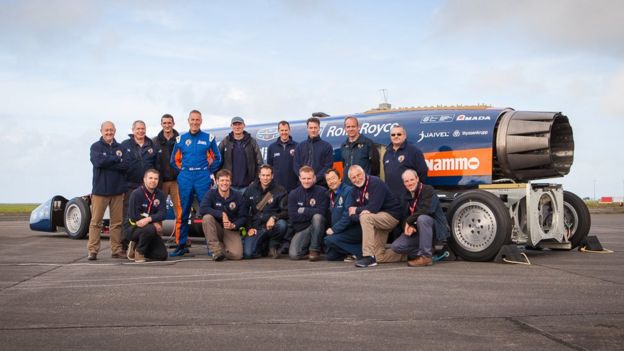
TeamImage copyrightBLOODHOUND SSC/STEFAN MARJORAM
Image captionThe team is working towards a public day of running on 26 October

Jonathan.Amos-INTERNET@bbc.co.uk and follow me on Twitter: @BBCAmos

MPA og overvåkingen i nord - NRK

Fiskerne bekymret for sikkerheten til havs
– Norges befolkning har krav på sikkerhet til havs. Hvem skal ha denne beredskapen mens Orion-flyene utfases og de nye overvålingsflyene er på plass. Vi frykter denne oppgaven blir utfordrende å opprettholde, sier leder Kjell Ingebrigtsen i Norges fiskarlag.

LEGGES NED: I fjor ble Arbeiderpartiet enige med regjeringspartiene om å legge ned Andøy flystasjon. 350 mennesker mister jobben, og opp mot 700 blir berørt når Andøy flystasjon legges ned etter å ha vært Norges og Natos øyne på russernes aktivitet i nord helt siden 1957.
FOTO: PRIVAT
Susanne Lysvold
Susanne Lysvold@susannelyJournalist
 Publisert i går, kl. 09:44

Lederen i Norges Fiskarlag, Kjell Ingebrigtsen
Kjell Ingebrigtsen i Norges Fiskarlag er bekymret for sikkerheten til havs, dersom beredskapen Orion-flyene har i dag svekkes.
FOTO: HÅKON JACOBSEN / NRK
– Vi er veldig bekymret for situasjonen. Når det skjer en ulykke langt til havs teller hvert minutt. I disse havområdene er marginene små. Orion-flyene har stor rekkevidde og deres lokaliseringsevne har vært avgjørende for å berge liv i flere tilfeller, sier leder Kjell Ingebrigtsen i Norges Fiskarlag.
Fiskerne er bekymret for sikkerheten til havs etter nyhetsoppslag om redusert Orion-aktivitet og mannskapsmangel ved Andøya flystasjon som har kommet i kjølvannet av stortingsvedtaket om å legge ned Andøy flystasjon og samlokalisere en framskutt jagerflybase og de maritime overvåkingsflyene på Evenes.
Nye fly om fem år
Norge har nå seks maritime overvåkningsfly av Orion-klassen, som er stasjonert på Andøya. Orion-flyene nærmer seg slutten av sin operative levetid, ifølge regjeringen.
Det første av dem fem nye maritime overvåkingsflyene av typen P-8-Poseidon skal etter planen ikke lande i Norge før i 2022 ​og de resterende fire innen 2023.
Et Orion-fly lander på Andøya
Luftforsvarets seks P-3 Orion overvåkningsfly er i dag stasjonert på Andøya flystasjon.
FOTO: EMMA BERGHEIM
– Norge har ansvar for søk og redning helt opp til Nordpolen, og må ha tilstrekkelige ressurser tilgjengelig. Vi stiller spørsmål om hvem som skal ha denne beredskapen mens Orion-flyene utfases og de nye flyene er på plass. Vi frykter denne oppgaven blir utfordrende å opprettholde, sier Ingebrigtsen.
Fire oppdrag i fjor
I fjor hadde Forsvarets Orion-fly fire søk- og redningsoppdrag i Norges ansvarsområde (se kart under).
– Flere av dem gjaldt fiskeflåten. Flyene har stor rekkevidde og stor betydning for dekningen av nordområdene i søk- og redningssammenheng, sier fiskarlagslederen.
Forsvaret: – Sikkerheten ivaretas
Norges ansvarsområder ifølge Arktisk SAR-avtale
Kartet viser ansvarsområdene de ulike landene har i forhold til søk og redning.
Orlogskaptein Per-Thomas Bøe, som er talsperson for forsvarssjefen sier han forstår bekymringen fra fiskerne.
– Det vil nok kunne bli perioder med mindre aktivitet på Orion-basen i overgangsperioden mellom de gamle og de nye flyene. Men søk- og redningsberedskapen vil bli opprettholdt hele perioden. Overgangen til de nye flyene vil skje gradvis og det blir en overlappende kapasitet, sier Bøe til NRK
.

Mega diverson - AF66, en A380 landet i Goose Bay med motortrouble - Flightradar24


B-737-700 loss of cowling i 2016 likner veldig:


Vintersesongen står for døren - Ta dine forholdsregler - ASN

Accident description
Last updated: 1 October 2017
Status:Final
Date:Friday 11 December 2015
Time:09:10
Type:Silhouette image of generic C208 model; specific model in this crash may look slightly different
Cessna 208B Grand Caravan
Operator:Wasaya Airways
Registration: C-FKDL
C/n / msn: 208B-0240
First flight: 1990
Total airframe hrs:36073
Cycles:58324
Engines: 1 Pratt & Whitney Canada PT6A-114A
Crew:Fatalities: 1 / Occupants: 1
Passengers:Fatalities: 0 / Occupants: 0
Total:Fatalities: 1 / Occupants: 1
Airplane damage: Destroyed
Airplane fate: Written off (damaged beyond repair)
Location:28 km (17.5 mls) NE of Pickle Lake Airport, ON (   Canada)
Phase: En route (ENR)
Nature:Cargo
Departure airport:Pickle Lake Airport, ON (YPL/CYPL), Canada
Destination airport:Angling Lake/Wapekeka Airport, ON (YAX), Canada
Flightnumber: 127
Narrative:
Wasaya Airways flight 127 (WSG127) was to be the first of three cargo trips in the Cessna 208B Caravan (registration C-FKDL) planned from Pickle Lake Airport, Ontario, Canada to Angling Lake/Wapekeka Airport, Ontario. The first flight was planned to depart at 09:00.
The pilot went to the Wasaya apron and conducted a pre-flight inspection of C-FKDL while a ground crew was loading cargo. The pilot returned to the hangar and received a briefing from the station manager regarding the planned flights. The pilot was advised that the first officer assigned to the flight had been reassigned to other duties in order to increase the aircraft's available payload and load a snowmobile on board.
The pilot completed and signed a Wasaya flight dispatch clearance (FDC) form for WSG127, and filed a copy of it, along with the flight cargo manifests, in the designated location in the company operations room. The FDC for WSG127 showed that the flight was planned to be conducted under visual flight rules (VFR), under company flight-following, at an altitude of 5500 feet above sea level (ASL). Time en route was calculated to be 66 minutes, with fuel consumption of 413 pounds.
The pilot returned to the aircraft on the apron. Loading and fueling were complete, and the pilot conducted a final walk-around inspection of C-FKDL. Before entering the cockpit, the pilot conducted an inspection of the upper wing surface.
At 08:54, the pilot started the engine of C-FKDL and conducted ground checks for several minutes. At 08:58, the pilot advised on the mandatory frequency that WSG127 was taxiing for departure from runway 09.
WSG127 departed from runway 09 at 09:00, and, at 09:01, the pilot reported on the mandatory frequency that the flight was airborne. The flight climbed eastward for several miles and then turned left toward the track to mandatory frequency. At about 3000 feet ASL, WSG127 briefly descended about 100 feet over 10 seconds, and then resumed climbing. At 09:05, the pilot reported that WSG127 was clear of the mandatory frequency zone.
WSG127 intercepted the track to Angling Lake and climbed northward until the flight reached a peak altitude of about 4600 feet ASL at 09:08:41, and then began descending at 09:08:46. At 09:09:16, the flight made a sharp right turn of about 120° as it descended through about 4000 feet ASL. At 09:09:39, the descent ended at about 2800 feet and the aircraft climbed to about 3000 feet ASL before again beginning to descend. At approximately 09:10, WSG127 collided with trees and terrain at an elevation of 1460 feet ASL during daylight hours.


Probable Cause:

Findings as to causes and contributing factors

1. Although the aircraft was prohibited from flying in known or forecast icing conditions, Wasaya Airways Limited Partnership (Wasaya) flight 127 (WSG127) was dispatched into forecast icing conditions.
2. The high take-off weight of WSG127 increased the severity of degraded performance when the flight encountered icing conditions.
3. The pilot of WSG127 continued the flight in icing conditions for about 6 minutes, resulting in progressively degraded performance.
4. WSG127 experienced substantially degraded aircraft performance as a result of ice accumulation, resulting in aerodynamic stall, loss of control, and collision with terrain.
5. The Type C pilot self-dispatch procedures and practices in use at Wasaya at the time of the occurrence did not ensure that operational risk was managed to an acceptable level.
6. Wasaya had not implemented all of the mitigation strategies from its January 2015 risk assessment of Cessna 208B operations in known or forecast icing conditions, and the company remained exposed to some unmitigated hazards that had been identified in the risk assessment.
7. There was a company norm of dispatching Cessna 208B flights into forecast icing conditions, although 4 of Wasaya's 5 Cessna 208B aircraft were prohibited from operating in these conditions.


Accident investigation:
cover
Investigating agency: TSB Canada
Status: Investigation ongoing
Duration: 1 year and 10 months
Accident number: A15C0163
Download report: