mandag 29. mars 2021

Helikopterulykke i Alaska - Curt Lewis


Five killed, one hurt as helicopter crashes at Alaska glacier

ANCHORAGE (Reuters) - Five people were killed and one injured in a helicopter crash at a glacier near Anchorage, Alaska State Troopers said on Sunday.

Searchers found the crash site and survivor late Saturday night after the chopper was reported overdue, the troopers said in a written statement. The injured person was reported to be in serious but stable condition.

The helicopter was ferrying skiers who had been on a backcountry tour, the troopers said. Killed were Petr Kellner, 56, and Benjamin Larochaix, 50, both of the Czech Republic; Gregory Harms, 52, of Colorado; Sean McManamy, 38, and pilot Zachary Russell, 33, the troopers said. The survivor, who was not identified late Sunday, was hospitalized, the trooper said.

The crash site was near Knik Glacier northeast of Anchorage. The helicopter was an Airbus AS350B3 owned by Soloy Helicopters of Wasilla, Alaska, the troopers said.

The victims’ bodies were recovered Sunday by the Alaska Army National Guard and volunteers from the Alaska Mountain Rescue Group, the trooper said. The remains have been turned over to the state medical examiner, the troopers said. A temporary flight restriction imposed by the Federal Aviation Administration was lifted late Sunday.

The National Transportation Safety Board will investigate the crash, the troopers said.

Knik Glacier, in the northern Chugach Mountains, is a destination for sightseeing flights and, in summer, hiking and boating tours. The crash site is near the Knik River outflow of the 28-mile glacier, according to a map provided by the troopers.

Knik Glacier and other glaciers in the area have been the sites of numerous military and civilian air crashes over several decades.

Another backcountry skier was killed this weekend in a separate accident in the same general area. Erin Lee, 40, of Fairbanks died Saturday after being buried in an avalanche near Matanuska Glacier, also northeast of Anchorage.


Motorproblemer i helgen - Curt Lewis


Incident: ANA B773 over Pacific on Mar 28th 2021, engine shut down in flight


An ANA All Nippon Airways Boeing 777-300, registration JA788A performing flight NH-106 from Tokyo Haneda (Japan) to Los Angeles,CA (USA), was enroute at FL350 over the Pacific Ocean about 620nm west of Vancouver,BC (Canada) and about 1270nm northwest of Los Angeles, when the crew needed to shut the left hand engine (GE90) down due to loss of oil pressure. The aircraft drifted down to FL240 and diverted to Vancouver for a safe landing on runway 26R about 115 minutes after leaving FL350. The aircraft taxied to the apron after inspection by emergency services.


Incident: Fedex MD11 at London on Mar 25th 2021, engine trouble

A Fedex Federal Express McDonnell Douglas MD-11, registration N582FE performing flight FX-9049 from London Stansted,EN (UK) to Memphis,TN (USA), was climbing out of Stansted's runway 22 when the crew stopped the climb at 4000 feet due to engine #3 (CF6, right hand) trouble. The aircraft turned north, overflew Bishop's Stortford,EN (UK) on vectors, subsrquently climbed to FL070, later climbed to FL140, turned out to the North Sea to dump fuel, and returned to Stansted for a safe landing on runway 22 about 65 minutes after departure.

A resident in Bishop's Stortford reported he heard an aircraft late night around 22:30L (22:30Z) emitting bangs similiar to compressor stalls.

The occurrence aircraft is still on the ground in London about 69 hours after landing back. The engine is going to be replaced.


Incident: Aeroflot A333 at Vladivostok on Mar 27th 2021, rejected takeoff due to engine failure

An Aeroflot Airbus A330-300, registration VP-BDD performing flight SU-1703 from Vladivostok to Moscow Sheremetyevo (Russia), was accelerating for takeoff from Vladivostok's runway 25L when the crew rejected takeoff at low speed (just below 80 knots over ground) due to an engine (Trent 772) failure. The aircraft slowed safely and returned to the apron.

The aircraft is still on the ground in Vladivostok about 17 hours after the rejected takeoff.

The airport reported the passengers disembarked and were taken to hotels.

Passengers reported one of the engines failed during the takeoff run, the crew reacted quickly as lightning.


Ubåt -Tyske A212 selges til Norge - Kan ha russisk utstyr ombord - Skummel sak - Bild am Sonntag


German submarines fitted with Russian technology: report

A report that German submarines are navigating the globe with Russian hardware has sparked security concerns. The newspaper Bild claims that the equipment is "open" to cyber sabotage and even "full loss of operability."


A navigation system of Russian origin called Navi-Sailor 4100 has been installed on at least 100 vessels operated by Germany's military, the Bundestag, including submarines, since 2005, according to the mass-market newspaper Bild am Sonntag.


The navigation devices were developed by Transas, a company founded in St. Petersburg in 1990. Although it was purchased in 2018 by the Finnish firm Wartsila, the defense division remained in Russian hands.

The Bild report claims that the system's data encryption does not comply with military security standards, in an apparent reference to NATO, of which Germany is a member.


"During a worst-case cyberattack, navigation data could be hacked and the ship could fully lose operability," Bild quoted an unnamed officer as saying. The report also pointed out that Russia sometimes carries out naval maneuvers close to Germany's Baltic Sea coastline.


 Used widely on civilian ships, the Navi-Sailor system was fitted on about 100 German navy ships in 2005, during the chancellorship of the Social Democrat Gerhard Schröder, Bild reports. He is currently the chairman of the board of directors of the Russian company Gazprom's Nord Stream 2 Baltic Sea pipeline project.

Subsequent governments, Bild reports, also decided to install the navigation system on two German submarines: the U35 and U36, launched in 2015 and 2016, respectively.

These German-built 212A-class submarines, billed as highly maneuverable and quiet and elusive for long periods under water, use a mix of hydrogen cell, diesel and battery propulsion and are fitted with six torpedo tubes.


Transas devices vulnerable?


Bild reported that its query to the German Defense Ministry (BMVg) on whether the Transas system was vulnerable to hacking elicited the reply that "the government is making great efforts to ensure the IT, cyber and crypto-media security in operational areas of the BMVg." 

Wartsila's website says the Transas subsidiary provides 35% of electronic chart systems used by world shipping and ports, and 45% of world simulation equipment, typically used for training.  

"Marine onboard equipment & data services are used on more than 13,000 commercial vessels and patrol boats of naval and Coast Guard fleets from over 100 nations," according to Wartsila.


Greens demand explanation

Tobias Lindner, the top Bundestag representative for the opposition Greens on the German parliament's defense committee, voiced alarm following Bild's report. 

"The Bundeswehr must ensure that the navy's navigation software does not represent a security leak. The ministry must quickly explain why software from a manufacturer in NATO countries is not being used," Lindner said.


 Norway blocks sale to Russian company

On a similar issue of technology sensitivities, on Tuesday the government of NATO member Norway blocked the sale of Rolls-Royce's Norwegian offshoot, Bergen Engines, to Russia's TMH Group.

Such engines and technology would have been of "great military importance to Russia" but would "clearly be contrary to the best interests of the Norwegian and allied security policy," according to the government.

Norwegian Public Security Minister Monica Maeland described the measure as "absolutely necessary," saying security cooperation with Russia did not exist.

TMH Group is a privately owned company headquartered in Russia that makes locomotives and rail equipment.

Hydrogen - Neste generasjon turbo-props diskutert her - AW&ST

 Aviation Week MRO

Opinion: New Turboprops Could Be A First Step Toward Sustainability


Credit: EmbraerAviation has truly been locked down for the past 12 months, but at the same time, a huge number of players and ideas have emerged around electric vertical-takeoff-and-landing vehicles, alternative fuels and the use of hydrogen as aviation doubles down on reducing its environmental footprint.

As part of these efforts, it is important to achieve something meaningful quickly and in line with a long-term strategy. Disruptive designs will not materialize right away. To reach breakthroughs for hydrogen or sustainable aviation fuels, many questions about technology, infrastructure and availability have to be answered. But progress can occur sooner using existing technology and a platform the industry has known for decades: turboprops.

Regional aircraft can provide services rivaled only by buses or ships, depending on circumstances and environment, and thus play a significant role in meeting mobility needs. These smaller aircraft also are the perfect “testbed” for efforts to make aviation greener.

Turboprops may be ideally suited for Europe and other developed markets, where sustainable aviation fuel (SAF) or hydrogen infrastructure is most likely to be in place sooner. No longer is the turboprop just for “startups” or peripheral markets. The turboprop has an image of being an outdated concept, but modern turboprops fly nearly at jet speeds and altitudes.

Global warming has driven the world to take measures, including reductions in aviation emissions. But to focus only on cutting carbon emissions when talking about flying at 30,000 ft. may be jumping a bit short. For example, hydrogen power, as the current focal point, will produce water vapor that could “seal” heat to the Earth. This is currently being addressed by research agencies and potential suppliers alike.

Consuming less energy is always good, however, and that is exactly what turboprops can do. Future turboprops have to be lighter, more aerodynamically efficient and equipped with the latest propulsion technology. Their propellers should be revitalized, whether in the form of open rotors, unducted fans or conventional propellers. The turboprop will always burn less fuel per trip.

Making transportation more efficient using turboprops will be the first step, followed by SAF, hydrogen, fuel cells or hybrid concepts, when they are ready. But waiting is not really an option. Several manufacturers have turboprop aircraft in their portfolios, and others are considering launching a new one.

It seems rather obvious that turboprops will see a revival, given available technologies and anticipated breakthroughs. Passenger preferences will drive this revival, too—after all, do people really want to fly via hubs, traveling longer distances and burning more fuel?

Nico Buchholz has been in charge of Lufthansa Group fleet plans for 15 years and lead Bombardier Aerospace’s supply chain management. He now advises clients in the aviation industry mainly on network and fleet decisions.

The views expressed are not necessarily those of Aviation Week.

Aviation Daily Roundup: Mar. 26, 2021 - AW&ST

 Aviation Week Network

Sjekk overskrifter her: https://tinyurl.com/32s7x5kd

USAF ser etter sivilister - AVweb


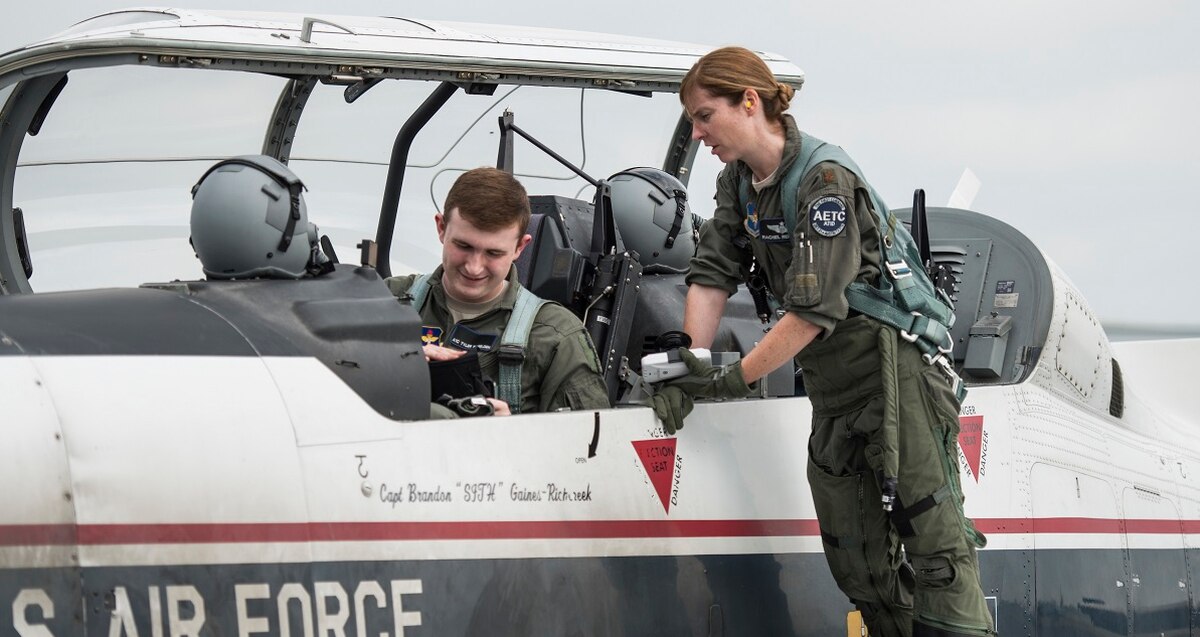
Air Force Trying To Attract Civilian Pilots

The Air Force is turning the tables on the aviation industry and is trying to attract trained civilian pilots into its corps. The Air Force is looking at two pathways to bring in pilots whose flying skills and general abilities will let them bypass some of the military training that all new Air Force officers go through. “Somebody who is exceptional and extremely well qualified might be able to bypass undergraduate pilot training altogether. We would put those folks through an Air Force fundamentals course … to bring them up to speed on Air Force differences, teach them how we fly, teach them the things that they need to know to make a difference,” Maj. Gen Craig Wills told Stars and Stripes . It’s also looking at working with colleges and universities that offer undergraduate aviation programs and include some military-style curriculum so that when they graduate they can skip some of the Air Force training if they decide to join up.

The Air Force is short pilots now and is training about 250 fewer than the 1500 a year it has set as a goal and attracting some from civvy street might be a partial answer. “Potentially, we could have an opportunity where we have added to the number of pilots at a relatively low-cost point,” Wills said. “Obviously, the number one thing is the quality of the training and the standard of these officers. That’s non-negotiable.” The Air Force is also trying to get more diversity in its cockpits, which are now occupied overwhelmingly (more than 80 percent)  by white males. There is, of course, more to being an Air Force pilot than being a great pilot.“The most important thing on that program is you still have to be willing to fight and kill and potentially die for your country to serve as an Air Force officer. And that’s a pretty big lift,” Wills said.

Helikopter - "Turøytypen" selges enda - Airbus Helicopters


H225 i Sør Koreansk tjeneste - Arkivbilde

Singapore receives its first H225M helicopter


@AirbusHeli @TheRSAF #MakingMissionsPossible #H225M

Singapore, 29 March 2021 – The Republic of Singapore Air Force (RSAF) has taken delivery of its first H225M helicopter in Singapore.

Airbus Helicopters signed a contract with Singapore’s Ministry of Defence for the acquisition of H225M Medium Lift Helicopters in 2016.

Congratulating Singapore on the H225Ms, Airbus Helicopters CEO Bruno Even said: “Airbus is very happy to celebrate this important milestone with the RSAF. This delivery is exceptionally significant as Airbus and the RSAF overcame the COVID-19 pandemic challenges in 2020 to achieve a smooth handover of the helicopter.”

“The RSAF has been a long-term partner of Airbus since its first Aerospatiale SA316B Alouette III entered into service more than 50 years ago. We appreciate the trust Singapore has placed in our helicopters, and we look forward to the H225Ms playing a critical role in the RSAF for many years to come,” added Even.

Singapore’s fleet of H225Ms is expected to assume a wide range of roles, including search and rescue, aeromedical evacuation, as well as humanitarian assistance and disaster relief operations.

A combat-proven multi-purpose and versatile asset, the H225M enables military forces to deploy wherever and whenever needed. 104 H225Ms are currently in service across the world, having accumulated more than 143,000 flight hours. The H225M is relied upon by Brazil, France, Indonesia, Malaysia, Mexico, Thailand, and Kuwait to support their most demanding missions.