


Has the Ukraine war sounded the death knell for military rotorcraft?
Among the iconic images generated by the Russia-Ukraine war is Russian military helicopters buzzing low over the Ukrainian countryside on the opening day of the full-scale invasion in February 2022.
Lines of Mil Mi-24s and Mi-8s streaked toward the city of Hostomel, discharging bright orange countermeasure flares at treetop level over the grey winter forests and fields north of Kyiv.
The mission, which ended up failing spectacularly, was to seize an airfield owned by Antonov, establish an airhead, and land large numbers of Russian troops via fixed-wing Ilyushin Il-76 transports.
Although a portion of the Russian army assault force did manage to land at Hostomel, their numbers were inadequate to firmly secure it. Enough helicopters and their escorts were downed by Ukrainian defenders armed with shoulder-fired missiles that the Russian troops could not hold their position.
They withdrew long enough for the Ukrainians to effectively destroy the airport runway and prevent the Russians from landing reinforcements.
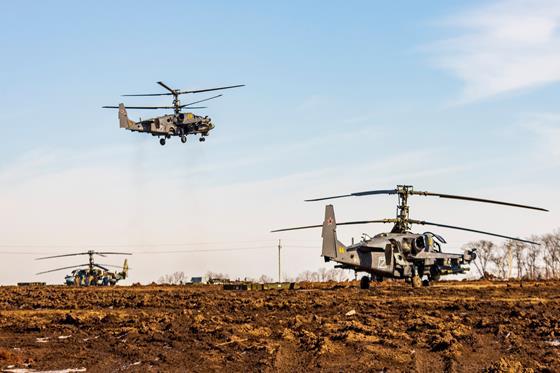
The battle at Hostomel, combined with significant Russian rotary-wing losses in the ensuing months, cemented the impression that the age of miliitary rotorcraft was ending.
Within a year of the Hostomel debacle, Russia had ceased large-scale helicopter operations. Ukraine’s small fleet of Soviet-era types has seen minimal frontline use.
Belief that the helicopter’s days were numbered deepened when the US Army cancelled development of the Future Attack Reconnaissance Aircraft scout platform in 2024.
That feeling continues to endure among many an armchair general, despite robust sales of existing rotorcraft designs from Sikorsky and Boeing and a US Army commitment to field Bell’s next-generation MV-75 tiltrotor.
But one former American general says it was bad Russian tactics and poor planning that drove high casualties in Ukraine, not the helicopter’s obsolescence.
“You see their aircraft flying in formation, in the middle of the day, at an altitude that is a perfect box for both surface-to-air missiles as well as small arms fire,” Jeffrey Schloesser tells FlightGlobal in an interview.
Schloesser, who is currently the senior vice-president of strategic pursuits at Bell, retired from the US Army as a two-star general, having commanded the helicopter-centric 101st Airborne Division and a battalion of the elite 160th Special Operations Aviation Regiment.
“The Russians, using really outdated tactics and techniques and procedures during the initial parts of the war, suffered huge amounts of rotary-wing casualties and I think that became the perception throughout much of the world,” Schloesser adds.
While the Bell executive certainly has incentives to downplay suggestions that the helicopter is obsolete, Schloesser says Russia’s struggle to effectively employ its rotary-wing force should in fact be regarded as an internal failing of Moscow’s generals and war plan.
In our latest analysis, based on a wide-ranging interview with Schloesser, we dig into the history of rotary-wing operations in the Russia-Ukraine war to try and answer a key question: is the helicopter still relevant on a battlefield saturated with precision weapons and drone swarms?
For an additional exploration of this issue, listen to the 1 December episode of the FlightGlobal Focus podcast, which features more of our interview with Schloesser and a discussion with the full FlightGlobal defence editorial team.
In the Indo-Pacific, the Australian army showed its feelings on the rotorcraft debate, commencing flight operations with the service’s growing fleet of Boeing AH-64E attack helicopters.
That milestone came just days after Boeing secured a mammoth, multi-billion Apache contract covering aircraft for Poland, Kuwait and Egypt.


Ingen kommentarer:
Legg inn en kommentar
Merk: Bare medlemmer av denne bloggen kan legge inn en kommentar.