onsdag 3. januar 2018

Helikopter - CEO i CHC snakker om 2018 - R&W


CHC CEO Talks Helicopter Industry Opportunities in 2018

By Woodrow Bellamy III | January 2, 2018


CHC Helicopter President and CEO Karl Fessenden has a lot to look forward to in 2018. The Texas-based helicopter operator is flying new helicopters in new regions for the first time — integrating new cockpit and health monitoring technologies into its operations and continuing to streamline its fleet and cost structure.

When CHC unveiled its new brand in 2017, one of your statements was that the company will "reach beyond legacy achievements." How will you continue to "reach beyond" in 2018?

We will continue to reach beyond in 2018 by staying focused on meeting the needs of our customers while further strengthening our safety culture. We’ve invested in our global fleet with the introduction of new Airbus H175s in Europe, Middle East and Africa, and Leonardo AW189s in Asia Pacific, and will continue discussing other options with current and future customers.

We have also been recognized for recent innovations such as our testing with Skytrac for a new real-time health and usage monitoring system (HUMS) and cockpit electronic flight bag (EFB) solution on a Leonardo AW139 and our APAC team’s advancement of white phosphor night-vision goggles in challenging conditions.


CHC Helicopter CEO Karl Fessenden. Photo courtesy of CHC

What initiatives or actions is CHC taking to improve safety?

One of our key year-end initiatives was launching our "Taking Care" safety campaign with employees and customers. We held stand-down events and briefings at every base during the month of December with candid discussions on how we can continue to build open and honest dialogue and further improve safety in all facets of our operation.

As you think about the operations and services across SAR, EMS, oil and gas transport and maintenance and repair that CHC Helicopter will provide in 2018, where do you see the biggest demand for your services? 

We are seeing signs of stabilization, but the market remains challenging. We expect to see new opportunities for oil and gas transport, renewable energy such as offshore wind production, search and rescue and emergency medical service needs in current and emerging markets, and our continued investment in our global maintenance, repair and overhaul capabilities through Heli-One.

Considering aviation is one of the most regulated industries in the world across all segments, are there any particular regulatory issues or challenges you see impacting CHC’s operations either in the U.S. or globally in 2018 and beyond?

The regulatory picture across the world is constantly changing, which is why we have a number of key personnel allocated to roles in tracking these changes both at the regional and global levels.

We recently amended our global safety management manuals to ensure we continue to be aligned with the latest thinking from ICAO on both global guidelines to general aviation and on safety management systems. In the regions, we are seeing changes in Australia — effectively, bringing EASA and CASA closer together in the way they conduct regulatory oversight — as well as further developments in Europe in the near future with the introduction of the Helicopter Offshore Operations (HOFO) regulations.

The helicopter community also continues to engage with the fixed-wing aviation community to see where we can learn from them on areas where regulations have already been implemented. Flight data monitoring and line operations safety audit (LOSA) are two examples of activity where we are ahead of the regulatory requirements and show that regulation is just one aspect of ensuring safety.

We will also continue to focus on the safety of our people and passengers as well as our industry. We will continue our close work with regulators and also other operators through our involvement with Helioffshore to continue to drive safety efforts on a global scale.

Are there any specific areas of CHC’s operations and services that you’re focused on improving or expanding upon in 2018? 

While the outlook for our industry remains challenging, we believe the actions we took in 2017, especially streamlining our fleet and cost structure to better meet the needs of our customers, has positioned us for both short- and long-term success. We are now the only operator that provides a true global standard of excellence based on best practices gleaned from seven decades of successful operations and a culture dedicated to taking care of safety for our employees and passengers. This ensures all of our customers receive the same level of service and reliability anywhere they need to go. We look forward to continuing to build on this strong foundation in 2018 and beyond.

SAR - Ulykkeshelikopteret frigitt av Statens Havarikommisjon for Forsvaret. TU


Nesepartiet på ulykkeshelikopteret mens det fortsatt befant seg på Leonardo Helicopters-fabrikken i Yeovil. Sensorene som synes er FLIR nederst, LOAM lengre opp og to lidarsensorer på hver sin utvekst. (Bilde: Eirik Helland Urke)

AW101 REDNINGSHELIKOPTER
Havarikommisjonen er ferdig med undersøkelsen av AW101-helikopteret
Gir redningshelikopteret tilbake til Luftforsvaret.
Norges første AW101-redningshelikopter hadde bare rukket å tilbringe ei uke på 330-skvadronens hovedbase på Sola da det veltet under bakkekjøring 24. november.
Nå jobbes det med å granske skadeomfanget, mens havarikommisjonen går videre til neste fase av sin undersøkelse:
– Vi har nå fullført de fysiske undersøkelsene av helikopteret. Det er frigjort til Luftforsvaret slik at de sammen med produsenten kan kartlegge skadene og starte reparasjonsarbeidet, forteller undersøkelsesleder Håkon Sitre i Statens havarikommisjon for Forsvaret (SHF).

Har hele hendelsesforløpet
SHF kunne ganske tidlig etter ulykken opplyse at de ikke hadde avdekket noen kritiske feil med helikopteret som har halenummer 0268 og er det fjerde helikopteret Leonardo Helicopters har produsert for Norge.
Dermed har det heller ikke gått ut noen varsler til produsenten, luftfartsmyndigheter og andre AW101-brukere.
Dataene fra den kombinerte taleregistratoren og ferdsskriveren (CVR/FDR) har blitt lastet ned hos den franske flyhavarikommisjonen, BEA, mens øvrige datalagringsenheter ble sendt til Leonardo-fabrikken i Yeovil i England.

Ferdsskriver/taleregistrator i avionikkhylla i ulykkeshelikopteret mens det fortsatt befant seg på produksjonslinja i England høsten 2016. Bilde: Eirik Helland Urke

Sitre forteller at de nå har en klar formening om hva som skjedde. Spørsmålet som gjenstår å finne svar på, er hvorfor.
– Framover vil vi fokusere på områder som samspillet mellom mennesker og maskin, design, grensesnitt, trening og prosedyrer. Men det er for tidlig å si noe mer om årsakssammenhenger, sier han.
Det er også for tidlig å si når den endelige undersøkelsesrapporten blir klar. Det er ikke planlagt noen foreløpig rapport. 

Utsatt innfasingsplan
Fortsatt er det ikke tatt imot flere enn det skadede helikoptret. Da dette ble levert var planen å ha to AW101-helikoptre på plass til en offisiell markering på Sola 20. desember. Denne ble utsatt.
Det som er mer kritisk enn seremonier, er at før AW101 kan tas i bruk operativt og overta for Sea King, må de gjennom en testfase (OT&E) som er beregnet å ta cirka et år selv med to og potensielt tre helikoptre involvert i prosessen.
I starten av desember opplyste Justis- og beredskapsdepartementet at de inntil videre jobbet for at leveransene skulle fortsette uten større forsinkelser, men bekreftet samtidig at hendelsen kan påvirke framdriften. Teknisk Ukeblad venter på svar fra departementet om hvordan framdriftsplanen ser ut i øyeblikket. 
Det sier seg selv at det begynner å haste dersom målet om å ha AW101 på alle 330-skvadronens seks baser i løpet av 2020 skal nås. 
Da det første helikopteret ble fløyet over Nordsjøen i november, var dette sju måneder forsinket. Etter planen det er jobbet med i flere år, skulle de første to AW101-maskinene blitt levert til Norge i slutten av mars 2017 og blitt faset inn fra april 2018.

At denne tidsplanen var i ferd med å ryke, kom fram da AW101 landet på norsk jord for første gang (se video under) i forbindelse med åpningen av 330-skvadronens nye hovedbase i juni i fjor. Da var formuleringen blitt endret til «innfasing i løpet av 2018».

SAS med to tunger

SAS har bebreidet LCC (Low Cost Carriers) for å benytte utenforstående selskaper ved ansettelse av flypersonell. Nå er det omtrent 10 nasjoner som flyr for SAS Irland. mange ansettes via bemanningsselskaper. SAS  følger altså i fotsporene til for eksempel Norwegian på flere områder. På tide å etterlyse egne ideer fra SAS . Nå er de bare en copy cat.

Longyear ikke lenger internasjonal flyplass - LT

Dette betyr at dersom en kommer fra utlandet, må en gå igjennom immigrasjons- og tollmyndighet et annet sted før en kan fly til Svalbard. Dette ble innført i fjor. Hvordan dette takles for skipsanløp vet jeg ikke. (Red.)

Changes to national airport

The Norwegian Ministry of Transport and Communications has decided to amend the status of Svalbard Airport Longyear (LYR) from international to national airport with effect from 1 October 2017.

mandag 1. januar 2018

2017 - Det sikreste flyåret i historien - The Independent


AIRLINE SAFETY: 2017 WAS SAFEST YEAR IN
HISTORY FOR PASSENGERS AROUND WORLD, RESEARCH SHOWS

That an Air France A380 lost an engine over the Atlantic and landed safely this year is 'testament to the robustness' of the aircraft / AFP/Getty Images

But air safety expert says 'It is unlikely that this historic low will be maintained' and warns of risk of electronic devices causing inflight fires
·      SIMON CALDER TRAVEL CORRESPONDENT
·         @SimonCalder
·         2 hours ago
CLICK TO FOLLOW
THE INDEPENDENT TRAVEL
In a year when more people flew to more places than ever, 2017 was the safest on record for airline passengers.
The Dutch-based aviation consultancy, To70, has released its Civil Aviation Safety Review for 2017. It reports only two fatal accidents, both involving small turbo-prop aircraft, with a total of 13 lives lost. 
No jets crashed in passenger service anywhere in the world. 
The two crashes which occurred on New Year’s Eve – a seaplane in Sydney which killed six, and a Cessna Caravan which crashed in Costa Rica, killing all 12 on board – are not included in the tally, since both aircraft weighed under 5,700kg - the threshold for the report.
The first fatal accident included in the report was in October: an Embraer Brasilia operating as an air ambulance in Angola. The pilots lost control after reportedly suffering an engine failure, Seven people died, including the patient.
In November, a Czech-built Let 410 belonging to Khabarovsk Avia crashed on landing at Nelkan in the Russian Far East with the loss of six lives. A four-year-old girl was the only survivor.
A much higher death toll occurred in Bishkek, the capital of Kyrgyzstan, when a Turkish Boeing 747 freighter belonging to ACT AIrlines overshot the runway and ended up in a village close to the airport, killing 35 on the ground as well as four crew.
In addition, jet blast killed a tourist standing close to the runway on the Caribbean island of St Maarten. 
The chances of a plane being involved in a fatal accident is now one in 16 million, according to the lead researcher, Adrian Young.
But Mr Young, senior aviation consultant for To70, told The Independent: “It is unlikely that this historic low will be maintained; in part, these very positive figures rest on good fortune. Nevertheless, the safety level that civil aviation has achieved is remarkable”.
He cautioned: “The risks to civil aviation remain high as shown by the seriousness of some of the non-fatal accidents.” They included, he said, “the spectacular loss of the inlet fan and cowling of an engine on an Air France A380” over Greenland in September.
“That the aeroplane continued to operate safely to a diversion airport and was then flown home for repair on three engines says a lot about the robustness of the aeroplane.”
The report warns that electronic devices in checked-in bags pose a growing potential danger: “The increasing use of lithium-ion batteries in electronics creates a fire risk on board aeroplanes as such batteries are difficult to extinguish if they catch fire.
“Airlines worldwide are training their crews to fight any fires in the cabin; the challenge is keeping such batteries out of passenger luggage.”
In 2016, 271 people lost their lives in seven fatal events. They included the crash of an Egyptair flight from Paris to Cairo which killed 66, and a LaMia jet carrying the Brazilian football team Chapecoense which ran out of fuel in Colombia and crashed with the loss of 71 lives.
The death toll in the two previous years was significantly higher. In 2015, 471 people died in four crashes; they included a Metrojet flight from Sharm el Sheikh to St Petersburg, Russia, which killed 224, and a Germanwings Airbus A320 from Barcelona to Dusseldorf whose first officer, Andreas Lubitz, killed 150 on board by deliberately crashing into the French Alps,
In 2014, 864 people died in five crashes, including the losses of two Malaysia Airlines 777s: MH370, whose fate is still unknown, and MH17, downed by a missile over eastern Ukraine.
The UK has the best air-safety record of any major country. No fatal accidents involving a British airline have happened since the 1980s. The last was on 10 January 1989; 47 people died when a British Midland Boeing 737 crashed at Kegworth in Leicestershire.

In contrast, sub-Saharan Africa has an accident rate 44 per cent worse than the global average, according to the International Air Transport Association (IATA). In November, Alexandre de Juniac, IATA’s director general, said: “African safety has improved, but there is a gap to close.”

Inflight photoshooting of a B787 - CNN video

Back to articleCNN) — "This is not an ordinary flight," says veteran Air Canada Captain Dave Butler. "We're going to have some fun today."
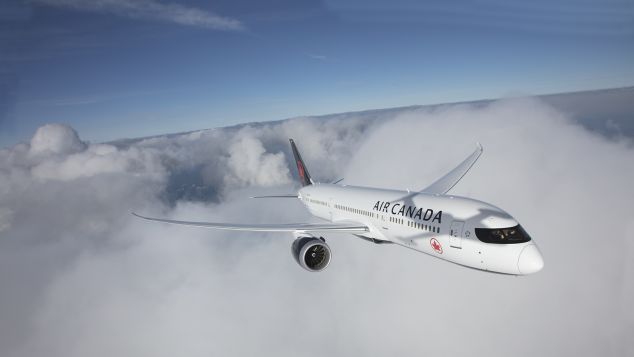
Air Canada had taken a 787 Dreamliner out of normal operation to be an actual runway model for its new corporate rebrand during a complex two-day photo shoot. The final product is pure glamor, but the meticulous creation is a side of the airline industry few get to see.
Only a handful of airline staff and CNN were aboard this 298-seat airliner.
The pristine jetliner had been delivered just days before from Boeing. The customary preflight safety briefing that would typically have been presented by a flight attendant fell to Butler.

New look

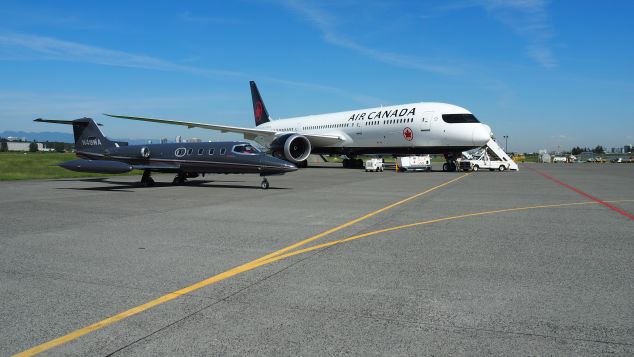
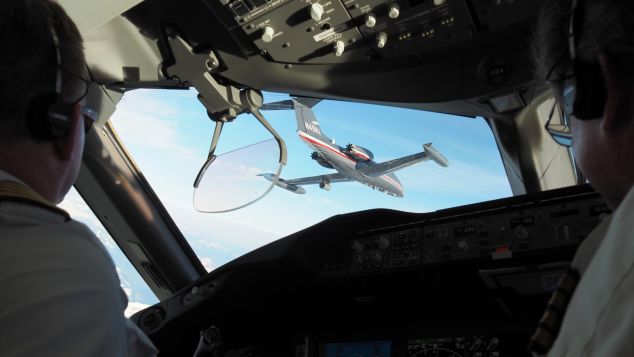
For two days in May, the long-range airliner started and ended its flying in Vancouver, British Columbia. The Air Canada plane was chased by a Learjet 25B business jet, flown by Los Angeles-based aerial photographers Wolfe Air Aviation.
Air Canada is in the middle of a makeover from the ground up. From uniforms to catering to the paint scheme on its airliners, the carrier is shedding more than a decade of pearlescent blue in favor of black, white and red on its airplanes. The vanity shoot will become the backdrop for the airline's rebranding.
Kevin La Rosa II, pilot and aerial photography coordinator for Wolfe Air, led the team for the high-flying photo shoot.
"It's fun for our team to show up [for] a new livery because we're all airplane fanatics, too. So we come in and we study the way the paint job looks...we're literally planning how we're going to attack it and cover every single part of the aircraft," said La Rosa.

AC-Lear-Howard Slutsken-7
The new Air Canada design took part in a photoshoot in the air -- tailed by a photographer in a Learjet 25B business jet, pictued left.
Courtesy Howard Slutsken

Jetliner ballet

The final product looks effortless; A piece of advanced machinery caught soaring over the natural beauty of Canada's West Coast. Capturing such imagery is a ballet where the pilots have to know every move, but the dance of the two aircraft can't be choreographed in advance. The sky is an unpredictable photo studio.
La Rosa, 31, is a second-generation aerial photographer. His credits include the Marvel movies and nearly every Transformer film. He earned his Screen Actors Guild card flying a helicopter for the 2005 movie "Mr. and Mrs. Smith."
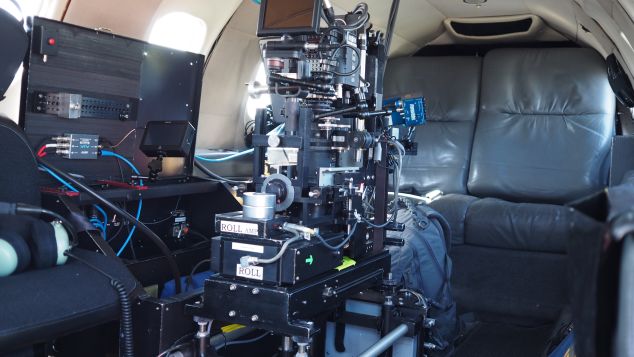
The cramped flight deck of the modified business jet has three monitors up front to give La Rosa and his co-pilot a look through the lens.
"Anywhere we put our eyes, we have a very quick reference of what the framing looks like," said La Rosa. "We literally fly the shot. The jet becomes nothing more than a [camera] dolly in the sky."

The Learjet 25B business jet is equipped with apparatus to capture Air Canada en route.
Courtesy Howard Slutsken
The Learjet's cabin is not a whole lot bigger than a minivan. Packed with a million dollars of high-tech camera gear, flights only last about two hours. The plane's engines guzzle fuel, but they respond instantly, giving the short-winged Learjet snappy maneuverability. Add an underwing still camera pod and a dark gray paint scheme, and the 40-year-old plane is easily mistaken for something sinister.
In fact, during a low pass over downtown Vancouver on the first evening of filming, police phone lines were flooded with calls from citizens concerned they were witnessing some type of military activity.


Outsmarting an airlinerThe high-flying photo shoot is a complex scenario.


The high-flying photo shoot is a complex scenario.
Courtesy Howard Slutsken
Aboard the modified business jet was Brian Losito, Air Canada's corporate photographer who typically spends his days documenting the Montreal-based airline's fleet from the ground.
"Kevin gets me in the perfect light and the perfect background," said Losito, who took 2,500 photos on the first day alone. "But if I haven't got the shot, I'll ask them. I'm in constant communication."
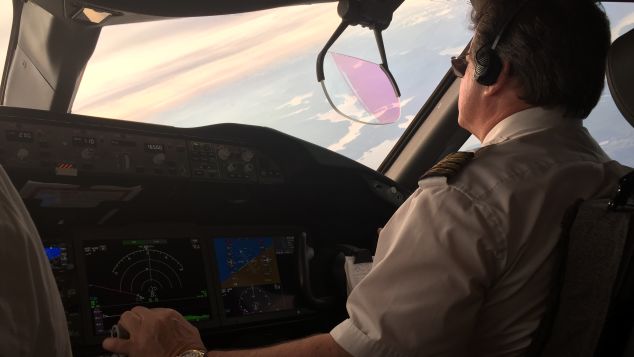
During the flight, Capt. Butler handled air traffic communication and co-ordination with the Learjet, while Capt. Mark Watt, an accomplished formation pilot who spends his off-duty time flying at the Reno Air Races, hand flew the 787.
Hand-flying the 787 requires outsmarting the advanced airliner. With steep banks and quick turns planned, Watt learned on an earlier flight to disable the autopilot from automatically righting the jet and leveling its wings while he was maneuvering for the perfect shot.
Every flight has to be done in close coordination with air traffic control. Watt and Butler have to accept responsibility for keeping the airplanes at a safe distance.
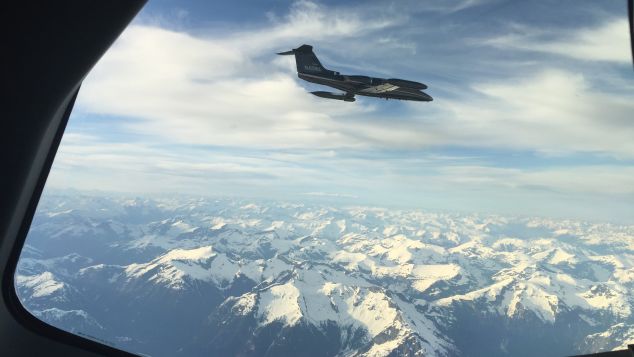
Capturing these photographs in the skies involves the two planes in tight formation and continuous communication.
Courtesy Howard Slutsken
Once in formation, the Learjet switches off its location tracking transponder, and the pair becomes a 'flight of two.'
"We're the mothership for ATC," said Watt. The Learjet "can always see us, they never lose sight of us even when we lose sight of them."

Hazardous flying

Flying the nimble Learjet so close to a 206-foot long Dreamliner is extremely dangerous. La Rosa has to keep a safe distance at all times while getting the perfect shot.
"You just have to adapt. You have to be totally flexible. Safety is number one. If somebody doesn't like something, we knock it off," said Watt.
This Air Canada experience was no ordinary flight.
Courtesy Howard Slutsken
Just like an enormous ship on the water, the 787 creates a wake that can flip a smaller plane if it gets too close in the wrong spot -- below and behind the jet's wings.
"It could damage the aircraft and hurt us," said La Rosa. "You can feel when you're right next to it. I've never hit a wake and I never want to."

B787-9 Learjet Shadow-Brian Losito-Air Canada

The finished results show off Air Canada's new look.
Courtesy Brian Losito/Air Canada
Even as the Lear flew just feet ahead of the 787's nose, La Rosa could feel the Air Canada jet's bow wave nudging the tail of the much smaller plane. From the flight deck of the 787, you could hear the rumble of the nearby Learjet's engines as it pulled in tight.
As a passenger on an empty jetliner, it's tempting to press your nose up against the window, watching the sleek business jet pull in tight. But the lucky few aboard had to keep their distance. One face in the enormous windows might spoil an otherwise perfect shot.

12 omkom i ulykke med Cessna Caravan i Costa Rica - Twitter

image on Twitter
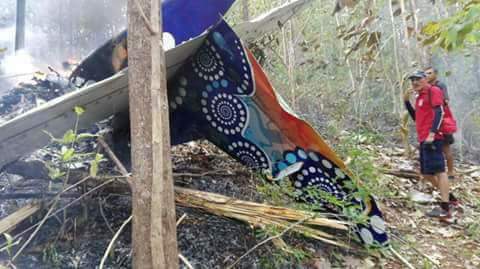
View image on Twitter Derecho AéreoCR @CrAereoAl ser las 12:16pm se da la Alerta#4B cerca del Campo de Aterrizaje de Punta Islita tras la caída de la Aeronave Cessna Gran Caravan 208B matricula TI-BEI operado por la compañía Nature Air. En la Aeronave viajaban 2 Tripulantes y 10 Pasajeros, todos fallecidos.