Formålet med bloggen er å bidra til informasjon om luftfart av alle slag. Også litt om ubåter og forsvarsspørsmål. Nyheter vil du finne her også, en del på engelsk som er det mest brukte luftfartsspråket. Har du selv noe som bør komme ut, så send meg en mail til per.gram@hesbynett.no - Politikk på alle nivåer over hele verden er i kaos. Voldsomme endringer kan finne sted på kort tid, som også kan få innvirkning på forsvarsdisposisjoner. Det må kommenteres.
Airlines offer £354,000 salary TAX FREE as world faces massive pilot
shortage
Reports say the world needs 620,000 new pilots over the
next two decades - and airlines are reaching out with huge salary offers to
those that they can employ
A MASSIVE global pilot shortage is causing
desperate airlines to raise salaries to $500,000 (£354,000) year.
Due to
increased demand in the travel industry, more planes are being ordered, so more
pilots are needed to fly them. Who will fly our planes? More people wanting to
travel means the demand for pilots is ever-growing
Who will fly our
planes? More people wanting to travel means the demand for pilots is
ever-growing In 2016, aircraft manufacturer Boeing predicted that the
aviation industry would require 620,000 new pilots over the next two
decades.
And in Asia, where people's disposable income is increasing and
flying for work or pleasure is becoming more common, many airlines are falling
short.
"China is trying to attract pilots by paying $500,000 (£354,000)
tax free," says a BBC report.
Solutions such as airlines subsidising the
cost of training and recruiting more women - who currently only account for 3
per cent of pilots worldwide - have been mooted.
It can cost up to £120,000 to train as a
commercial pilot It currently costs anywhere between £40,000 and
£120,000 to train as a commercial pilot and most airlines expect the student
pilot to pay.
According to Flight Deck Friend a full-time commercial
flight training course completed at a European flight school will cost upwards
of £80,000 to around £120,000.
And on his blog Ask the Pilot, Patrick
Smith explains: "Although pilots are earning more, overall quality of life is
still suffering. And that's because things are in panic mode.
"The
industry is being reactive when it should have been proactive. The improvements
we're seeing should have been put in place years ago.
"Because they
weren't, numerous airlines now face chronic understaffing issues. This results
in pilots being forced to work high-stress schedules with minimal time
off."
Last year the pilot shortage in the UK caused budget carrier
Ryanair to cancel hundreds of thousands of flights.
Europe's largest
airline sparked outrage by cancelling 20,000 flights after admitting it did not
have enough standby pilots to operate its schedule without significant
delays.
It responded by promising pilots significant improvements in pay
and conditions, exceeding rates paid by rivals, with negotiations to take place
with each of its 86 bases individually.
The airline said: "Ryanair will
continue to engage with the London Stansted ERC (Employee Relations Council) to
understand how it can address their remaining concerns, especially as it will be
recruiting new pilots in Stansted from November at these higher pay rates."
Watch an airplane fill with smoke after a phone charger
explodes Electronics and their accessories exploding
unexpectedly has become so commonplace that no one even seems to be surprised
any more when it happens. For example, earlier this week a video surfaced of a
portable phone charger ablaze on the floor of an airplane as it was landing.
Rather than panic, the passengers simply gathered around to see what was going
on. One even offered up a water bottle, but a fire extinguisher was used to put
out the fire.
According to local reports, the fire broke out on board an
Aeroflot Airbus A320 on January 30th just as the plane was touching down at the
Volgograd airport. Once the fire had been extinguished, the passengers were
evacuated off of the plane, which (as you can see in the video) had begun to
fill with smoke.
"As passengers were disembarking following a routine
landing, a portable power bank belonging to one of the passengers began emitting
white smoke," said an Aeroflot spokesperson. "The smoke was immediately put out
by cabin crew, and all passengers calmly disembarked as normal using regular
airstairs. There were no injuries."
Although the scene
was surprisingly calm, at least a few people were panicked enough to release two
emergency slides, which were allegedly used by at least a few of the passengers
(although that's not what Aeroflot says).
The fact that the plane had
already landed certainly made the incident less terrifying than it would have
been if the passengers felt they were stranded in midair with a fire. Still,
it's rather impressive to see a group of strangers react with composure to a
small explosion, especially when the whole world seems to be on high alert.
Narrative:
A Beechjet
400A, N570TM, suffered a runway excursion incident after landing on runway 24R
at Cleveland. The aircraft ended up in the Engineered Material Arresting
System (EMAS) at the end of the runway.
According to FAA
records, this is the 13th incident to date where EMAS has safely stopped an
overrunning aircraft. It is the first such incident at Cleveland-Burke Lakefront
Airport.
Politikerne bør nå innse at Forsvaret har gjort en stor feil som må rettes på. Den eneste løsningen er å kansellere kontrakten med NH Industries, og å vurdere nye helikoptertyper, eksempelvis typene under. Min personlige vurdering er at Seahawk, med sin ekstremt lange fartstid i mange versjoner, er et sikkert valg. 28 nasjoner flyr den, bl.a. Danmark med Seahawk og Sverige med Blackhawk.
Elon Musk's huge Falcon Heavy rocket set for launch
By Jonathan AmosBBC Science Correspondent
6 hours ago
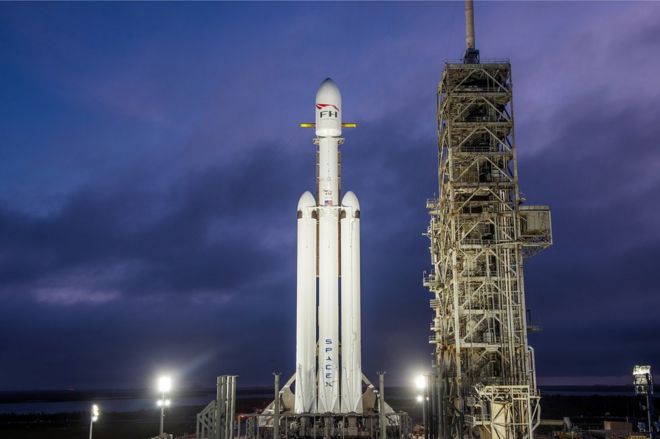
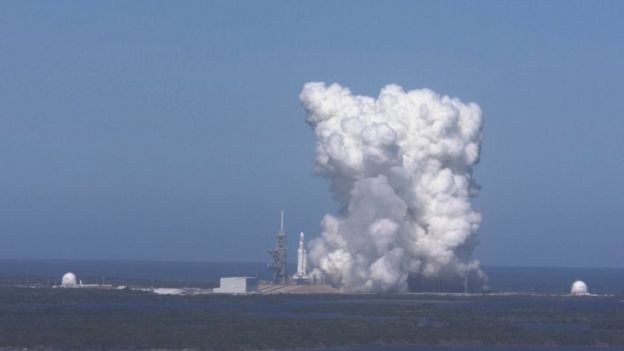
Image copyrightSPACEXImage caption The Falcon Heavy will go up from the Kennedy Space Center
US entrepreneur Elon Musk will attempt to fly the world's most powerful rocket later from the Kennedy Space Center.
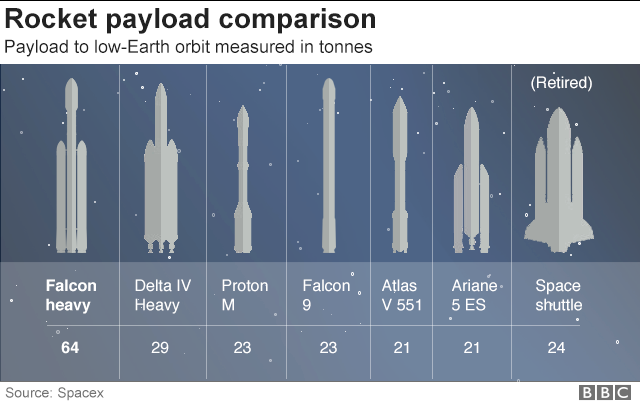
His Falcon Heavy vehicle is designed to have more than twice the lifting capacity of any existing launcher.
Because of the historic high failure rate of maiden flights, the rocket will only carry a dummy payload, however.
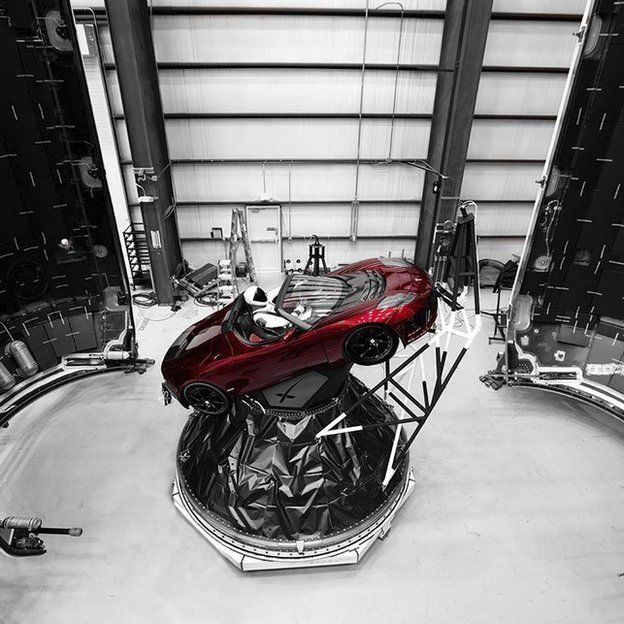
Mr Musk has decided this should be his old cherry-red Tesla sports car. A mannequin wearing a space suit will be strapped to the driving seat.
The entrepreneur says David Bowie's classic hit Space Oddity will be looping on the radio in the roadster as it is hurled into an elliptical orbit that stretches out to Mars' orbit around the Sun.
"[The car will] get about 400 million km away from Earth, and it'll be doing 11km/s," he told reporters in a briefing on Monday. "We estimate it will be in that orbit for several hundred million years, maybe in excess of a billion years."
Three cameras attached to the car would provide "epic views", Mr Musk added.
Image copyrightElon Musk/InstagramImage caption The car will be sent towards Mars' orbit - but there is little chance it will hit the planet Thousands of spectators are expected to descend on Florida's Space Coast to witness the ascent, which could occur as early as 13:30 EST (18:30 GMT).
Mr Musk's rocket company, SpaceX, has given itself three hours to get the vehicle up on Tuesday. If technical glitches lead to a postponement, a second attempt will be made on Wednesday.
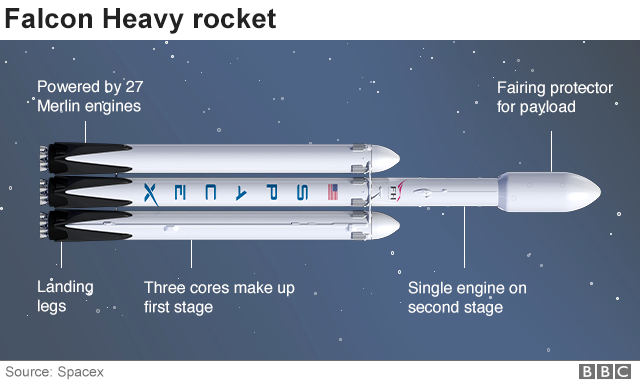
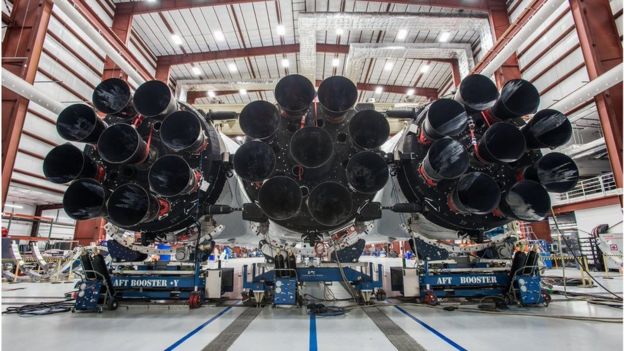
The Falcon Heavy is essentially three of SpaceX's workhorse Falcon 9 vehicles strapped together. But the triple-booster configuration has demanded a number of specific alterations, including a strengthening of the central core booster.
The 27 Merlin engines at the base of the rocket should be capable of generating almost 23,000 kilonewtons of thrust - slightly more than double that of the world's current most powerful rocket, the Delta IV Heavy, which is operated by US competitor United Launch Alliance. The 70m-tall Falcon Heavy is designed to put up to a maximum of 64 tonnes in low-Earth orbit. That is like putting five London double-decker buses in space.
In reality, however, the Heavy would rarely be asked to raise so much because SpaceX intends to land the rocket's boosters back on Earth after launch and the fuel required to do this necessarily negates some performance. But the rocket's immense thrust does open up some fascinating new possibilities. These include:
much bigger satellites for use by US intelligence and the military. The scale of these satellites is limited by current rocket performance.
large batches of satellites, such as those for Mr Musk's proposed constellation of thousands of spacecraft to deliver broadband across the globe.
bigger, more capable robots to go to the surface of Mars, or to visit the outer planets such as Jupiter and Saturn, and their moons.
putting up huge telescopes. Hubble's successor, the James Webb telescope, is having to be folded origami-like for its launch in 2019
At the moment, the Falcon Heavy only has a handful of bookings on its manifest.
Two of these are for large telecommunications satellites that must be thrown up into a geostationary orbit some 36,000km above the Earth.
"These satellites are over six tonnes, knowing that the capacity of the rocket is eight tonnes to geostationary transfer orbit (GTO) - if it is fully reused," Rachel Villain, from the leading space consultancy Euroconsult, told BBC News.
"So, obviously, the objective must be to fully re-use the rocket, otherwise the capacity to GTO is 20 tonnes which is a lot to fill."
She added: "The main targets are possibly the US government and those proprietary constellations. And when I say US government, I mean both beyond Earth orbit (Nasa) and the US Department of Defence, because SpaceX is now a recognised supplier to the DoD for classified and non-classified missions." Assuming it works, the Falcon Heavy raises some thorny issues for US space policy.
While Nasa could certainly find many uses for the extra capability, it has its own "monster rocket" in development.
The conundrum for the agency and legislators in Washington DC is that this Space Launch System, as it is known, is still some years away from entering service (in a 70-tonnes to LEO configuration); but more than that - it will probably cost about $1bn per flight. Mr Musk says his Falcon Heavy will cost just $90m per flight.
Many commentators are already asking how Congress can justify the considerable extra expense of the SLS when a much cheaper alternative is about to become available.
And Mr Musk is not the only entrepreneur developing a commercial heavy-lift solution that promises to dramatically undercut the SLS on cost.
Jeff Bezos, the head of Amazon.com, is working on a rocket he calls New Glenn, which should be able to put 45 tonnes in low-Earth orbit. He has even teased something more powerful still, called New Armstrong. Image copyrightSPACEXImage caption A test firing of the engines occurred at the end of last month Mr Musk has emphasised the difficulties in getting the Falcon Heavy ready for its maiden outing.
His formal announcement of the project was in 2011, with a first flight planned for perhaps 2013. Five years later, the entrepreneur concedes the chances are significant.
"If it goes wrong, hopefully it goes wrong far into the mission, so at least we learn as much as possible along the way," he said.
"I'll consider it a win if it just clears the pad and doesn't blow the pad to smithereens. That's 4,000,000lbs of TNT equivalent. There's probably not going to be much left if that thing lets loose."
Getting all 27 engines to light in unison and control them during the first phase of ascent is not straightforward.
The Soviets tried to ignite 30 engines on the first stage of their ill-fated Moon rocket, the N1, and never got to orbit. Mr Musk has a future rocket under development he calls the BFR. This will feature 31 first-stage engines. Image copyrightSPACEXImage caption The Falcon Heavy is essentially three Falcon 9s strapped together Jonathan.Amos-INTERNET@bbc.co.uk and follow me on Twitter: @BBCAmos