
Sjekk overskrifter med resymè her: https://tinyurl.com/2p856cmv

Formålet med bloggen er å bidra til informasjon om luftfart av alle slag. Også litt om ubåter og forsvarsspørsmål. Nyheter vil du finne her også, en del på engelsk som er det mest brukte luftfartsspråket. Har du selv noe som bør komme ut, så send meg en mail til per.gram@hesbynett.no - Politikk på alle nivåer over hele verden er i kaos. Voldsomme endringer kan finne sted på kort tid, som også kan få innvirkning på forsvarsdisposisjoner. Det må kommenteres.


ATW 2022 Award Winners Span The Globe
March
31, 2022

Credit: Rolls-Royce
Air
Transport World has announced the 10 winners of its 2022 ATW Airline
Industry Achievement Awards.
The
2022 ATW winners span the globe and will be celebrated at a
gala dinner on June 21 in Doha, Qatar. They include US carrier Alaska Airlines,
which was named Airline of the Year; Eco-Airline of the Year Widerøe, a
Norwegian regional carrier; Cargo Operator of the Year Korean Air; Value
Airline of the Year Indian LCC IndiGo; Airline Market Leader Royal Jordanian;
and Regional Airline of the Year Canadian North.
In addition,
awards will be presented to two individuals who have made important and
significant contributions to the global air transport industry. Former Hawaiian
Airlines CEO Mark Dunkerley will be honored with the Lifetime Achievement Award
and AerCap CEO Aengus Kelly will receive the Excellence in Leadership Award.
ATW will also
recognize the achievements of the Commercial Aviation Alternative Fuels
Initiative, or CAAFI, with the Eco-Organization of the Year Award, and L3Harris
with the Aviation Technology Achievement Award.
“We are very
excited about celebrating the remarkable achievements of our 2022 winners, who
demonstrate the continued strength and innovation of this industry,” ATW Editor-in-Chief
Karen Walker said.
The
2022 ATW Winners are:
Alaska
Airlines: Strong
financial and operational performances combined with a deep commitment to and
investment in industry-leading carbon emission reduction initiatives won Alaska
the top honor of Airline of the Year. The airline also joined the oneworld
global alliance, launched the Ascend Pilot Academy for aspiring pilots and
implemented network optimization software, Flyways, that uses artificial
intelligence and machine learning to optimize air traffic and enable more
fuel-efficient flight paths for aggregate savings of fuel, carbon emissions and
time.
Widerøe: As one of
Europe’s largest regional carriers, Norway-based Widerøe has been at the
cutting edge of ensuring a sustainable future for aviation. Through its
subsidiary Widerøe Zero, it partnered with Embraer and Rolls-Royce to study a
conceptual zero-emission regional aircraft, and with Tecnam and Rolls-Royce on
an all-electric commuter class aircraft for entry into service in 2026.
IndiGo: India-based
IndiGo is one of the world’s fastest-growing low-cost carriers. IndiGo
increased its market share during the pandemic, and as borders reopen, it is
continuing expansion into international markets, as seen in the March
announcement about restoring flights to Thailand. IndiGo has maintained a
disciplined approach to its growth and was one of very few airlines to not
defer aircraft deliveries during the pandemic, still taking new Airbus
narrowbodies from its massive order backlog.
Korean Air: Last
Year, Korean Air was named the ATW 2021 Airline of the Year.
Korean has continued to go from strength to strength, remaining at the
forefront of addressing the global cargo capacity shortages resulting from the
pandemic. Korean is named the 2022 Cargo Operator for being a pioneer in
converting passenger aircraft to freighters, launching two new gateways in the
US, at Rickenbacker International in Columbus, Ohio, and Chicago Rockford in
Illinois, that are helping alleviate American’s supply chain issues. In other
innovations, Korean also introduced iCargo, a cloud-based air cargo management
system that standardizes cargo service.
Royal
Jordanian: The
national carrier of Jordan set a vision to be the airline of choice connecting
Jordan and the Levant with the world. From its hub at Queen Alia International,
the national carrier of the Hashemite Kingdom of Jordan provides an extensive
network for passengers via Amman to Levant, Europe, the US, Canada, North
Africa and the Far East. Through its oneworld global alliance partners, that
network includes over 1,000 airports in 170 countries. The airline smartly leverages
Jordan’s location to attract travelers seeking a rich tourism experience,
whether religious, eco and adventure, wellness or history and culture.
Canadian
North: In its
76th year, this remarkable carrier is 100% owned by Inuit Birthright
organizations and provides essential passenger and cargo services to 25 remote
Canadian Arctic communities, most of which have no land or year-round marine
access. Canadian North also operates thousands of charter flights each year
throughout North America and beyond. It continued operations through the
pandemic, upgraded its fleet with Boeing Next-Generation 737 aircraft and
collaborated with Amazon to launch the first delivery hub in the Canadian
Arctic. It is an airline with a mission, heart and a dedication to the customers
and communities it serves.
Mark
Dunkerley: Dunkerley
has devoted his life to aviation and the airline business. Among his many
accomplishments, he led Hawaiian Airlines from bankruptcy in 2003 to being one
of the world's most successful airlines by the time of his retirement as
President and CEO in 2018. Previous roles included senior executive positions
at Sabena, British Airways and Miami International Airport. A pilot with
several ratings up to commercial pilot, he continues his work promoting and
safeguarding the air transport business as Board Chair of the esteemed
Smithsonian National Air and Space Museum in Washington DC.
Aengus
Kelly: Kelly
continues his distinguished career as a leader and shaper of the global air
transport industry. As CEO and Executive Director at Dublin-based AerCap, he
leads an aviation leasing company that is the world’s largest owner of
commercial aircraft and the most active aircraft trader. Having overseen the
successful acquisition of GE Capital Aviation Services (GECAS), he has created
a combined company that owns approximately 2,000 aircraft, over 900 engines and
more than 300 helicopters with a highly attractive portfolio, a diversified
customer base, an industry-leading team, and an order book of around 400 of the
most in-demand new technology assets in the world.
CAAFI: The
Commercial Aviation Alternatives Fuels Initiative is a key public-private
partnership working to foster the development, commercialization, and
availability of sustainable aviation fuel (SAF), an essential path to lowering
the carbon footprint of aviation over the next two or three decades. CAAFI’s
influence is broad and deep and is key to enabling and fostering aviation
sustainability ambitions, such as the IATA net-zero carbon emissions by 2050
goal announced in 2021 and the US government’s adoption of a SAF Grand
Challenge to replace all of aviation’s jet fuel consumption with SAF by 2050.
L3Harris
Commercial Aviation: Ab initio pilot training is a very important
part of the process of taking people with little or no flying experience and
onto a commercial airline career track that is essential to addressing the
global shortage of airline pilots. L3Harris has revolutionized the technology
within its Airline Academy, developing and deploying Flight Data Monitoring for
its ab initio environment, making it safer, data driven and more measurable.
Despite numerous challenges through the pandemics, L3Harris ensured this safety
initiative stayed on track and gained momentum.
The
48th ATW Awards, sponsored by CFM International, will be
presented at a gala dinner on June 21in Doha, Qatar, at the closing of the 78th
IATA AGM and World Air Transport Summit.
Trans-Atlantic team to
develop technical concept for NATO’s Future Surveillance and Control
capabilities
By
-
31 March 2022

Ⓒ Airbus SAU
2022 MANGO Producciones
Airbus
Defence and Space together with Northrop Grumman Corporation (NYSE: NOC) and
seven industrial players forming the ASPAARO (Atlantic Strategic Partnership for Advanced
All-domain Resilient Operations) team
have been selected by the NATO Support and Procurement Agency (NSPA) to conduct
one of three Risk Reduction and Feasibility Studies (RRFS). The studies aim to
suggest technical solutions for the Alliance Future Surveillance and Control
(AFSC).
In November
2021, Airbus with subcontractors Northrop Grumman, BAE Systems (UK), Exence
(Poland), GMV (Spain), IBM (US), KONGSBERG (Norway), Lockheed Martin (US) and
MDA (Canada) submitted a proposal to NSPA outlining how this transatlantic team
would address the complexities of NATO’s future capability requirements.
The
selection of the ASPAARO team as a study partner represents an important step
toward providing NATO with unmatched tactical surveillance, command and control
capabilities to overcome the challenges of the future and replace the current
Airborne Warning and Control System fleet which will reach the end of its
service life around 2035.
Over the
next months the ASPAARO team will perform a thorough assessment of a fully
distributed surveillance model; refine details; assess related feasibility,
risks and costs; and provide a recommended technical solution with proven
technologies, open standards and interfaces for the multi-domain capabilities
AFSC shall provide.
“Airbus is
committed to a long-lasting cooperation with NATO and its member nations on the
Alliance Future Surveillance and Control (AFSC) programme. The current crisis
situation is a reminder that vigilance, as well as surveillance and control
capabilities, are of key importance to the defence of the Alliance. Airbus
Defence and Space is leading the ASPAARO team which will be contributing to the
Risk Reduction and Feasibility Studies. The focus is on a cross-domain fully
distributed system to create the most reliable, resilient and capable solution
for NATO’s future surveillance and control,” said Michael
Schoellhorn, CEO of Airbus Defence and Space.
Northrop
Grumman President of Aeronautics Systems Tom Jones stressed ASPAARO’s team
commitment to NATO’s security mission. “The ASPAARO
team brings together some of the world’s best engineers, scientists and system
managers. The team is committed to offering optimum technical solutions to our
NATO customer’s future surveillance and security needs.”
The outcome
of the three studies will help NATO and individual allies make informed
decisions on the final AFSC technical concept and acquisition of surveillance
systems.

A search-and-rescue mission was started, but due to adverse weather conditions (snow) and the risk of falling objects, no emergency services could be deployed so far. The mission, however, was able to use a drone to get a more detailed overview of the site.
Hanspeter Krüsi, head of communications of St.Gallen police, said to local press that the destruction of the aircraft is enormous and that they were expecting that the sole occupant, a 63-year-old Italian, had died.
Säntis is the highest mountain in the Alpstein massif of northeastern Switzerland.
| Status: |  Information is only available from news or social media reports Information is only available from news or social media reports |
| Date: | Wednesday 30 March 2022 |
| Time: | 12:22 |
| Type: | 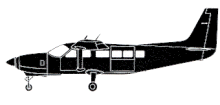 Cessna 208 Caravan I |
| Operating for: | Skydive Costa d'Argento |
| Registration: | D-FLIC |
| MSN: | 20800274 |
| First flight: | 1998 |
| Crew: | Fatalities: 1 / Occupants: 1 |
| Passengers: | Fatalities: 0 / Occupants: 0 |
| Total: | Fatalities: 1 / Occupants: 1 |
| Aircraft damage: | Destroyed |
| Aircraft fate: | Written off (damaged beyond repair) |
| Location: | Säntis Mountain ( Switzerland) Switzerland) |
| Phase: | En route (ENR) |
| Nature: | Unknown |
| Departure airport: | Siegen-Siegerland Airport (SGE/EDGS), Germany |
| Costa d'Argento Airfield, Italy |
Narrative:
A Cessna 208 Caravan I, D-FLIC, was destroyed when it impacted the side of a mountain.
A police spokesperson stated that they were expecting that all occupants of the aircraft had died. It is unclear at this time how many were on board.

“After an extensive business and technical review, we are pleased to announce that we have launched the De Havilland DHC-515 Firefighter program, which will involve negotiating contracts with our European customers and ramping up for production,” said Brian Chafe, Chief Executive Officer of De Havilland Canada.
The DHC-515 Firefighter will build on the history of the iconic Canadair CL-215 and CL-415 aircraft which have been a critical part of European and North American aerial firefighting fleets for over 50 years. Important upgrades are being made that will increase the functionality and effectiveness of this legendarily rugged firefighting aircraft.
European customers have signed letters of intent to purchase the first 22 aircraft pending the positive outcome of government-to-government negotiations through the Government of Canada’s contracting agency, the Canadian Commercial Corporation (CCC). De Havilland Canada expects first deliveries of the DHC-515 by the middle of the decade, with deliveries of aircraft 23 and beyond to begin at the end of the decade, providing other customers with the opportunity to renew existing fleets or proceed with new acquisition opportunities at that time.
De Havilland Canada acquired the Canadair CL programme in 2016 and has been contemplating a return to production since 2019. The new DHC-515 Firefighter matches the other aircraft in the De Havilland fleet in terms of lifespan, ruggedness and Canadian aerospace engineering quality. The final assembly of the aircraft will take place in Calgary, Alberta where work on the CL-215 and CL- 415 aircraft currently takes place. It is anticipated that more than 500 people will need to be recruited over the coming years to successfully deliver this programme.
“To bring the DHC-515 into production is important for not only our company, but countries around the world who rely on our aircraft to protect their people and forests,” said Chafe. “We understand the important role the previous aircraft have played in protecting people and property and as our climate continues to change and summers increase in both temperature and length, the DHC-515 will be an important tool for countries around the globe to use in putting out fires.”

FedEx Express to Test Elroy VTOL for Autonomous
Middle Mile Cargo Delivery
By Woodrow Bellamy III | March 30, 2022
Send Feedback | @WBellamyIIIAC
autonomous air cargo, Chaparral, Elroy Air, VTOL

FedEx is partnering with Elroy Air to evaluate the
use of an autonomous VTOL aircraft for middle-mile logistics operations. (FedEx
Express)
FedEx Express, the regional subsidiary of FedEx
Corp., has a new partnership agreement with Elroy Air aimed at flight-testing
their autonomous vertical takeoff and landing (VTOL) air cargo system for
middle-mile logistics operations by 2023.
Elroy Air revealed its pre-production vertical takeoff and landing (VTOL) aircraft,
the Chaparral—which could become the first end-to-end autonomous VTOL air cargo
system—in January. Headquartered in San Francisco, the startup has received funding from Catapult Ventures, Lockheed Martin Ventures, Marlinspike
Capital, and Prosperity7 Ventures, in addition to various angel investors.
The new agreement between the two companies is a
“first of its kind agreement,” according to the March 30 announcement from
FedEx Express, which plans to test the Chaparral’s ability to fly shipments
between its various sortation facilities. Joe Stephens, senior vice president
of engineering and technology at FedEx Express, in the announcement said the
air cargo operator was “built on innovation and we are always looking toward
new technologies to help enhance the logistics industry through improved
safety, efficiency and customer service.”
Chaparral is being developed with a
hybrid-electric architecture and an in-flight rechargeable lithium battery to
be capable of carrying cargo weighing up to 500 pounds with a maximum range of
300 miles. An early prototype of Elroy’s Chaparral was first flown in 2019.
Today, the model possesses eight vertical lift fans, four distributed electric
propulsors, and updated systems for ground autonomy and cargo handling.
FedEx Express is the second regional carrier to
express interest in future operations of Chaparral, after signing an agreement
with Mesa Airlines for a future purchase of up to 150 aircraft. Kofi Asante,
Elroy Air’s vice president of business development, said the company is ready
to help FedEx build “the next generation of express logistics. When you’re not
limited by challenging infrastructure, traffic, or airports, logistics can
reach more people, faster than ever before.”
Elroy Air first began working with FedEx in
January 2020, and will continue to pursue certifications toward a goal of
beginning flight-testing of the Chaparral for middle-mile logistics operations
in 2023.


The NATO Support and Procurement Agency (NSPA) has awarded a contract for a study on future air surveillance, command and control concepts to a team led by Boeing. The risk reduction and feasibility study is being conducted in preparation for the planned retirement of NATO’s E-3 airborne warning and control system (AWACS) aircraft. NATO’s current fleet of 14 E-3s, the first of which was delivered in 1982, is scheduled to leave service in 2035.
“We are committed to helping NATO and its allies meet evolving security challenges,” said Kim Stollar, Boeing managing director for EU and NATO government affairs. “The combined engineering and aerospace expertise of our team will ensure we deliver a technical concept that provides the most effective means of addressing NATO’s future surveillance, command, and control needs.”
For the study, Boeing has partnered with the ABILITI team, which was established in 2019. Companies partnering on ABILITI include Indra, Leonardo, Inmarsat, Thales, ESG Elektroniksystem-und Logistik-GmbH, Lufthansa Technik and Mott MacDonald. The value of the contract was not announced.

