fredag 30. januar 2015

Russerne om kryssing av luftleder: Forstår ikke problemet


Russia says patrols near UK airspace were 'routine'


A Russian Tu-95 Bear 'H' aircraft
 
Two Russian Tu-95 Bear H aircraft were "escorted" by RAF jets (file photo)

Related Stories


Russia has dismissed claims its planes caused "disruption to civil aviation" in the UK this week, saying its actions were not "threatening" or "disruptive".

The UK Foreign Office said the Russian planes, which came near UK airspace on Wednesday before being "escorted" by RAF jets, were "part of an increasing pattern of out-of-area operations".

Russia's ambassador to the UK said the concerns were "not understandable".

He insisted the patrols were "routine" and met "international legal norms".

Typhoon fighters were scrambled from RAF Lossiemouth and RAF Coningsby to escort the Russian aircraft, and the RAF said the mission lasted 12 hours.

Russian military pilots are becoming more and more aggressive, flying at escorting RAF aircraft and keeping radio and transponder silence, defence analyst Paul Beaver says

The Foreign Office refused to give details of the disruption to civil aviation.

BBC defence correspondent Jonathan Beale said the Russian planes - two Tu-95 Bear H bombers - came within 25 miles of the UK.

They travelled from the north, past the west coast of Ireland and to the English Channel before turning and going back the way they had come, he said.

He said the bombers did not file a flight plan, did not have their transponders switched on and "weren't talking to air traffic control".
'Strict compliance'
In a statement, the Russian embassy in the UK said ambassador Alexander Yakovenko had met with British officials to discuss the issue.

The statement said: "This flight (as all other routine flights of the Russian military aircraft) was carried out in strict compliance with the international legal norms including international flight rules and regulations, without violation of other countries' airspace, therefore it cannot be regarded as threatening, destabilising or disruptive."

This is the latest in a series of similar incidents involving Russian aircraft. Last month Foreign Secretary Philip Hammond said the UK was concerned about the "extremely aggressive probing" of its airspace by Russia.

In a statement on the RAF website, one of the controllers involved in the mission said: "Thanks to our integration with air defence systems across Nato, we were able to begin mission planning early and therefore were ready to act in good time."
'Strutting their stuff'
The controller added: "The operations room was both calm and focused.

"We constantly train for these scenarios so that we are well rehearsed and ready to maintain the integrity of our airspace."

Former RAF pilot Andrew Brookes, who is a fellow at defence think tank The Royal United Services Institute, told BBC Radio 4's Today programme similar incidents had happened in other parts of the world.

He added: "The Russians are coming back on to the world stage, they've cranked up an air force that they have neglected for many years, and they are basically strutting their stuff around the globe."

Ballonggutta setter rekord - Video


Balloonists surpass world distance record

Sjekk video her: http://tinyurl.com/mra7947

No-one has crossed the Pacific Ocean in a gas balloon since 1981, as Alistair Leithead reports
Two pilots have surpassed the world distance record for a flight in a helium balloon after crossing the Pacific Ocean.
American Troy Bradley and Russian Leonid Tiukhtyaev also hope to set a new duration record.
They left Japan in their "Two Eagles" balloon on Sunday and had aimed to land in Canada or the US.
However, weather has forced them to change course towards Mexico where they are due to land sometime on Saturday.
Their hi-tech balloon is fitted with monitors and other instruments that track their course and compile data to be submitted to record-keepers.
The specially-designed capsule sits beneath a huge helium-filled envelope and is designed to stay aloft for up to 10 days.
To set new distance and durations records the team needed to beat the existing records by 1%.
For distance that meant a journey of about 5,260 miles (8,465km) to beat the existing record of 5,208 miles set in 1981.
On Thursday, the Two Eagles team tweeted: "The pilots have just surpassed the distance needed to set a new record. 5,261 miles or 8,467km."
"We're not taking any time to celebrate,'' said head of mission control Steve Shope.
"We have a lot of work we have to do, and we're just taking this flight one hour at a time."
On its website, the team says Two Eagles will not have "broken the record" until documentation is approved by the US National Aeronautic Association followed by the Federation Aeronautique Internationale - a process that could take several weeks or months.

Two Eagles balloon over sea near Japan. 26 Jan 2015

The Two Eagles balloon is capable of staying aloft for up to 10 days
The existing duration record they hope to beat was set in 1978 when three pilots made the first trans-Atlantic balloon flight, spending 137 hours, 5 minutes and 50 seconds in a gas balloon.
To set a new record, the Two Eagles team must stay aloft for about 138 hours and 45 minutes.
At the moment, it is not clear exactly where the Two Eagles balloon will land.
The team had been aiming for Canada but a ride of high-pressure ridge off the US West Coast forced the balloon into a sweeping right turn toward Mexico.

A network of balloon enthusiasts has been organised to act as chase crews, but correspondents says it remains unclear if the balloon will be able to land in a place where a ground crew can help them.

Corsair FG-1D - Video


Goodyear Corsair FG-1D


Du ser videoen bedre her: http://tinyurl.com/m7mpzf9

This Goodyear Corsair FG-1D was built under licence by the Goodyear Aircraft Corporation at their facility in Akron, Ohio and allocated Bu No 88297. She was accepted by the US Navy on 9th April 1945 and delivered a mere two days later. She was initially dispatched to Guam in the Pacific, being allocated to the Aircraft Pool Airwing 2. The next piece of her known history has her at a Repair Depot in the Philippines, possibly Samar, for repairs in October 1945.
The Fighter Collection’s Corsair is an extremely original example of the type as she has never been restored and has the distinction of being one of the few still flying with fabric wings.
This Corsair is painted in the colours of a British Fleet Air Arm machine, KD345 of 1850 Squadron during December 1945, when they were embarked on HMS Vengeance of the British Pacific Fleet.
Specifications:
Manufacturer: GOODYEAR AIRCRAFT CORPORATION
Type: FG-1D
Maximum Take Off Weight: 5670kg
Year Built: 1945
Engines: 1 x Pratt & Whitney R-2800-8
Propeller: Hamilton Standard 23E50-495-6501A-0


Her er maskinen på Duxford 2012 Fotos: Rolf Messmer og Per Gram

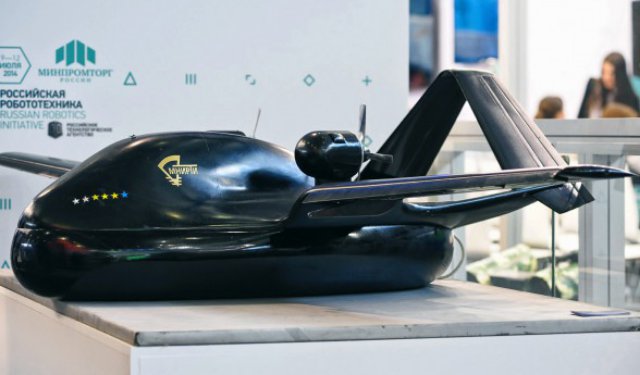
UAV - Russisk oppfinnsomhet

Russian Chirok Strike UAS Prepares for

Test Flights


Chirok
The first full-size model of the Chirok (Teal) reconnaissance and strike drone is preparing for test flights. It was introduced last year at the Innoprom Expo on a 1:5 scale in Yekaterinburg. Now the full-size model is ready, sporting a wingspan of 10 meters. The Chirok is getting ready for flight tests, according to reports TASS received from the United Instrument Manufacturing Corporation, which developed the drone.
The official presentation of the full-size Chirok model will be held at MAKS this year. United Instrument Manufacturing Corporation CEO Alexander Yakunin believes serial production of the drone will begin in 2016.
The Chirok is a dual-purpose aircraft, developed by the Moscow Radio Engineering Research Institute. It is designed for monitoring the ground or water surface, and for cargo transport. As expected, the military will be able to use the UAV for reconnaissance and as an unmanned combat aircraft.
The Chirok combines the latest achievements of engineering from different areas: electronics, aerospace, and the chemical industry. The technologies employed allow for building a truly modern aircraft. It is lightweight and durable, and has high performance marks, despite its impressive dimensions. The Chirok has a 10 m wingspan, with a maximum take-off mass not exceeding 700 kg. The device has an all-composite (carbon) body. The membrane of the air cushion is made of super-modern material, which was developed by Russian specialists. The technology behind the production of this material is based on Russian know-how.
The maximum take-off weight of the Chirok is up to 700 kg, and the maximum weight of its payload is up to 300 kg. On board it will be able to use opto-electronic devices for various types of monitoring. The UAV is also capable of carrying precision-guided weapons. It can also ascend to a height of 6,000 meters, with a range of up to 2,500 km. Currently, UIMC experts are working on further improvements for the technical specifications of the Chirok UAV.
Another feature of the design is that the arms can be positioned within the aircraft’s housing. For previous models, arms were mounted on the external suspension. Such a solution reduces the visibility of the UAV and improves its aerodynamic properties.
“This type of machine is designed for use in harsh environments: in regions where there are no runways. The machine will help to solve this problem across a large swath of our great country,” said Yakunin. “Our project will be offered to customers on both civil and military markets. I think it will generate a lot of interest in the energy sector and with the Ministry of Defense,” said Yakunin.
The United Instrument Manufacturing Corporation, a Russian state-backed corporation, was created in 2014, as part of the Rostec state-backed corporation, to develop the high-tech manufacturing of competitive products in the field of technology and communications systems, automated control systems, and electronic security and robotic systems for the Russian Armed Forces and other special groups, as well as competitive products for civil and dual-purpose. It brings together 55 enterprises and research institutions in the Russian electronic industry.

In-Flight Entertainment tatt til nye høyder

Thursday, January 29, 2015

Gogo Vision Reaches New Installation Milestone

Woodrow Bellamy III 
[Avionics Today 01-29-2015] Gogo announced a new milestone, as its Gogo Vision In-Flight Entertainment (IFE) system is now installed on more than 1,700 commercial aircraft. The IFE system allows passengers to rent movies and television shows on their Wi-Fi enabled Personal Electronic Devices (PEDs).
 
 
Gogo test aircraft. Photo: Gogo.
 
Gogo Vision uses an onboard server with pre-loaded content to deliver movies and television shows to PEDs through wireless access points built into the cabin. The In-Flight Connectivity (IFC) provider also gives airlines the option to deploy its seat-selection technology in order to distribute content based on where a passenger sits in the cabin.
 
"We also now have the ability to install the Gogo Vision product on aircraft with or without our connectivity product," said Ash ElDifrawi, chief commercial officer at Gogo. "We know that the vast majority of passengers are carrying their own Wi-Fi enabled device on a plane, this technology leverages that trend.” 

UAV - No Fly Zone under Super Bowl til helgen

Thursday, January 29, 2015

No Drone Zone: FAA Says No Drones at the Super Bowl

Woodrow Bellamy III 
[Avionics Today 01-29-2015] The FAA issued a statement warning individual users of Unmanned Aircraft Systems (UAS) not to operate the devices during the NFL's Super Bowl match this weekend between the New England Patriots and Seattle Seahawks. FAA officials are warning operators that the use of drones at the Super Bowl could land violators in jail and that flying the unmanned aircraft over a crowded stadium can result in reckless operations.
 
DJI Phantom Unmanned Aircraft System. Photo: DJI
 
"The Super Bowl is strictly a 'No Drone Zone.' The FAA bars unauthorized aircraft — including drones — from flying over or near NFL regular- and post-season football games," the agency said in a statement. 
 
These same restrictions apply to other sporting events that take place in stadiums seating 30,000 or more fans. An FAA-issued Notice to Airmen (NOTAM) issued also indicates that the agency is establishing a Temporary Flight Restriction (TFR) centered on the University of Phoenix Stadium during the Super Bowl on Feb. 1. This includes a highly restricted inner ring within a 10-mile radius of the stadium in which "general aviation aircraft, media, banner towers, blimps and unmanned aircraft will be prohibited." 

torsdag 29. januar 2015

Fra den kalde krigen

Fishpot - Et sted over Barentshavet - Foto: Per Gram